

(2026) PASS CTAL_TM_001 exam with ISTQB CTAL_TM_001 Real Exam Questions
Real exam questions are provided for ISTQB Test Manager Advanced tests, which can make sure you 100% pass
ISTQB CTAL_TM_001 Exam Syllabus Topics:
| Topic | Details |
|---|---|
| Topic 1 |
|
| Topic 2 |
|
| Topic 3 |
|
NEW QUESTION # 46
It the lest manager must repeatedly step in to resolve conflicts within the team what phase is the team in and what competencies are required from the test manager?
- A. Norming Personal
- B. Storming Social
- C. Forming Professional
- D. Performing Methodological
Answer: B
Explanation:
* Understanding Team Development Phases:
* TheStormingphase is where team members often experience conflicts as they establish their roles and relationships.
* Resolving conflicts in this phase is essential for team cohesion and productivity.
* Competencies Required:
* Social competenciesare needed to mediate, facilitate communication, and encourage collaboration.
* Evaluation of Options:
* A. Forming Professional:
* Incorrect. The Forming phase involves team orientation, not conflict resolution.
* B. Storming Social:
* Correct. This phase requires social skills to address conflicts and foster a productive environment.
* C. Norming Personal:
* Incorrect. The Norming phase focuses on team cohesion and process standardization.
* D. Performing Methodological:
* Incorrect. The Performing phase assumes the team is high-functioning and requires minimal intervention.
* Syllabus Alignment:
* ISTQB emphasizes understanding team dynamics and applying social skills for effective team management during challenging phases (TM-3.1.5).
References:
ISTQB Advanced Level Test Management Syllabus (TM-3.1.5)
NEW QUESTION # 47
Which of the following is the proper order for the stages of a tool lifecycle?
- A. Evolution Acquisition Retirement Support
- B. Acquisition Support Evolution Retirement
- C. Acquisition Evolution Support Retirement
- D. Evolution Support Acquisition Retirement
Answer: B
Explanation:
Definition of Tool Lifecycle Stages:
Acquisition: The tool is selected and procured.
Support: Maintenance and updates are provided to ensure ongoing usability.
Evolution: The tool is upgraded or adapted for new needs.
Retirement: The tool is decommissioned when no longer useful.
Evaluation of Options:
A . Acquisition Support Evolution Retirement:
Correct. This sequence reflects the natural progression of a tool lifecycle.
B . Acquisition Evolution Support Retirement:
Incorrect. Support should occur before evolution as maintenance ensures stability before upgrades.
C . Evolution Acquisition Retirement Support:
Incorrect. Evolution cannot occur before acquisition.
D . Evolution Support Acquisition Retirement:
Incorrect. Acquisition must come first.
Syllabus Alignment:
ISTQB highlights the lifecycle stages of tools in test environments as starting with acquisition and ending with retirement (TM-1.6.4).
Reference:
ISTQB Advanced Level Test Management Syllabus (TM-1.6.4)
NEW QUESTION # 48
Which of the following statements is true regarding Fault Tree Analysis?
- A. It is used to determine the root cause of observed and potential failures.
- B. It is used to target defect-based testing.
- C. It is used to select the pairs of items to be used in pairwise testing.
- D. It is a formal technique used to identify the likely effects of risks.
Answer: A
Explanation:
Fault Tree Analysis (FTA) is a technique used to analyze the causes of faults (defects). The technique visually models how logical relationships between failures, human errors, and external events can combine to cause specific faults to disclose1. FTA can help to determine the root cause of observed and potential failures by tracing back the fault events to their initiating causes and identifying the combinations of events that can lead to the fault occurrence2. Therefore, option A is the correct answer. Option B is incorrect because FTA is not used to select the pairs of items to be used in pairwise testing, which is a technique to generate test cases based on the combinations of two input parameters. Option C is incorrect because FTA is not a formal technique used to identify the likely effects of risks, which are uncertain events or conditions that may have a positive or negative impact on the project objectives. Option D is incorrect because FTA is not used to target defect-based testing, which is a testing technique that uses information about the types, causes, andlocations of defects discovered in previous projects to guide the selection, creation, and prioritization of test cases. References: 1: Fault Tree Analysis | ISTQB Glossary 2: Fault Tree Analysis (FTA) - Software Testing Genius : ISTQB Glossary, Pairwise Testing : ISTQB Glossary, Risk : ISTQB Glossary, Defect-Based Test Technique : Fault Tree Analysis (FTA) - Software Testing Genius : Fault Tree Analysis | ISTQB Glossary
NEW QUESTION # 49
Which of the following would be the TWO most appropriate examples of entry criteria documented in the system integration test plan? 2 credits
- A. The sign-off of a performance test software release note (test item transmittal report) by both development and testing showing that system performance meets the specified acceptance criteria.
- B. The percentage of acceptance test procedures scheduled for execution.
- C. The percentage of requirements coverage achieved during system integration test.
- D. The availability of the latest version of the capture-replay tool (for testing the interface with the newly developed test management tool).
- E. The percentage of decision coverage achieved during unit testing.
Answer: D,E
NEW QUESTION # 50
You are Test Manager working on a project which is improving the user interface for its call centre staff handling customer enquiries. The project has completed UAT for the first iteration; however a large number of defects were raised by call centre staff seconded to help with the User Acceptance testing.
The defects described the user interface as not being intuitive enough with a poor 'help' facility. A user representative spent a week working with developers and system testers to explain the issues, which were subsequently agreed to have resulted from poorly specified usability requirements.
The requirements were defined separately for each iteration and have been formally reviewed by business analysts, developers and the IT director.
The user representative was also able to answer a number of other questions that the system test team had regarding call centre workflows, which improved their domain knowledge.
You have been asked to conduct a project retrospective and recommend improvements for the next iteration which introduces further user interface changes. Which of the following would be the MOST effective improvement for the next iteration?
- A. System test cases to incorporate usability testing and be reviewed by a call centre user representative.
- B. Call centre representatives to participate in reviews of the user interface requirements.
- C. A call centre user representative to be seconded to the system test team to help improve test design.
- D. System test analysts to attend external training on usability testing techniques.
Answer: A
NEW QUESTION # 51
Which of the Mowing Is commonly used by a test manager to identity risks'
- A. Experience with similar projects
- B. Function points within the software
- C. Lines of code in the system under test
- D. Record/playback test automation tools
Answer: A
Explanation:
Common Risk Identification Techniques:
A test manager often relies on experience with similar projects to foresee risks related to technical complexity, domain challenges, or previous defects.
Other options listed are less effective for comprehensive risk identification.
Evaluation of Options:
A (Lines of code) and B (Function points) are quantitative measures, not directly tied to risk identification.
C is correct as past experience is crucial for identifying risks early.
D (Record/playback tools) is irrelevant to risk analysis.
Reference and Syllabus Alignment:
Risk identification techniques are discussed under "Risk Management" (TM-1.3.1).
NEW QUESTION # 52
Test results are reported as "Requirements tested, passed, and failed".
What test strategy are you using? [1]
- A. Reactive
- B. Model-based
- C. Analytical
- D. Exploratory
Answer: C
Explanation:
An analytical test strategy is a test strategy that is based on the analysis of the factors that affect the quality of the software under test, such as the requirements, the risks, the complexity, or the criticality1. An analytical test strategy uses these factors to define the test objectives, scope, approach, and techniques, as well as to prioritize and allocate the test resources2. Reporting the test results as "Requirements tested, passed, and failed" implies that the testing is driven by the requirements, which are the specifications of the desired features and functions of the software under test. Testing based on the requirements is an example of an analytical test strategy, as it uses the requirements as the main factor to guide the testing activities. Therefore, option C is the correct answer. Option A is incorrect because a model-based test strategy is a test strategy that uses models to represent the desired behavior and structure of the software under test, and to derive test cases, test data, test procedures, and test oracles. A model-based test strategy does not necessarily report the test results as "Requirements tested, passed, and failed", as it may use other types of models, such as state diagrams, data flow diagrams, or decision tables, to generate and execute the tests. Option B is incorrect because an exploratory test strategy is a test strategy that uses the tester's knowledge, skills, and creativity to design and execute tests dynamically, without predefined test cases or test procedures. An exploratory test strategy does not report the test results as "Requirements tested, passed, and failed", as it does not follow a formal or structured testing process, but rather relies on the tester's intuition, experience, and feedback. Option D is incorrect because a reactive test strategy is a test strategy that uses the actual behavior and results of the software under test to design and execute tests, without prior knowledge or documentation of the software. A reactive test strategy does not report the test results as "Requirements tested, passed, and failed", as it does not have any requirements or specifications to compare the software against, but rather uses the software itself as the test basis. Reference: 1: ISTQB Glossary, Analytical Test Strategy 2: ISTQB Advanced Level Test Manager Syllabus, Section 1.1.1 : ISTQB Glossary, Requirement : ISTQB Advanced Level Test Manager Syllabus, Section 1.1.1 : ISTQB Glossary, Model-Based Testing : ISTQB Advanced Level Test Manager Syllabus, Section 1.1.1 : ISTQB Glossary, Exploratory Testing : ISTQB Advanced Level Test Manager Syllabus, Section 1.1.1 : ISTQB Glossary, Reactive Test Strategy : ISTQB Advanced Level Test Manager Syllabus, Section 1.1.1 : Test Strategy | ISTQB Glossary : Test Strategy - ISTQB not-for-profit association
NEW QUESTION # 53
Your team has been given the following test objective Ensure that the users are happier with this version than they were with the last version?
What is wrong with the way this is defined?
- A. It cannot be measured because happier' is subjective
- B. It is not aligned with the organization's objectives
- C. It does not define a timeframe
- D. It is unlikely that just a version change will make users happier so this is not achievable
Answer: A
Explanation:
* Context Analysis:
* The test objective should beSMART(Specific, Measurable, Achievable, Relevant, Time-bound)." Happier" is subjective and not measurable.
* Evaluation of Options:
* A. It is unlikely that just a version change will make users happier so this is not achievable:
* Incorrect. Achievability isn't the main issue; measurement is.
* B. It cannot be measured because 'happier' is subjective:
* Correct. The issue lies in the inability to quantify or measure the term "happier."
* C. It does not define a timeframe:
* Incorrect. While timeframe definition is important, the primary flaw here is subjectivity.
* D. It is not aligned with the organization's objectives:
* Incorrect. The test objective could align but still fail due to lack of measurability.
* Syllabus Alignment:
* ISTQB emphasizes creating measurable and actionable test objectives (TM-1.4.1).
References:
ISTQB Advanced Level Test Management Syllabus (TM-1.4.1)
NEW QUESTION # 54
It is now the last day of the second iteration and the team has been consistently underestimating the time needed. They estimate intuitively rather than using estimation techniques.
Which two estimation techniques would be BEST for the team in this scenario?
- A. Planning poker
- B. Velocity extrapolation
- C. 3-point estimation
- D. Wideband Delphi
- E. Estimation of test effort based on ratio
Answer: A,C
Explanation:
* C (3-point estimation):Offers a structured approach to improve accuracy by accounting for uncertainty.
* D (Planning poker):Commonly used in Agile; supports collaborative and experiential-based estimation.
"Planning poker is an example of the expert-based approach... team members are estimating the effort to deliver a feature based on their experience."
- ISTQB-CTFL_Syllabus_2018_V3.1, section 5.2.6
NEW QUESTION # 55
How does a risk based testing approach address risks in a software product? SELECT ONE OPTION
- A. By prioritizing tests according to which product risks they address.
- B. By identifying known risks in defect reports.
- C. By calculating the likelihood and impact of a risk, the probability of finding defects is increased.
- D. By designing tests that address only the highest risk areas.
Answer: A
NEW QUESTION # 56
Which classification information would be most useful to capture for newly identified defects? [2]
- A. The priority that the business assigned to the project that the defect was found in
- B. The system build that the defect was found in
- C. The number of test steps in the test script that found the defect
- D. The name of the configuration manager who built the system
Answer: B
Explanation:
Capturing the system build information for newly identified defects is crucial as it helps in tracking the defect back to a specific state of the software. This information is essential for developers to understand the context of the defect and for testers to manage regression testing effectively. It allows for precise identification of when the defect was introduced, aiding in quicker resolution and ensuring that similar issues can be prevented in future builds.
Reference:
ISTQB Glossary, Distributed Testing1
Defect Report in ISTQB: Software Engineering - The Knowledge Academy
ISTQB Advanced Level Test Manager Syllabus, Section 3.2.1
Defect classification and prioritisation: ISTQB offers a standardised defect classification scheme The most useful classification information to capture for newly identified defects is the system build that the defect was found in. This is because the system build is the version of the software that is compiled, integrated, and tested together. By capturing the system build for each defect, the test team can track and manage the defects more effectively, and identify the root causes and impacts of the defects. The system build can also help to reproduce and verify the defects, and to measure the quality and progress of the software development. Defect Management - ISTQB not-for-profit association Reference: Certified Tester Advanced Level Test Manager (CTAL-TM) - ISTQB not-for-profit association, ISTQB Test Manager Certification - ISTQB Exams Worldwide - ISTQB Official Registration, Defect Management - ISTQB not-for-profit association
NEW QUESTION # 57
You have been assigned t o a project that has a very tight schedule. In fact, given your first analysis you do not think the planned test execution can be completed within the schedule There is no time allowed for defect fixing or for repeating tests. Regression testing has been left out of the planning entirely There is no time to develop test automation. The team has agreed that this Is not the way to run a project, yet they are stuck with the current schedule Given this information what is the best way to proceed with the testing to try to meet the deadline with the best outcome1?
- A. Review the personnel plan and get more resources onto the test team
- B. Develop a test automation plan so that automation can be started now
- C. Conduct a quality risk analysis and prioritize the testing based on risk so the highest risk items are tested first
- D. Continue with the current plan but highlight to the project manager that either the deadline will be missed or the testing will not be done
Answer: C
Explanation:
Dealing with Tight Schedules:
Prioritization based on quality risk ensures critical areas are tested, minimizing risks to the project.
In tight schedules, testing everything is impractical; focus must shift to high-risk areas.
Evaluation of Options:
A is unlikely feasible given the tight schedule.
B highlights the issue but does not propose a solution.
C (developing automation) is not possible given time constraints.
D is correct because risk-based testing ensures the best possible outcome within the constraints.
Reference and Syllabus Alignment:
Risk-based testing is a core concept under "Test Process and Risk Management" in ISTQB syllabus (TM-1.3.1, TM-1.3.4).
NEW QUESTION # 58
You are the Test Manager on a new project. The schedule is aggressive and will require the team to work at peak efficiency. The requirements are not well defined yet, but it is clear that the project will be using new technologies. To help the developers meet the development schedule, an offshore group will be added to the development team.
At this time there is not enough budget to add more testing resources. The project stakeholders are very concerned about the quality of delivered product and will be watching the project closely, particularly during the testing cycles. The exit criteria from the system test level require no open high priority/severity defects, 100% pass rate for all test cases covering risks that are classified as
"high" or "very high", 90% pass rate for all "medium" risks and 50% pass rate for all "low" and "very low" risks.
Given this information, which lifecycle model should you recommend?[3]
- A. Spiral
- B. Iterative/incremental
- C. Waterfall
- D. V-model
Answer: B
Explanation:
An iterative/incremental lifecycle model is a type of software development lifecycle that divides the project into smaller iterations or increments, each delivering a part of the functionality and undergoing its own planning, analysis, design, implementation, and testing phases1. This model is suitable for projects that have aggressive schedules, unclear requirements, new technologies, distributed teams, and high quality expectations, as it allows for early feedback, risk reduction, parallel development, frequent delivery, and continuous improvement2. Therefore, option B is the correct answer. Option A is incorrect because a spiral model is a type of iterative/incremental model that adds risk analysis and prototyping activities to each iteration3. While this model can also handle unclear requirements, new technologies, and high quality expectations, it may not be the best choice for projects that have aggressive schedules and distributed teams, as it requires more time and communication for risk assessment and prototyping4. Option C is incorrect because a V-model is a type of sequential model that maps each development phase to a corresponding testing phase in a V-shaped diagram5. This model is suitable for projects that have clear and stable requirements, well-known technologies, co-located teams, and moderate quality expectations, as it allows for early verification, traceability, and defect prevention. However, this model may not be the best choice for projects that have aggressive schedules, unclear requirements, new technologies, distributed teams, and high quality expectations, as it does not allow for early feedback, risk reduction, parallel development, frequent delivery, and continuous improvement. Option D is incorrect because a waterfall model is a type of sequential model that follows a linear sequence of phases from requirements to deployment. This model is suitable for projects that have simple and fixed requirements, well-known technologies, co-located teams, and low quality expectations, as it allows for easy planning, management, and documentation. However, this model may not be the best choice for projects that have aggressive schedules, unclear requirements, new technologies, distributed teams, and high quality expectations, as it does not allow for early feedback, risk reduction, parallel development, frequent delivery, and continuous improvement. References: 1: ISTQB Glossary, Iterative/incremental lifecycle model 2: ISTQB Advanced Level Test Manager Syllabus, Section 1.2.1 3:
ISTQB Glossary, Spiral model 4: ISTQB Advanced Level Test Manager Syllabus, Section 1.2.1 5: ISTQB Glossary, V-model : ISTQB Advanced Level Test Manager Syllabus, Section 1.2.1 : ISTQB Advanced Level Test Manager Syllabus, Section 1.2.1 : ISTQB Glossary, Waterfall model : ISTQB Advanced Level Test Manager Syllabus, Section 1.2.1 : ISTQB Advanced Level Test Manager Syllabus, Section 1.2.1
NEW QUESTION # 59
Assume that you are part of a team conducting test design for a new university system that will allow students to update their own personal information. The Test Strategy states that positive and negative testing should be carried out. along with performance, security and interoperability testing against all new requirements.
The following requirements have been identified by stakeholders:
1. Students must be able to make changes to the following information:
a Name (due to marital status)
b Marital status
c. Home address
d. Home telephone number
e. Email address
f. Mobile telephone number
g. Contact details in case of emergency
2 Only Reception staff must have access to the information held.
3 The system must support 2000 concurrent users and details updated on the system within 20 seconds.
4. Interoperability of the new system with the other systems maintained by the University for student Registrations.
Test analysis for functional and non-functional testing has iust bequn and the following test conditions have been identified: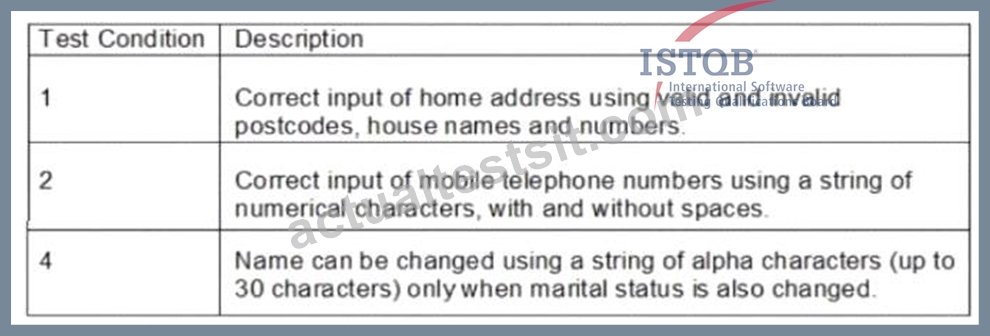
Which one of the following is a valid test condition that is missing from the table of test conditions and has clear traceability back to the test strategy and requirements?
SELECT ONE OPTION
- A. Correct input of student's date of birth details, using the format dd/mm/yyyy
- B. Correct input of home telephone numbers using a string of alpha characters only.
- C. System is compatible with market leading accessibility tools for blind or partially sighted users.
- D. Time taken to update student information is 20 seconds or less when sup-plied correctly, or an error message is returned
Answer: D
NEW QUESTION # 60
Which testing metric identifies defect density?
- A. People
- B. Process
- C. Project
- D. Product
Answer: D
Explanation:
Defect density is a testing metric that measures the number of defects identified in acomponent or system divided by the size of the component or system (expressed in standard measurement terms, e.g., lines-of-code, number of classes or function points)1. Defect density is a product metric, as itevaluates the quality or reliability of a software product2. Therefore, option B is the correct answer. Option A is incorrect because project metrics are metrics that measure the characteristics of the software project, such as cost, schedule, effort, scope, or resources3. Option C is incorrect because process metrics are metrics that measure the characteristics of the software process, such as effectiveness, efficiency, productivity, or maturity. Option D is incorrect because people metrics are metrics that measure the characteristics of the software personnel, such as skills, experience, motivation, or satisfaction. References: 1: Defect Density | ISTQB Glossary 2: Software Testing Metrics: What is, Types & Example 3: [Project Metrics - Software Testing Fundamentals] : [Process Metrics - Software Testing Fundamentals] : [People Metrics - Software Testing Fundamentals]
NEW QUESTION # 61
'Safe as Houses' is a company that specialises in home security software, including alarm systems, surveillance cameras and other forms of deterrence.
It is currently developing the software for a device which simulates an active television, producing sound and light images that suggest someone is home watching the television. 'Safe as Houses' recently won a lucrative contract to supply the software to Smart Alarms', who will be manufacturing the hardware devices Sound will be created using actual television and film archives, licensed through a third-party supplier, 'Silver Sound Ltd'. A user interface will be developed in house to allow the customer to choose sound tracks.
The software will be delivered as a programme of work, consisting of three projects. Project 1 will develop the software for the light images. Project 2 will develop the sound system and Project 3 will integrate the two using hardware prototypes supplied from 'Smart Alarms'. The programme will conclude with 'Smart Alarms' performing User Acceptance testing in usability labs.
The 'Safe as Houses' test team has experience in testing alarm and surveillance systems but lacks experience in testing light imagery software. The organisational test policy includes the following objectives:
1 Exploratory testing should be used to augment more formal, structured testing within constraints of time and budget
2. Test automation tools should be purchased and employed to maximise the breadth and efficiency of regression testing The Programme risk register currently includes the following risks:
RISK1 Working prototypes will be delivered late to the integration test environments RISK 2 A delay in signing the contract with 'Silver Sound Ltd' will impact the programme schedule RISK 3 Inexperience in testing light imagery software will cause major defects to be missed RISK 4 The user interface software for the sound systems will be delivered late into testing Refer to SCENARIO 2 - The IT Director for 'Safe as Houses' is recruiting a Programme Test Manager and has been provided with a skills matrix for four prospective candidates. The matrix shows the skill level (5 being highest. 1 lowest) for each candidate: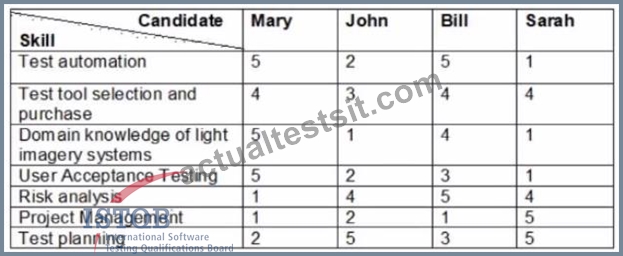
Consider which of these skills are key for a Programme Test manager in this scenario. Based on these, which candidate would be the most suitable?
SELECT ONE OPTION
- A. Sarah.
- B. John
- C. Bill
- D. Mary.
Answer: B
NEW QUESTION # 62
Your testing team has just received the test conditions for a new project. You are conducting Test Design activities for this project. Your team feels that it would be beneficial to create high-level test cases.
What should they do concurrently with creating these test cases? [2]
- A. Create the test summary report for the test cases you are creating.
- B. Create the traceability between the test cases and the requirements.
- C. Create the test plan.
- D. Create the test automation scripts.
Answer: B
Explanation:
The correct answer is D. Create the traceability between the test cases and the requirements. This is because traceability is the ability to follow the life of a requirement, in both a forward and backward direction, through its documentation, development, and testing. Traceability can help to ensure that the test cases are derived from the requirements, and that they cover all the relevant aspects of the system. By creating the traceability between the test cases and the requirements concurrently with creating the test cases, the test team can improve the quality and completeness of the test design, and facilitate the test analysis and reporting. Traceability Matrix - ISTQB not-for-profit association References: Certified Tester Advanced Level Test Manager (CTAL-TM) - ISTQB not-for-profit association, ISTQB Test Manager Certification - ISTQB Exams Worldwide - ISTQB Official Registration, Traceability Matrix - ISTQB not-for-profit association
NEW QUESTION # 63
Which of the following best describes the appraisal costs in the cost of quality'
- A. The cost spent preventing defects from occurring in the first place
- B. The cost for lawyers to deal with a lawsuit over a defect
- C. The cost for performing dynamic testing
- D. The cost for fixing defects
Answer: C
Explanation:
Definition of Appraisal Costs:
Appraisal costs include expenses related to evaluating and testing the product to detect defects before release.
These include costs for dynamic testing, reviews, inspections, and validation activities.
Evaluation of Options:
A refers to prevention costs, not appraisal.
B is correct because dynamic testing is an appraisal activity.
C refers to failure costs (internal/external), not appraisal.
D relates to legal failure costs.
Reference and Syllabus Alignment:
Appraisal costs are outlined under "Cost of Quality" in ISTQB syllabus (TM-2.1.1).
NEW QUESTION # 64
You are the Test Manager of a four-person test team working for a small distribution company with a single warehouse. Your team has been working with a third party development team on a new inventory management system. The company expects this system to generate approximately one million dollars per annum in profits for the company. Early in the project, various risks were identified, and steps taken to mitigate those risks.
For example, you sent your test team for training on the new system, and upgraded the test environment.
There are still some lingering risks that have not been addressed, but they have been determined to have a low chance of occurring, with minimal impact if they do occur.
What would be the best option to mitigate these remaining risks? [3]
- A. Note the risks, and ignore them for now.
- B. Redo the project test plan to add additional testing for these risk items.
- C. Create a cross-functional team to work to reduce the impact and likelihood of these risks coming to fruition.
- D. Contract with the Risk Protection Insurance company to assume these risks at a cost of $500,000 per annum.
Answer: C
Explanation:
Creating a cross-functional team to address the remaining risks is the best option, as it actively involves various stakeholders in the mitigation process. This approach allows for diverse perspectives and expertise to be applied to reduce both the likelihood of the risks occurring and their potential impact, without incurring excessive costs or ignoring the risks altogether.
References:The ISTQB Advanced Level Test Manager syllabus and related documents emphasize the importance of risk management throughout the testing process. It suggests that forming teams to address risks can be an effective strategy, as it leverages collective knowledge and resources to mitigate risks in a cost- effective manner
NEW QUESTION # 65
Which of the following is a factor that is likely to increase the test estimate? [1]
- A. Static test data
- B. Use of a new technology
- C. A requirement for high level test documentation
- D. Assigned personnel who are experienced on working with similar projects in similar environments
Answer: B
Explanation:
A test estimate is an approximation of the amount of effort, time, and resources required to perform testing activities for a software project1. A test estimate can be influenced by various factors, such as the size, complexity, and quality of the software, the scope, objectives, and approach of the testing, the skills, experience, and availability of the test team, the tools, methods, and standards used for testing, and the constraints, risks, and assumptions related to the project2. One of the factors that is likely to increase the test estimate is the use of a new technology. A new technology is a technology that is unfamiliar or unproven to the test team or the organization, such as a new programming language, framework, platform, or tool3. The use of a new technology can increase the test estimate because it may require more time and effort to learn, understand, and apply the technology, as well as to deal with potential issues, challenges, or limitations that may arise from the technology. Therefore, option A is the correct answer. Option B is incorrect because a requirement for high level test documentation is not a factor that is likely to increase the test estimate, but rather a factor that is likely to increase the test documentation effort. Test documentation is the set of documents that describe the test basis, test objectives, test design, test procedures, test results, and test evaluation of a software project. A requirement for high level test documentation means that the test documents need to be detailed, comprehensive, and consistent, which may require more time and effort to produce, review, and maintain. However, this does not necessarily affect the test estimate, as the test documentation effort can be considered as a separate or parallel activity to the test execution effort. Option C is incorrect because assigned personnel who are experienced on working with similar projects in similar environments is not a factor that is likely to increase the test estimate, but rather a factor that is likely to decrease the test estimate. Experienced personnel are personnel who have the relevant knowledge, skills, and abilities to perform the testing activities for a software project. Assigned personnel who are experienced on working with similar projects in similar environments can decrease the test estimate because they may require less time and effort to understand, design, implement, and execute the tests, as well as to deal with potential issues, challenges, or limitations that may arise from the project. Option D is incorrect because static test data is not a factor that is likely to increase the test estimate, but rather a factor that is likely to decrease the test estimate. Test data is the data that is used as input or output for the tests. Static test data is test data that is fixed and predefined, and does not change during the test execution. Static test data can decrease the test estimate because it may require less time and effort to create, manage, and maintain, as well as to ensure the validity, reliability, and traceability of the test data. Reference: 1: ISTQB Glossary, Test Estimate 2: ISTQB Advanced Level Test Manager Syllabus, Section 3.1.1 3: What is New Technology? - Definition from Techopedia : The Impact of New Technologies on Software Testing : ISTQB Glossary, Test Documentation : ISTQB Glossary, Experienced-Based Test Technique : ISTQB Glossary, Test Data : ISTQB Glossary, Static Test Data : Test Manager - ISTQB not-for-profit association : [ISTQB Foundation Level #38 - Test Estimation Techniques - Software Testing Mentor] : [What are the estimation techniques in software testing?]
NEW QUESTION # 66
If you are monitoring code coverage during testing to determine what areas still need testing what type of testing is likely occurring?
- A. Black-box
- B. Non-functional
- C. White-box
- D. Functional
Answer: C
Explanation:
* Context Analysis:
* Monitoring code coverage is inherently tied to knowledge of the internal structure of the software, a characteristic of white-box testing.
* Evaluation of Options:
* A. Black-box:
* Incorrect. Black-box testing focuses on functionality without knowledge of internal structures.
* B. White-box:
* Correct. White-box testing uses internal code knowledge to determine areas that need more coverage.
* C. Functional:
* Incorrect. Functional testing assesses functionality without inspecting internal code.
* D. Non-functional:
* Incorrect. Non-functional testing focuses on performance, usability, etc., not code coverage.
* Syllabus Alignment:
* ISTQB associates code coverage monitoring with white-box testing techniques (TM-1.2.6).
References:
ISTQB Advanced Level Test Management Syllabus (TM-1.2.6)
NEW QUESTION # 67
Your test team has created a custom automation tool that will be used for an upcoming release. Now that the tool has been coded, what should be the next step?
- A. Test the tool
- B. Create the tool support guide
- C. Perform an ROI study
- D. Compare the new tool to open source tools
Answer: A
Explanation:
The next step after creating a custom automation tool is to test the tool itself. This is to ensure that the tool is reliable, functional, and compatible with the system under test. Testing the tool involves verifying its features, performance, usability, security, and stability. Testing the tool also helps to identify and fix any defects or issues before using it for the actual testing of the product. ISTQB Advanced Level Test Manager SyllabusTop
7 Automation Testing Tools to Consider References:
* ISTQB Advanced Level Test Manager Syllabus
* Top 7 Automation Testing Tools to Consider - testRigor AI-Based ...
NEW QUESTION # 68
Which of the following are primary activities in conducting product risk analysis? [1]
- A. Risk identification, risk assessment
- B. Risk testing, risk management
- C. Risk identification, risk testing
- D. Risk management, risk assessment
Answer: A
Explanation:
Product risk analysis is the process of identifying and assessing the product risks that may affect the quality or functionality of the software under test1. Product risk analysis involves two primary activities: risk identification and risk assessment. Risk identification is the activity of finding, naming, and describing the risks that might affect the software under test2. Risk assessment is the activity of estimating the impact and probability of occurrence (likelihood) of the identified risks, and prioritizing them based on these factors3.
Therefore, option B is the correct answer. Option A is incorrect because risk testing and risk management are not primary activities of product risk analysis, but rather activities that follow or use the results of product risk analysis. Risk testing is the activity of designing, implementing, and executing tests based on the product risk levels to reduce the level of product risks and inform stakeholders of their status4. Risk management is the activity of planning, monitoring, and controlling the risks and the risk mitigation actions in the software project5. Option C is incorrect because risk identification and risk testing are not primary activities of product risk analysis, but rather activities that are part of product risk analysis and risk-based testing respectively. Option D is incorrect because risk management and risk assessment are not primary activities of product risk analysis, but rather activities that are part of risk management and product risk analysis respectively. References: 1: ISTQB Glossary, Product Risk Analysis 2: ISTQB Glossary, Risk Identification 3:
ISTQB Glossary, Risk Assessment 4: ISTQB Glossary, Risk-Based Testing 5: ISTQB Glossary, Risk Management : Product Risk Analysis (PRA) | TMap : Risk-Based Testing | ISTQB Glossary : Risk Analysis | ISTQB Glossary
NEW QUESTION # 69
You are testing a new product that will turn on the windshield wipers of a car when the sensors detect there is moisture on the windshield. Depending on the information returned from the sensors, the wipers will be turned on at one of the following speeds: slow intermittent, medium intermittent, fast intermittent, slow constant, medium constant, fast constant. Your team has identified the following test condition:
Test Condition 1.1.1 - Verify that the windshield wipers can go from slow constant to fast constant speed when the amount of moisture increases appropriately.
Your team has defined the following steps for a test case for this test condition:
1. Set the moisture sensor to request slow constant
2. Increase the moisture to set the sensor to request fast constant
3. Verify that the wipers respond with fast constant speed
Given this information, which of the following statements is correct? [2]
- A. This test case is not traceable to the test condition.
- B. This test case is traceable to the test condition and provides 100% requirements coverage of the defined test condition.
- C. There is not enough information in the test condition to define a test case.
- D. The test case is traceable to the test condition and provides 100% statement coverage of the defined test condition.
Answer: D
Explanation:
The correct answer is D. The test case is traceable to the test condition and provides 100% statement coverage of the defined test condition. This is because the test case is derived from the test condition, and it covers all the possible outcomes of the test condition, such as the initial state, the input, and the expected output. Statement coverage is a metric that measures the percentage of executable statements that are exercised by a test case. In this case, the test case exercises all the statements in the test condition, thus achieving 100% statement coverage. Statement Coverage - ISTQB not-for-profit association Reference: Certified Tester Advanced Level Test Manager (CTAL-TM) - ISTQB not-for-profit association, ISTQB Test Manager Certification - ISTQB Exams Worldwide - ISTQB Official Registration, Statement Coverage - ISTQB not-for-profit association
NEW QUESTION # 70
......
Latest CTAL_TM_001 Pass Guaranteed Exam Dumps Certification Sample Questions: https://www.actualtestsit.com/ISTQB/CTAL_TM_001-exam-prep-dumps.html
CTAL_TM_001 Exam with Guarantee Updated 232 Questions: https://drive.google.com/open?id=1i2QtgSewOWNZBNgQsV14sZgvRHBp9mCK