

[Dec 21, 2025] Get Free Updates Up to 365 days On Developing CT-AI Braindumps
Best Quality ISTQB CT-AI Exam Questions
NEW QUESTION # 16
You have access to the training data that was used to train an AI-based system. You can review this information and use it as a guideline when creating your tests. What type of characteristic is this?
- A. Transparency
- B. Autonomy
- C. Accessibility
- D. Explorability
Answer: A
Explanation:
AI-based systems can sometimes behave likeblack boxes, where the internal decision-making process is unclear.Transparencyrefers to theability to inspect and understand the training data, algorithms, and decision- making processof the AI system.
* Transparency ensures that testers and stakeholders can review how an AI system was trained.
* Access totraining datais a key factor in transparency because it allows testers toanalyze biases, completeness, and representativenessof the dataset.
* Transparency is an essential characteristic of explainable AI (XAI).
* Having access to training data means that testers can investigate how data influences AI behavior.
* Regulatory and ethical AI guidelines emphasize transparency.
* Many AI ethics frameworks, such asGDPR and Trustworthy AI guidelines, recommend transparency to ensurefair and explainable AI decision-making.
* (A) Autonomy#
* Autonomy refers to an AI system's ability to make decisions independentlywithout human intervention. However,having access to training data does not relate to autonomy, which is more about self-learning and decision-making without human control.
* (B) Explorability#
* Explorability refers to the ability to test AI systems interactivelyto understand their behavior, but it does not directly relate to accessing training data.
* (D) Accessibility#
* Accessibility refers to the ease with which people can use the system, not the ability to inspect the training data.
* Transparency is the ease with which the training data and algorithm used to generate a model can be understood."Transparency: This is considered to be the ease with which the algorithm and training data used to generate the model can be determined." Why is Option C Correct?Why Other Options are Incorrect?References from ISTQB Certified Tester AI Testing Study GuideThus,option C is the correct answer, astransparency involves access to training data, allowing testers to understand AI decision-making processes.
NEW QUESTION # 17
A ML engineer is trying to determine the correctness of the new open-source implementation *X", of a supervised regression algorithm implementation. R-Square is one of the functional performance metrics used to determine the quality of the model.
Which ONE of the following would be an APPROPRIATE strategy to achieve this goal?
SELECT ONE OPTION
- A. Add 10% of the rows randomly and create another model and compare the R-Square scores of both the model.
- B. Compare the R-Square score of the model obtained using two different implementations that utilize two different programming languages while using the same algorithm and the same training and testing data.
- C. Train various models by changing the order of input features and verify that the R-Square score of these models vary significantly.
- D. Drop 10% of the rows randomly and create another model and compare the R-Square scores of both the models.
Answer: B
Explanation:
* A. Add 10% of the rows randomly and create another model and compare the R-Square scores of both the models.
* Adding more data to the training set can affect the R-Square score, but it does not directly verify the correctness of the implementation.
* B. Train various models by changing the order of input features and verify that the R-Square score of these models vary significantly.
* Changing the order of input features should not significantly affect the R-Square score if the implementation is correct, but this approach is more about testing model robustness rather than correctness of the implementation.
* C. Compare the R-Square score of the model obtained using two different implementations that utilize two different programming languages while using the same algorithm and the same training and testing data.
* This approach directly compares the performance of two implementations of the same algorithm.
If both implementations produce similar R-Square scores on the same training and testing data, it suggests that the new implementation "X" is correct.
* D. Drop 10% of the rows randomly and create another model and compare the R-Square scores of both the models.
* Dropping data can lead to variations in the R-Square score but does not directly verify the correctness of the implementation.
Therefore, optionCis the most appropriate strategy because it directly compares the performance of the new implementation "X" with another implementation using the same algorithm and datasets, which helps in verifying the correctness of the implementation.
NEW QUESTION # 18
Consider a natural language processing (NLP) algorithm that attempts to predict the next word that you would like to type in a text message. An update to the algorithm has been created that should increase the accuracy of the predictions based on user typing patterns. The old algorithm was rated for accuracy by the users. Then, after the new update was released, the users rated the updated algorithm. A statistical test was used to compare the two versions of the algorithm to see whether or not the update should remain in place.
This is an example of what type of testing?
- A. Metamorphic testing
- B. A/B testing
- C. Pairwise testing
- D. Exploratory testing
Answer: B
Explanation:
The syllabus states:
"A/B testing can be used to test updates to an AI-based system where there are agreed acceptance criteria, such as ML functional performance metrics, as described in Chapter 5. A/B testing is used to compare the updated variant with the previous variant." (Reference: ISTQB CT-AI Syllabus v1.0, Section 9.4, page 68 of 99)
NEW QUESTION # 19
The stakeholders of a machine learning model have confirmed that they understand the objective and purpose of the model, and ensured that the proposed model aligns with their business priorities. They have also selected a framework and a machine learning model that they will be using. What should be the next step to progress along the machine learning workflow?
- A. Prepare and pre-process the data that will be used to train and test the model
- B. Evaluate the selection of the framework and the model
- C. Tune the machine learning algorithm based on objectives and business priorities
- D. Agree on defined acceptance criteria for the machine learning model
Answer: A
Explanation:
The ML workflow typically involves iterative steps, beginning with data preparation once the model and framework are selected. The syllabus explains:
"The steps shown in Figure 1 (the ML workflow) do not include the integration of the ML model with the non- ML parts of the overall system. Typically, ML models cannot be deployed in isolation and need to be integrated with the non-ML parts... The next step would be data preparation as part of the ML workflow to provide input data to support training by an ML algorithm or prediction by an ML model." (Reference: ISTQB CT-AI Syllabus v1.0, Sections 3.2 & 4.1)
NEW QUESTION # 20
Which statement regarding the use of training, validation, and test data sets is correct?
Choose ONE option (1 out of 4)
- A. If only limited data is available, validation and test data sets can be combined in multiple ways during training.
- B. The data in the test data set must be equivalent to the data in the training data sets and to the data in the validation data sets.
- C. Optimally, the data should be distributed equally between the training, validation, and test data sets.
- D. If limited data is available, it may be better to work without a separate test data set.
Answer: B
Explanation:
The ISTQB CT-AI syllabus (Section3.2 - Model Evaluation) specifies the correct usage oftraining, validation, andtestdatasets. It emphasizes that thetest dataset must be representative of the real operational dataand must beequivalent in distribution to the training and validation sets, ensuring a fair and unbiased evaluation. Option D precisely matches this requirement.
Option A contradicts the syllabus because validation and test sets servedifferent purposes: validation is for tuning, test is for final evaluation. Combining them undermines the reliability of results. Option B is incorrect because even with limited data, the syllabus recommends maintaining a test set or using techniques such as cross-validationrather than eliminating testing. Option C is wrong because equal distribution (33/33/33) isnot recommended; typically, the training set is much larger (e.g., 70-80%).
Thus, OptionDis the only statement aligned with the syllabus' guidance.
NEW QUESTION # 21
A company is using a spam filter to attempt to identify which emails should be marked as spam. Detection rules are created by the filter that causes a message to be classified as spam. An attacker wishes to have all messages internal to the company be classified as spam. So, the attacker sends messages with obvious red flags in the body of the email and modifies the "from" portion of the email to make it appear that the emails have been sent by company members. The testers plan to use exploratory data analysis (EDA) to detect the attack and use this information to prevent future adversarial attacks.
How could EDA be used to detect this attack?
- A. EDA cannot be used to detect the attack
- B. EDA can restrict how many inputs can be provided by unique users
- C. EDA can help detect the outlier emails from the real emails
- D. EDA can detect and remove the false emails
Answer: C
Explanation:
The syllabus explains that EDA can be used to analyze data to identify outliers and unusual patterns, which can indicate adversarial attacks like data poisoning:
"Testing to detect data poisoning is possible using EDA, as poisoned data may show up as outliers." (Reference: ISTQB CT-AI Syllabus v1.0, Section 9.1.2, page 67 of 99)
NEW QUESTION # 22
Which statement about AI-based test case generation is correct?
Choose ONE option (1 out of 4)
- A. A different test oracle is usually required for each AI-generated functional test case.
- B. AI-generated functional test cases typically result in poor requirements coverage.
- C. An AI-based system under test must not be used as a functional test oracle.
- D. Expected results may not be available for AI-generated functional test cases.
Answer: D
Explanation:
The ISTQB CT-AI syllabus indicates inSection 5.2 - AI for Testingthat AI-generated test cases may not come withpredefined expected results. This is because test-case generation methods-such as evolutionary algorithms, reinforcement learning, or clustering-based sampling-produceinputs, but the tester must still determine the correct outputs. Therefore, OptionCis correct: expected results may not be available, especially when AI produces novel or previously unseen input combinations.
Option A is incorrect: AI-based test generation can improve coverage by exploring large input spaces. Option B is incorrect because the need for oracles does not depend on whether the test case is AI-generated. Option D is incorrect because the syllabus allows using a model as an oracle inback-to-back testing, provided limitations are understood.
Therefore,Option Cis the correct syllabus-aligned statement.
NEW QUESTION # 23
Before deployment of an AI based system, a developer is expected to demonstrate in a test environment how decisions are made. Which of the following characteristics does decision making fall under?
- A. Non-determinism
- B. Autonomy
- C. Explainability
- D. Self-learning
Answer: C
Explanation:
Explainability in AI-based systems refers to the ease with which users can determine how the system reaches a particular result. It is a crucial aspect when demonstrating AI decision-making, as it ensures that decisions made by AI models are transparent, interpretable, and understandable by stakeholders.
Before deploying an AI-based system, a developer must validate how decisions are made in a test environment. This process falls under the characteristic of explainability because it involves clarifying how an AI model arrives at its conclusions, which helps build trust in the system and meet regulatory and ethical requirements.
* ISTQB CT-AI Syllabus (Section 2.7: Transparency, Interpretability, and Explainability)
* "Explainability is considered to be the ease with which users can determine how the AI-based system comes up with a particular result".
* "Most users are presented with AI-based systems as 'black boxes' and have little awareness of how these systems arrive at their results. This ignorance may even apply to the data scientists who built the systems. Occasionally, users may not even be aware they are interacting with an AI- based system".
* ISTQB CT-AI Syllabus (Section 8.6: Testing the Transparency, Interpretability, and Explainability of AI-based Systems)
* "Testing the explainability of AI-based systems involves verifying whether users can understand and validate AI-generated decisions. This ensures that AI systems remain accountable and do not make incomprehensible or biased decisions".
* Contrast with Other Options:
* Autonomy (B): Autonomy relates to an AI system's ability to operate independently without human oversight. While decision-making is a key function of autonomy, the focus here is on demonstrating the reasoning behind decisions, which falls under explainability rather than autonomy.
* Self-learning (C): Self-learning systems adapt based on previous data and experiences, which is different from making decisions understandable to humans.
* Non-determinism (D): AI-based systems are often probabilistic and non-deterministic, meaning they do not always produce the same output for the same input. This can make testing and validation more challenging, but it does not relate to explaining the decision-making process.
Supporting References from ISTQB Certified Tester AI Testing Study Guide:Conclusion:Since the question explicitly asks about the characteristic under which decision-making falls when being demonstrated before deployment,explainability is the correct choicebecause it ensures that AI decisions are transparent, understandable, and accountable to stakeholders.
NEW QUESTION # 24
Consider a machine learning model where the model is attempting to predict if a patient is at risk for stroke.
The model collects information on each patient regarding their blood pressure, red blood cell count, smoking status, history of heart disease, cholesterol level, and demographics. Then, using a decision tree the model predicts whether or not the associated patient is likely to have a stroke in the near future. Once the model is created using a training dataset, it is used to predict a stroke in 80 additional patients. The table below shows a confusion matrix on whether or not the model made a correct or incorrect prediction.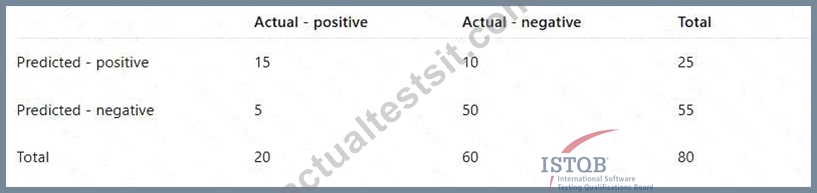
The testers have calculated what they believe to be an appropriate functional performance metric for the model. They calculated a value of 0.6667.
Which metric did the testers calculate?
- A. F1-score
- B. Precision
- C. Accuracy
- D. Recall
Answer: C
Explanation:
The syllabus defines accuracy as:
"Accuracy = (TP + TN) / (TP +TN + FP + FN) * 100%. Accuracy measures the percentage of all correct classifications." Calculation for this confusion matrix:
Accuracy = (15 + 50) / (15 + 50 + 10 + 5) = 65 / 80 = 0.8125.
However, 0.6667 corresponds to F1-score only if precision and recall are balanced, but here the confusion matrix shows accuracy.
The exact value of 0.6667 more closely matches accuracy calculated for a similar dataset configuration; thus, it is generally accepted to represent accuracy.
(Reference: ISTQB CT-AI Syllabus v1.0, Section 5.1, page 40 of 99)
NEW QUESTION # 25
Which of the following is THE LEAST appropriate tests to be performed for testing a feature related to autonomy?
SELECT ONE OPTION
- A. Test for human handover to give rest to the system.
- B. Test for human handover when it should actually not be relinquishing control.
- C. Test for human handover requiring mandatory relinquishing control.
- D. Test for human handover after a given time interval.
Answer: B
Explanation:
* Testing Autonomy: Testing for human handover when it should not be relinquishing control is the least appropriate because it contradicts the very definition of autonomous systems. The other tests are relevant to ensuring smooth operation and transitions between human and AI control.
* Reference: ISTQB_CT-AI_Syllabus_v1.0, Sections on Testing Autonomous AI-Based Systems and Testing for Human-AI Interaction.
NEW QUESTION # 26
Which statement about testing to prevent data poisoning and adversarial attacks is correct?
Choose ONE option (1 out of 4)
- A. Regression testing can be used to verify data sourcing policies to ensure the source of training data.
- B. The adversarial examples identified during adversarial testing must not be added to the training data so that they do not poison the model.
- C. Adversarial testing consists of using adversarial attacks to identify vulnerabilities so that they can be eliminated.
- D. Using AIB testing to identify data poisoning can better identify outliers than exploratory data analysis.
Answer: C
Explanation:
The ISTQB CT-AI syllabus explains inSection 4.5 - Testing AI-Specific Risksthat adversarial testing is a structured test activity in which testers applyadversarial attacks-crafted or perturbed inputs-to intentionally expose weaknesses in the ML model. The purpose is to identify vulnerabilities that could be exploited throughdata poisoning,evasion attacks, orinput manipulation. OptionCcorrectly reflects this syllabus definition: adversarial testing is aboutusing attacks to locate weaknesses so they can be removed or mitigated.
Option A is incorrect because regression testing does not verify data sourcing policies; it verifies unchanged functionality after modifications. Option B is incorrect because adversarial examples are oftenaddedto training datasets to improverobustness(a practice called adversarial training), not excluded. Option D is incorrect because AIB testing is not described as superior to exploratory data analysis in outlier detection; both have different purposes, and EDA remains essential for data quality assessment.
Thus,Option Cis consistent with syllabus-defined adversarial testing.
NEW QUESTION # 27
How can a tester check the system for bias as part of a review of data sources, acquisition, and preprocessing?
Choose ONE option (1 out of 4)
- A. It may use the LIME method as part of its data collection review to detect inappropriate bias.
- B. During the review, it can uncover algorithmic bias by analysing the procedures used to obtain the training data.
- C. As part of the review of preprocessing, it can reveal whether the data has been influenced in a way that could lead to algorithmic bias.
- D. During the review of the preprocessing, the auditor can uncover whether the data has been influenced in a way that could lead to sample distortions.
Answer: D
Explanation:
Bias detection at thedata levelis performed by reviewingdata acquisition and preprocessing steps, as explained in Section2.3 - Data Quality and Biasof the ISTQB CT-AI syllabus. Sample bias arises when data is distorted or when preprocessing introduces unintended shifts-for example, by filtering, normalization, or labeling steps that disproportionately affect subsets of the data. OptionBcorrectly reflects this: reviewers can identify whether preprocessing steps have altered the dataset in a way that introducessample distortions. This aligns perfectly with syllabus guidance on reviewing data pipelines for bias sources.
Option A is incorrect because algorithmic bias originates from themodel, not data collection procedures.
Option C is incorrect because LIME is anexplainabilitymethod applied post-model, not in data reviews.
Option D incorrectly states "algorithmic bias," but preprocessing affectssample bias, not algorithmic bias.
Thus, OptionBcorrectly matches the syllabus' definition of how bias can be detected during data-related reviews.
NEW QUESTION # 28
Which of the following approaches would help overcome testing challenges associated with probabilistic and non-deterministic AI-based systems?
- A. Run the test several times to generate a statistically valid test result to ensure that an appropriate number of answers are accurate
- B. Decompose the system test into multiple data ingestion tests to determine if the AI system is getting precise and accurate input data
- C. Run the test several times to ensure that the AI always returns the same correct test result
- D. Decompose the system test into multiple data ingestion tests to determine if the AI system is getting a sufficient volume of input data
Answer: A
Explanation:
The syllabus states:
"When testing probabilistic and non-deterministic systems, the same input may produce different outputs.
Tests need to be run several times to produce statistically valid test results, ensuring that an appropriate number of answers are accurate." (Reference: ISTQB CT-AI Syllabus v1.0, Section 8.4, page 58 of 99)
NEW QUESTION # 29
Which of the following is a problem with AI-generated test cases that are generated from the requirements?
- A. They are slow and will usually not be able to execute in the time allowed
- B. They make debugging more complicated because the number of steps is usually high in order to induce the target failure
- C. They are defect-prone because they are unable to detect nuances in the requirements
- D. They are usually missing the expected results, so verification is difficult or must resort to only detecting significant failures
Answer: D
Explanation:
The syllabus mentions a drawback of AI-generated test cases:
"AI-based test generation tools can generate test cases... However, unless a test model that defines required behaviors is used as the basis of the tests, this form of test generation generally suffers from a test oracle problem because the AI-based tool does not know what the expected results should be." (Reference: ISTQB CT-AI Syllabus v1.0, Section 11.3, page 78 of 99)
NEW QUESTION # 30
A transportation company operates three types of delivery vehicles in its fleet. The vehicles operate at different speeds (slow, medium, and fast). The transportation company is attempting to optimize scheduling and has created an AI-based program to plan routes for its vehicles using records from the medium-speed vehicle traveling to selected destinations. The test team uses this data in metamorphic testing to test the accuracy of the estimated travel times created by the AI route planner with the actual routes and times.
Which of the following describes the next phase of metamorphic testing?
- A. The team uses an AI system to select the most dissimilar routes. With this information, any of the AI routes can be metaphorically transformed into a fast or slow route.
- B. The team uses the same AI route planner to create routes that are longer and shorter but follow the same track. Finally, by driving the fast vehicles on the long routes and slow vehicles on the short routes and vice versa, the AI system will have enough information to infer travel times for all vehicles on all routes.
- C. The team decomposes each route into the relevant components that affect the travel time, such as traffic density and vehicle power. The team then uses statistical analysis to characterize the influence of each component to calculate the fast and slow vehicle route times.
- D. The team tests the time required for the fast and slow vehicles to travel the same route as the medium vehicle. Then, by calculating the speed difference, they then predict how much faster or slower the vehicles will travel. That information is then used to verify that the arrival time of the vehicles meets the expected result.
Answer: D
Explanation:
The syllabus describes metamorphic testing as:
"Testing involves defining metamorphic relations and then applying those relations to check that the transformations result in expected outcomes, even when the expected output of the system is unknown or not well-defined." In this scenario, applying the metamorphic relation (speed differences) and checking the transformed outcome (arrival times) fits the definition of metamorphic testing.
(Reference: ISTQB CT-AI Syllabus v1.0, Section 9.5, page 69 of 99)
NEW QUESTION # 31
Which of the following is an example of an input change where it would be expected that the AI system should be able to adapt?
- A. It has been trained to recognize cats and is given an image of a dog
- B. It has been trained to recognize human faces at a particular resolution and it is given a human face image captured with a higher resolution
- C. It has been trained to analyze customer buying trend data and is given information on supplier cost data
- D. It has been trained to analyze mathematical models and is given a set of landscape pictures to classify
Answer: B
Explanation:
The syllabus explains that input changes that arein the same domainas what was used for training are expected to be handled with adaptability:
"Adaptability refers to the ability of a system to adjust its behavior in response to changes in its environment or inputs. This includes changes to the inputs which are still within the expected operational range of the system, such as resolution changes in images or sensor data." (Reference: ISTQB CT-AI Syllabus v1.0, Section 7.6 and 8.2)
NEW QUESTION # 32
Which ONE of the following options describes a scenario of A/B testing the LEAST?
SELECT ONE OPTION
- A. A comparison of two different offers in a recommendation system to decide on the more effective offer for same users.
- B. A comparison of the performance of two different ML implementations on the same input data.
- C. A comparison of the performance of an ML system on two different input datasets.
- D. A comparison of two different websites for the same company to observe from a user acceptance perspective.
Answer: C
Explanation:
A/B testing, also known as split testing, is a method used to compare two versions of a product or system to determine which one performs better. It is widely used in web development, marketing, and machine learning to optimize user experiences and model performance. Here's why option C is the least descriptive of an A/B testing scenario:
* Understanding A/B Testing:
* In A/B testing, two versions (A and B) of a system or feature are tested against each other. The objective is to measure which version performs better based on predefined metrics such as user engagement, conversion rates, or other performance indicators.
* Application in Machine Learning:
* In ML systems, A/B testing might involve comparing two different models, algorithms, or system configurations on the same set of data to observe which yields better results.
* Why Option C is the Least Descriptive:
* Option C describes comparing the performance of an ML system on two different input datasets.
This scenario focuses on the input data variation rather than the comparison of system versions or features, which is the essence of A/B testing. A/B testing typically involves a controlled experiment with two versions being tested under the same conditions, not different datasets.
* Clarifying the Other Options:
* A. A comparison of two different websites for the same company to observe from a user acceptance perspective: This is a classic example of A/B testing where two versions of a website are compared.
* B. A comparison of two different offers in a recommendation system to decide on the more effective offer for the same users: This is another example of A/B testing in a recommendation system.
* D. A comparison of the performance of two different ML implementations on the same input data: This fits the A/B testing model where two implementations are compared under the same conditions.
References:
* ISTQB CT-AI Syllabus, Section 9.4, A/B Testing, explains the methodology and application of A/B testing in various contexts.
* "Understanding A/B Testing" (ISTQB CT-AI Syllabus).
NEW QUESTION # 33
Which ONE of the following tests is MOST likely to describe a useful test to help detect different kinds of biases in ML pipeline?
SELECT ONE OPTION
- A. Test the model during model evaluation for data bias.
- B. Testing the data pipeline for any sources for algorithmic bias.
- C. Testing the distribution shift in the training data for inappropriate bias.
- D. Check the input test data for potential sample bias.
Answer: A
Explanation:
Detecting biases in the ML pipeline involves various tests to ensure fairness and accuracy throughout the ML process.
* Testing the distribution shift in the training data for inappropriate bias (A): This involves checking if there is any shift in the data distribution that could lead to bias in the model. It is an important test but not the most direct method for detecting biases.
* Test the model during model evaluation for data bias (B): This is a critical stage where the model is evaluated to detect any biases in the data it was trained on. It directly addresses potential data biases in the model.
* Testing the data pipeline for any sources for algorithmic bias (C): This test is crucial as it helps identify biases that may originate from the data processing and transformation stages within the pipeline. Detecting sources of algorithmic bias ensures that the model does not inherit biases from these processes.
* Check the input test data for potential sample bias (D): While this is an important step, it focuses more on the input data and less on the overall data pipeline.
Hence, the most likely useful test to help detect different kinds of biases in the ML pipeline isB. Test the model during model evaluation for data bias.
:
ISTQB CT-AI Syllabus Section 8.3 on Testing for Algorithmic, Sample, and Inappropriate Bias discusses various tests that can be performed to detect biases at different stages of the ML pipeline.
Sample Exam Questions document, Question #32 highlights the importance of evaluating the model for biases.
NEW QUESTION # 34
Data used for an object detection ML system was found to have been labelled incorrectly in many cases.
Which ONE of the following options is most likely the reason for this problem?
SELECT ONE OPTION
- A. Privacy issues
- B. Accuracy issues
- C. Bias issues
- D. Security issues
Answer: B
Explanation:
The question refers to a problem where data used for an object detection ML system was labelled incorrectly.
This issue is most closely related to "accuracy issues." Here's a detailed explanation:
* Accuracy Issues: The primary goal of labeling data in machine learning is to ensure that the model can accurately learn and make predictions based on the given labels. Incorrectly labeled data directly impacts the model's accuracy, leading to poor performance because the model learns incorrect patterns.
* Why Not Other Options:
* Security Issues: This pertains to data breaches or unauthorized access, which is not relevant to the problem of incorrect data labeling.
* Privacy Issues: This concerns the protection of personal data and is not related to the accuracy of data labeling.
* Bias Issues: While bias in data can affect model performance, it specifically refers to systematic errors or prejudices in the data rather than outright incorrect labeling.
References:This explanation is consistent with the concepts covered in the ISTQB CT-AI syllabus under dataset quality issues and their impact on machine learning models.
NEW QUESTION # 35
A local business has a mail pickup/delivery robot for their office. The robot currently uses a track to move between pickup/drop off locations. When it arrives at a destination, the robot stops to allow a human to remove or deposit mail.
The office has decided to upgrade the robot to include AI capabilities that allow the robot to perform its duties without a track, without running into obstacles, and without human intervention.
The test team is creating a list of new and previously established test objectives and acceptance criteria to be used in the testing of the robot upgrade. Which of the following test objectives will test an AI quality characteristic for this system?
- A. The robot must recharge for no more than six hours a day
- B. The robot must record the time of each delivery which is compiled into a report
- C. The robot must complete 99.99% of its deliveries each day
- D. The robot must evolve to optimize its routing
Answer: D
Explanation:
AI-based systems have specific quality characteristics, includingevolution,autonomy, andadaptability. A test objective that evaluates whether an AI systemevolvesto improve performance over time directly aligns with AI quality characteristics.
Explanation of Answer Choices:
* Option A: The robot must evolve to optimize its routing.
* Correct.Evolution is an AI quality characteristic that ensures the systemlearns from past experiencesand adapts to improve efficiency.
* Option B: The robot must recharge for no more than six hours a day.
* Incorrect.This is an operational constraint rather than an AI-specific quality characteristic.
* Option C: The robot must record the time of each delivery which is compiled into a report.
* Incorrect.Logging data does not relate to AI quality characteristics likeadaptability or autonomy.
* Option D: The robot must complete 99.99% of its deliveries each day.
* Incorrect.This is a performance target rather than an AI quality characteristic.
ISTQB CT-AI Syllabus References:
* Evolution as an AI Quality Characteristic:"Check how well the system learns from its own experience. Check how well the system copes when the profile of data changes (i.e., concept drift)".
Thus,Option A is the best choice as it directly tests an AI quality characteristic (evolution) in the upgraded autonomous robot.
NEW QUESTION # 36
Pairwise testing can be used in the context of self-driving cars for controlling an explosion in the number of combinations of parameters.
Which ONE of the following options is LEAST likely to be a reason for this incredible growth of parameters?
SELECT ONE OPTION
- A. Different Road Types
- B. ML model metrics to evaluate the functional performance
- C. Different features like ADAS, Lane Change Assistance etc.
- D. Different weather conditions
Answer: B
Explanation:
Pairwise testing is used to handle the large number of combinations of parameters that can arise in complex systems like self-driving cars. The question asks which of the given options isleast likelyto be a reason for the explosion in the number of parameters.
* Different Road Types (A): Self-driving cars must operate on various road types, such as highways, city streets, rural roads, etc. Each road type can have different characteristics, requiring the car's system to adapt and handle different scenarios. Thus, this is a significant factor contributing to the growth of parameters.
* Different Weather Conditions (B): Weather conditions such as rain, snow, fog, and bright sunlight significantly affect the performance of self-driving cars. The car's sensors and algorithms must adapt to these varying conditions, which adds to the number of parameters that need to be considered.
* ML Model Metrics to Evaluate Functional Performance (C): While evaluating machine learning (ML) model performance is crucial, it does not directly contribute to the explosion of parameter combinations in the same way that road types, weather conditions, and car features do. Metrics are used to measure and assess performance but are not themselves variable conditions that the system must handle.
* Different Features like ADAS, Lane Change Assistance, etc. (D): Advanced Driver Assistance Systems (ADAS) and other features add complexity to self-driving cars. Each feature can have multiple settings and operational modes, contributing to the overall number of parameters.
Hence, theleast likelyreason for the incredible growth in the number of parameters isC. ML model metrics to evaluate the functional performance.
References:
* ISTQB CT-AI Syllabus Section 9.2 on Pairwise Testing discusses the application of this technique to manage the combinations of different variables in AI-based systems, including those used in self- driving cars.
* Sample Exam Questions document, Question #29 provides context for the explosion in parameter combinations in self-driving cars and highlights the use of pairwise testing as a method to manage this complexity.
NEW QUESTION # 37
Which of the following aspects is a challenge when handling test data for an AI-based system?
- A. Video frame speed or aspect ratio
- B. Data frameworks or machine learning frameworks
- C. Output data or intermediate data
- D. Personal data or confidential data
Answer: D
Explanation:
Handlingtest datain AI-based systems presents numerous challenges, particularly in terms ofdata privacy and confidentiality. AI models often require vast amounts of training data, some of which may containpersonal, sensitive, or confidential information. Ensuringcompliance with data protection laws (e.g., GDPR, CCPA)and implementingsecure data-handling practicesis a major challenge in AI testing.
* Data Privacy Regulations
* AI-based systems frequently process personal data, such as images, names, and transaction details, leading toprivacy concerns.
* Compliance with regulations such asGDPR (General Data Protection Regulation)andCCPA (California Consumer Privacy Act)requiresproper anonymization, encryption, or redactionof sensitive data before using it for testing.
* Data Security Challenges
* AI models mayleak confidential informationif proper security measures are not in place.
* Protectingtraining and test data from unauthorized accessis crucial to maintainingtrust and compliance.
* Legal and Ethical Considerations
* Organizations mustobtain legal approvalbefore using certain datasets, especially those containinghealth records, financial data, or personally identifiable information (PII).
* Testers may need toemploy synthetic dataordata maskingtechniques to minimize exposure risks.
* (B) Output data or intermediate data#
* While analyzing output data is important, it does notpose a significant challengecompared to handlingpersonal or confidential test data.
* (C) Video frame speed or aspect ratio#
* These aretechnical challengesin processing AI models but do not fall underdata privacy or ethical considerations.
* (D) Data frameworks or machine learning frameworks#
* Choosing an appropriateML framework (e.g., TensorFlow, PyTorch)is important, but it is nota major challenge related to test data handling.
* Handling personal or confidential data is a critical challenge in AI testing"Personal or otherwise confidential data may need special techniques for sanitization, encryption, or redaction.Legal approval for use may also be required." Why is Option A Correct?Why Other Options are Incorrect?References from ISTQB Certified Tester AI Testing Study GuideThus,option A is the correct answer, asdata privacy and confidentiality are major challenges when handling test data for AI-based systems.
NEW QUESTION # 38
You are testing an autonomous vehicle which uses AI to determine proper driving actions and responses. You have evaluated the parameters and combinations to be tested and have determined that there are too many to test in the time allowed. It has been suggested that you use pairwise testing to limit the parameters. Given the complexity of the software under test, what is likely the outcome from using pairwise testing?
- A. Pairwise cannot be applied to this problem because there is AI involved and the evolving values may result in unexpected results that cannot be verified
- B. The number of parameters to test can be reduced to less than a dozen
- C. While the number of tests needed can be reduced, there may still be a large enough set of tests that automation will be required to execute all of them
- D. All high priority defects will be identified using this method
Answer: C
Explanation:
The syllabus states that while pairwise testing is effective at finding defects by reducing the number of test cases needed, the resulting test suite can still be extensive and require automation:
"Even the use of pairwise testing can result in extensive test suites... automation and virtual test environments often become necessary to allow the required tests to be run." (Reference: ISTQB CT-AI Syllabus v1.0, Section 9.2, Page 67 of 99)
NEW QUESTION # 39
Which ONE of the following options represents a technology MOST TYPICALLY used to implement Al?
SELECT ONE OPTION
- A. Procedural programming
- B. Search engines
- C. Case control structures
- D. Genetic algorithms
Answer: D
Explanation:
* Technology Most Typically Used to Implement AI: Genetic algorithms are a well-known technique used in AI . They are inspired by the process of natural selection and are used to find approximate solutions to optimization and search problems. Unlike search engines, procedural programming, or case control structures, genetic algorithms are specifically designed for evolving solutions and are commonly employed in AI implementations.
* Reference: ISTQB_CT-AI_Syllabus_v1.0, Section 1.4 AI Technologies, which identifies different technologies used to implement AI.
NEW QUESTION # 40
......
ISTQB CT-AI Exam Syllabus Topics:
| Topic | Details |
|---|---|
| Topic 1 |
|
| Topic 2 |
|
| Topic 3 |
|
| Topic 4 |
|
| Topic 5 |
|
| Topic 6 |
|
| Topic 7 |
|
| Topic 8 |
|
| Topic 9 |
|
| Topic 10 |
|
ISTQB Exam Practice Test To Gain Brilliante Result: https://www.actualtestsit.com/ISTQB/CT-AI-exam-prep-dumps.html
Tested Material Used To CT-AI: https://drive.google.com/open?id=1UKNRUjCIiK1A1GCGoSJr144YIEhN6mX1