

Get Instant Access of 100% REAL D-PST-DY-23 DUMP Pass Your Exam Easily
D-PST-DY-23 Free Exam Questions with Quality Guaranteed
EMC D-PST-DY-23 (Dell PowerStore Deploy 2023) Certification Exam is designed to test the knowledge and skills of IT professionals who specialize in deploying Dell EMC PowerStore storage solutions. Dell EMC PowerStore is a modern, intelligent storage platform that delivers unprecedented performance and efficiency, enabling businesses to accelerate their digital transformation journey. Dell PowerStore Deploy 2023 Exam certification exam is intended for individuals who have experience deploying and managing Dell EMC PowerStore storage solutions and want to validate their skills and knowledge.
NEW QUESTION # 123
What is the role of PowerStore Manager in the context of VMware storage provisioning?
- A. Monitoring network traffic
- B. Creating vCenter clusters
- C. Managing vVols and storage resources
- D. Allocating CPU resources to virtual machines
Answer: C
NEW QUESTION # 124
Place the steps in the correct order to map a PowerStore volume to a NVMe host.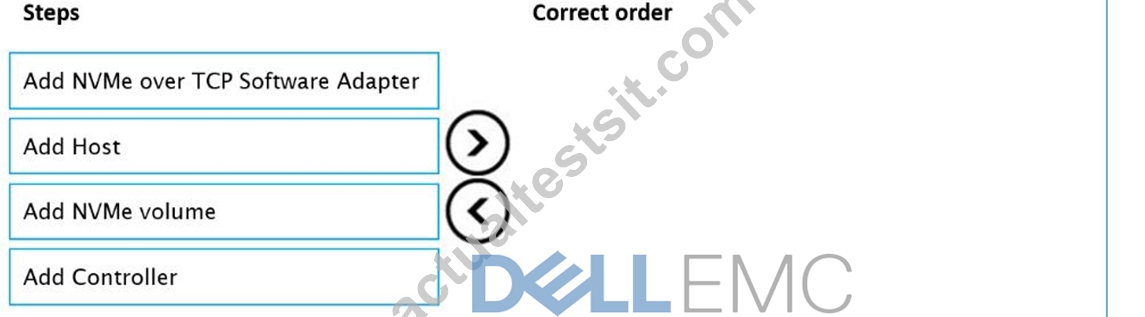
Answer:
Explanation: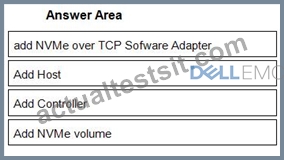
1 - add NVMe over TCP Sofware Adapter
2 - Add Host
3 - Add Controller
4 - Add NVMe volume
NEW QUESTION # 125
What is the main advantage of block provisioning over file provisioning in storage systems?
- A. Faster data retrieval times
- B. Better compatibility with cloud storage
- C. More efficient use of storage capacity
- D. Easier integration with virtualization technologies
Answer: C
NEW QUESTION # 126
During the discovery step of implementation, an unconfigured PowerStore is unavailable.
Which firewall ports must be open for a successful discovery?
- A. TCP port 80 and UDP port 80
- B. TCP port 5353 and UDP port 5353
- C. TCP port 8443 and UDP port 5353
- D. TCP and UDP ports 443 and 80
Answer: B
Explanation:
To properly discover a Dell PowerStore appliance using the Discovery Utility, you need to ensure that the following ports are open: TCP/UDP 5353: This port is used for mDNS (Multicast DNS) which is the protocol used by the PowerStore Discovery Utility to locate unconfigured PowerStore appliances. mDNS is essential for the appliance discovery process. (Grok 2) mDNS (Multicast DNS): PowerStore uses mDNS for discovery, especially when the array is unconfigured. mDNS allows devices to discover each other on a local network without needing a pre-configured DNS server. This is essential for the initial setup and discovery of a new PowerStore system.
Port 5353: This is the standard port used for mDNS communication. Both TCP and UDP port 5353 need to be open for mDNS to function correctly.
NEW QUESTION # 127
A storage admin is setting up a new protection policy with only snapshot rule for a new file system in PowerStore.
The administrator is given the below parameters.
File system name: FS-1 on SMB-NAS Server.OT
Size: 5TBOT
New protection policy: Policy-1OT
Snapshot rule: Snap-Rule only for Tuesdays on Hourly basis with default retention.OT Use the simulator to perform the configuration task.
When you have finished continue to the next question.
Answer:
Explanation:
See explanation below.
Explanation: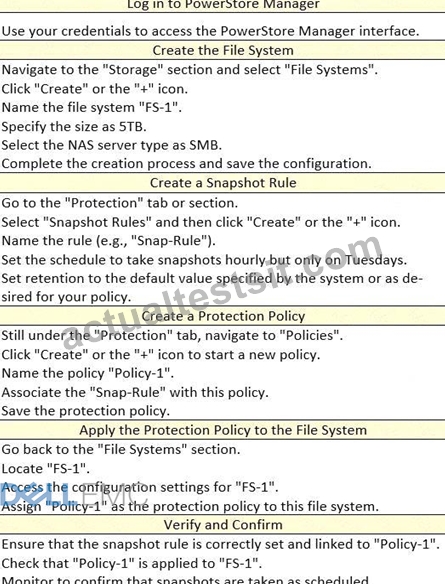
NEW QUESTION # 128
Which two components of Port Group Policy, indicates that the initiator and target connectivity is set while provisioning a volume to an ESXi host using iSCSI connectivity? (Choose two.)
- A. MPIO
- B. Active
- C. 1QN
- D. ICompliant
Answer: B,C
NEW QUESTION # 129
What are two minimum requirements for using VMware Site Recovery Manager (SRM) with PowerStore? (Choose two.)
- A. VMware vCenter Server and ESXi hosts version 6.5 and newer
- B. VMware vCenter Server and ESXi hosts version 6.7 and newer
- C. VMware SRM version 8.3 and newer
- D. VMware SRM version 8.0 and newer
Answer: B,C
NEW QUESTION # 130
Which ports are recommended for use as the interconnect between the two Dell supplied Data Switches connected to PowerStore?
- A. Four 1 GbE
- B. Two 10 GigE
- C. Two 100 GigE
- D. Two 25 GbE
Answer: C
NEW QUESTION # 131
What is required for metro connectivity in a vSphere environment?
- A. Host is located in remote site
- B. VMware SRM is enabled.
- C. Stretched vSphere cluster
- D. Host is located in local site
Answer: C
NEW QUESTION # 132
A customer has a new PowerStore T system that has been running for 45 days with multiple host systems attached. A user with the storage administrator role attempts to create a volume for a host, but the option is unavailable.
What is the cause?
- A. Appliance has reached the 90% full threshold
- B. Permanent license has not been applied
- C. The host is incorrectly zoned
- D. Incorrect privileges are assigned
Answer: B
NEW QUESTION # 133
Which term refers to the process of assigning specific storage resources to a host's operating system in PowerStore?
- A. Data deduplication
- B. LUN masking
- C. Storage virtualization
- D. Resource pooling
Answer: B
NEW QUESTION # 134
A storage administrator provisions a VMware file system from a NAS server configured with NFSv4.
What is the access requirement for the ESXi host?
- A. Kerberos with Integrity
- B. Read/Write
- C. Kerberos with Encryption
- D. Read/Write, allow Root
Answer: D
Explanation:
NFSv4 and ESXi Host Access
When provisioning a VMware file system (like a datastore) from a NAS server using NFSv4, the ESXi host needs specific permissions to function correctly:
Read/Write Access: This is fundamental. The ESXi host must be able to both read data from and write data to the datastore. This is essential for storing virtual machine files, writing logs, and managing the overall file system.
Allow Root Access: ESXi hosts require root-level access to the NFS datastore. This is critical for: Creating and Managing VMDKs: Root access is necessary to create, delete, and modify virtual machine disk files (VMDKs) on the datastore.
Managing VM Files: The host needs root permissions to manage various virtual machine configuration files and logs stored on the datastore.
Maintaining File System Integrity: Root access allows the ESXi host to perform essential file system operations to ensure consistency and prevent data corruption.
Why Other Options Are Incorrect
A). Read/Write: While read/write access is necessary, it's not sufficient on its own. Root access is also required.
B). Kerberos with Integrity: Kerberos is a security protocol that can be used with NFSv4 for authentication, but it's not a basic access requirement for ESXi hosts. While Kerberos enhances security, it's not strictly mandatory for basic functionality.
C). Kerberos with Encryption: Similar to Kerberos with integrity, encryption adds another layer of security but isn't a fundamental requirement for ESXi host access to an NFSv4 datastore.
Important Considerations
NFS Owner: When configuring NFSv4 on PowerStore, you typically set the "NFS Owner" to "root" for ESXi hosts. This ensures that the host has the necessary permissions.
no_root_squash: On some NAS systems, you might need to configure the no_root_squash option in the NFS export settings. This option prevents the NAS server from mapping the root user on the ESXi host to a less privileged user, ensuring that the host retains root access to the NFS share. Dell PowerStore Reference PowerStore: Create a File System for NFS Exports: This document in the PowerStore documentation provides guidance on creating and configuring file systems for NFS exports, including details about setting NFS permissions and the NFS owner.
NEW QUESTION # 135
What are the IP requirements for the management network during initial Configuration wizard for a PowerStore cluster?
- A. PowerStore T requires three IP addresses, and PowerStore X requires six IP addresses
- B. PowerStore T requires three IP addresses, and PowerStore X requires five IP addresses
- C. PowerStore T requires four IP addresses, and PowerStore X requires six IP addresses
- D. PowerStore T requires four IP addresses, and PowerStore X requires five IP addresses
Answer: C
NEW QUESTION # 136
Refer to the Exhibit.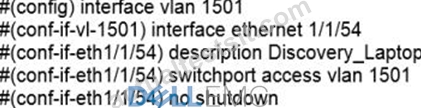
A Network administrator is failing to discover a PowerStore T system using the PowerStore Discovery Utility.
What might be the issue?
- A. Port 54 has not been set to trunk mode
- B. Port 54 needs to be enabled
- C. Discovery network uses only native VLAN
- D. Dedicated port needs to be used for discovery network
Answer: B
NEW QUESTION # 137
When creating a new volume on a multi-appliance PowerStore cluster what determines on which appliance the volume will be automatically provisioned?
- A. Resource balancer
- B. Replication balancer
- C. Cluster balancer
- D. Node balancer
Answer: A
NEW QUESTION # 138
Which two NAS servers must be configured with DNS support? (Choose two.)
- A. Servers that are joined to Active Directory.
- B. Servers that are accessed through S3 protocol.
- C. Servers that are used as FTP servers.
- D. Servers that are configured as Standalone.
- E. Servers that are used for Multiprotocol access.
Answer: A,E
NEW QUESTION # 139
How many host groups can a single host belong to?
- A. 0
- B. 1
- C. 2
- D. 3
Answer: D
NEW QUESTION # 140
At what point in the configuration of an External Storage import session does the data path from the host to the PowerStore system become the active I/O path?
- A. When the import session begins
- B. During the ImportKit installation
- C. Before launching the Import Storage wizard
- D. As MPIO restarts on the host
Answer: A
Explanation:
https://www.dell.com/support/manuals/en-aw/powerstore-1000/pwrstr-import/overview-of-the-non-disruptive-import-process?guid=guid-b91e4e36-e984-40ae-a484-75d8731926d6&lang=en-us
NEW QUESTION # 141
SIMULATION
An administrator received a request to provision a new test dev volume.
Use the simulator to provision a volume of 50 GB for their application team. Use a category of Other. The volume performance must not impact the production I/O when the system is heavily loaded.
When you have finished continue to the next question.
Answer:
Explanation:
See explanation below
Explanation: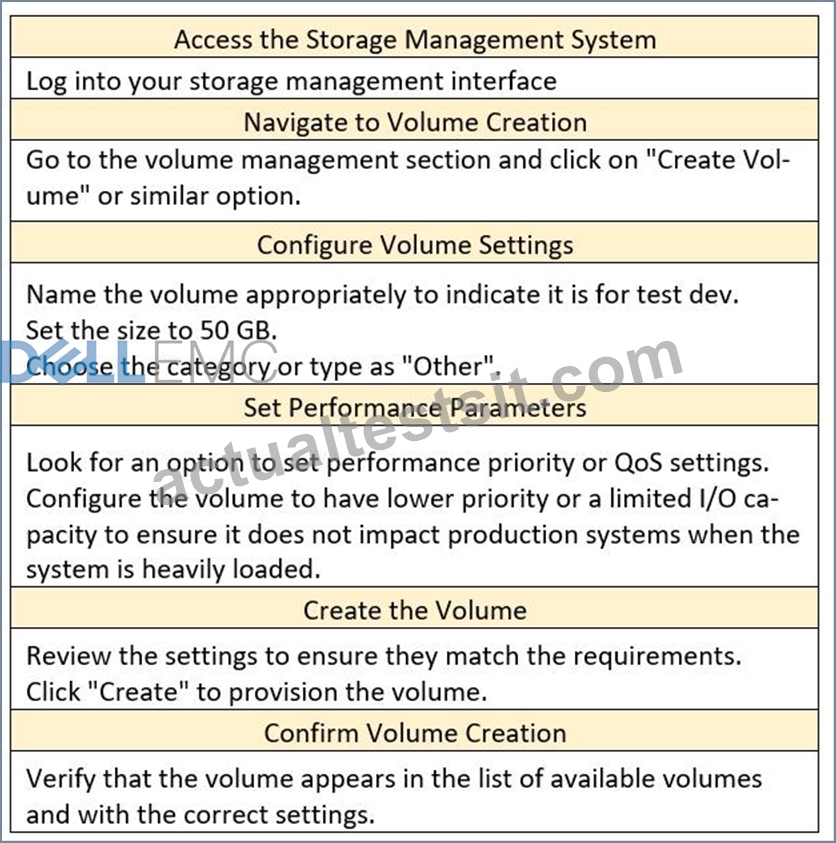
1. Create the Volume
Navigate to Storage > Volumes.
Click + CREATE.
Enter the volume name (e.g., "TestDevVolume").
Set the volume size to 50 GB.
In the "Category" dropdown, select Other.
Important: Under "Advanced Settings," locate the "Performance" section and set the Workload Type to Low. This will ensure that the volume's performance has minimal impact on production I/O, especially during periods of heavy system load.
Click Add.
Verification
After creating the volume, you can verify its settings on the Volumes page. Check that the size, category, and workload type are correctly configured.
Key Considerations
Workload Type: The "Low" workload type setting is crucial in this scenario. It prioritizes production I/O over the test/dev volume, preventing performance contention.
Performance Monitoring: It's a good practice to monitor the system's performance after provisioning the volume, especially during peak usage, to ensure that the production workloads are not negatively affected.
By following these steps, you'll successfully provision a 50 GB volume for the application team with the appropriate performance settings to avoid impacting production I/O. This meets the requirements of the simulation task.
NEW QUESTION # 142
A storage administrator needs to group Volume-1 and Volume-2 for consistency. The group should have a snapshot every day that is retained for 25 hours.
Use the simulator to make this configuration change.
When you have finished continue to the next question.
Answer:
Explanation:
See the steps in Explanation.
1. Open the simulator and log in with the default credentials: admin/Password123#.
2. SelectStorage>Volumesfrom the left menu.
3. SelectVolume-1andVolume-2from the list of volumes and clickGroup.
4. Enter a name for the volume group, such asConsistent-Group, and clickCreate.
5. SelectProtection>Protection Policiesfrom the left menu.
6. Click+ CREATEto launch the Create Protection Policy wizard.
7. Enter a name for the protection policy, such asDaily-Snapshot, and clickNext.
8. Click+ CREATEto create a new snapsho1t rule for the policy.
9. Enter a name for the snapshot rule, such asDaily-Rule, and clickNext.
10. SelectAll Daysfor the days to run the rule andTime of dayfor the frequency. Enter00:00as the start time and clickNext.
11. Enter25as the retention hours and clickNext.
12. Review the summary and clickFinishto create the snapshot rule.
13. ClickNextto continue the protection policy wizard.
14. Review the summary and clickFinishto create the protection policy.
15. SelectStorage>Volume Groupsfrom the left menu.
16. SelectConsistent-Groupfrom the list of volume groups and clickEdit.
17. ClickProtection Policyand selectDaily-Snapshotfrom the drop-down list. ClickSave.
18. The volume group is now configured with a protection policy that creates a snapshot every day at 00:00 and retains it for 25 hours.
NEW QUESTION # 143
During implementation of an iSCSI PowerStore X, the System Administrator is setting up performance policies on externally connected VMFS volumes. They create three DataStores with a high, medium, and low performance policy.
Testing is showing that the VM on the low performance DataStore is running at roughly the same performance as the VM on the high performance DataStore.
Both are performing well, but why is the System administrator seeing the same performance?
- A. PowerStore X policies are QoS based and only affect performance during contention
- B. PowerStore X tiered storage performance hasn't been turned on in system settings
- C. PowerStore X QoS-based performance policies can only be applied to VVols
- D. PowerStore X tiered storage performance policies can only be applied to workloads on the PowerStore X host
Answer: A
NEW QUESTION # 144
Refer the exhibit.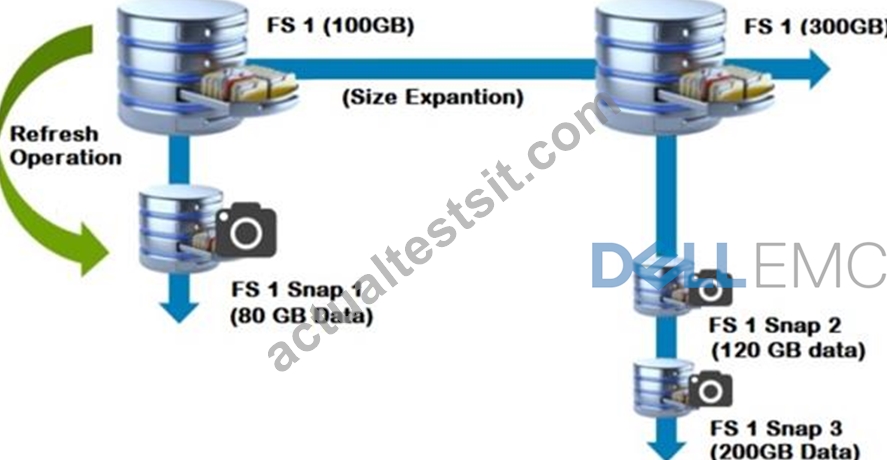
- A file system with 100 GB size is enabled with a protection policy.
- The administrator expanded the file system size to 300 GB size.
- The file system is filled up to 200 GB.
- The file system is restored with the snapshot FS1 Snap 1.
What will be the new size of the file system after restore activity?
- A. 300 GB
- B. 200 GB
- C. 80 GB
- D. 100 GB
Answer: D
NEW QUESTION # 145
Which requirement of a source storage system is invalid when participating in PowerStore Native Import migration?
- A. For PowerMax or VMAX, the front-end connectivity must be FC
- B. For EqualLogic, the front-end connectivity must be iSCSI
- C. With iSCSI connectivity between source and PowerStore, Global storage IP address is not required
- D. Administrator privileges are required on the source and associated hosts to import to a PowerStore cluster
Answer: C
NEW QUESTION # 146
A storage administrator has configured the addition of a VNX2 as a remote system for migration.
What is the result of this configuration?
- A. Import sessions from the VNX2 are scheduled for automatic cutover
- B. PowerStore Fibre Channel initiators are register on the VNX2 system
- C. Import sessions from the VNX2 are started for all Windows host accessed LUNs
- D. PowerStore iSCSI initiators are registered on the VNX2 system
Answer: B
NEW QUESTION # 147
......
The Dell PowerStore is a relatively new storage solution that was launched in 2020. It is a modern, flexible, and scalable storage platform that is designed to deliver high performance, efficiency, and reliability. The PowerStore is built on a unique architecture that combines storage and compute in a single appliance, enabling organizations to simplify their IT infrastructure and reduce costs.
The Dell PowerStore Deploy 2023 (EMC D-PST-DY-23) Certification Exam is a valuable credential that verifies an individual's knowledge and skills in handling Dell PowerStore Deploy 2023 systems. IDates who successfully pass D-PST-DY-23 exam can prove their expertise in designing, implementing, configuring, and managing Dell PowerStore Deploy 2023 storage solutions. As the demand for powerful and efficient storage systems continues to grow, obtaining this certification will help IT professionals stand out from their peers and give them a competitive edge in the job market.
D-PST-DY-23 Free Exam Files Downloaded Instantly: https://www.actualtestsit.com/EMC/D-PST-DY-23-exam-prep-dumps.html