

[May-2026] Dumps Brief Outline Of The CTFL-AcT Exam - ActualTestsIT
CTFL-AcT Training & Certification Get Latest ISTQB Foundation Level
Candidates who pass the ISQI CTFL-AcT certification exam receive a certificate that recognizes their expertise in acceptance testing. ISTQB Foundation Level - Acceptance Testing certification can help professionals advance their careers by demonstrating their proficiency in acceptance testing to potential employers. ISTQB Foundation Level - Acceptance Testing certification can also lead to higher salaries, as employers often prefer to hire certified professionals who can perform their job duties more efficiently.
NEW QUESTION # 17
Which of the following statements BEST describes the relationship between beta testing and acceptance testing?
- A. Beta testing and acceptance testing mean the same, but acceptance testing is the term used in Agile projects
- B. Beta testing is often used for acceptance testing of Software as a Service (SaaS) platforms
- C. Beta testing and acceptance testing are distinct testing techniques and have nothing to do with each other
- D. Beta testing is a specific from of acceptance testing required for Commercial Off-the-Shelf Software
Answer: B
Explanation:
Beta testing is a type of acceptance testing performed by end users in a real-world or production-like environment. It is especially relevant for cloud-based and SaaS platforms where widespread feedback is required before release.
Option B is correct because SaaS platforms often release features to a subset of users (beta users) to test the software under actual operating conditions, get feedback, and fix any defects that were not found during internal testing. This allows vendors to validate functionality, performance, and usability in diverse environments.
Other options:
A: Beta testing is not limited to Commercial Off-the-Shelf (COTS) software.
C: Incorrect - beta testing is a form of acceptance testing, not a separate unrelated technique.
D: Incorrect - beta testing and acceptance testing overlap, but they are not synonyms; the terminology does not change based on the development approach (Agile or not).
B). Beta testing is often used for acceptance testing of Software as a Service (SaaS) platforms
NEW QUESTION # 18
Which one of the following statements regarding acceptance criteria is true?
- A. In acceptance test-driven development (ATDD., acceptance criteria replace acceptance tests.
- B. Acceptance criteria specify what shall be tested to verify that a requirement or user story has been implemented correctly.
- C. Testers should not be involved in writing acceptance criteria to make sure that the test is independent.
- D. Acceptance criteria are specific to agile frameworks where they correspond to functional requirements.
Answer: B
NEW QUESTION # 19
During usability testing, the ergonomic of the products shall be checked. Which one of the following usability testing techniques matches this test objective BEST?
- A. Log file analysis
- B. Walkthrough
- C. Checklist-based evaluation
- D. Biometrics - based evaluation
Answer: C
Explanation:
Usability testing aims to evaluate the ease of use, efficiency, and satisfaction with which users can achieve tasks. When checking the ergonomics (e.g., layout, visual clarity, interaction comfort), checklist-based evaluations are particularly useful.
Option A is correct because a checklist of ergonomic/usability heuristics (e.g., Nielsen's heuristics, ISO 9241 standards) allows evaluators to systematically assess whether the interface meets established usability criteria.
Other options:
B (Biometrics-based evaluation) tracks physiological responses (e.g., stress or eye movement), which are useful but indirect and less targeted to ergonomic checks.
C (Walkthroughs) help assess usability by observing task flows, but they are less focused on layout and ergonomic design.
D (Log file analysis) captures behavior but not directly ergonomic issues like spacing, font size, or element alignment.
A). Checklist-based evaluation
NEW QUESTION # 20
Which TWO of the following statements about exploratory testing are most true?
- A. Exploratory testing is achieved by combining product discovery, test design and execution, and results L- interpretation
- B. Exploratory testing is rather carried out by people with a good knowledge of the business domain, bot not necessarily of the tested functionality
- C. Exploratory testing implements time-boxed sessions to prioritize tests bases on product risk analysis
- D. Exploratory testing is and experience-based test technique which refines acceptance criteria into acceptance test cases
- E. Exploratory testing generally begins with the definition of the test charter that defines the detailed test L-' conditions
Answer: A,E
Explanation:
Exploratory testing is a dynamic testing technique where learning, test design, execution, and interpretation occur simultaneously. It is especially useful when detailed requirements are unavailable or when testers rely on experience and intuition.
A is correct: Exploratory testing combines exploration, learning about the product, designing and executing tests on the fly, and interpreting the results - all within the same session.
E is also correct: Exploratory testing usually starts with a high-level test charter that defines the mission, objectives, or focus area for the session. It may not define specific test conditions, but it outlines the scope and intent.
Other options:
B: Not accurate - while timeboxing is used, exploratory testing typically relies on charters and experience rather than detailed product risk analysis to prioritize.
C: Incorrect - exploratory testing is not about refining acceptance criteria; that's part of ATDD.
D: Partially true but misleading - good business domain knowledge helps, but understanding the functionality is also important in exploratory testing.
NEW QUESTION # 21
How does ISTQB CTFL test activities relate to the IQBBA FL business analysis and requirements engineering activities?
- A. Test analysis and test design activities may result in changes of acceptance criteria.
- B. Business analysts who follow the IQBBA requirements engineering process will not be involved in designing test cases.
- C. The IQBBA solution evaluation phase precedes the ISTQB test implementation and test execution activities.
- D. Business analysts and tester have to decide, whether they follow the IQBBA or ISTQB lifecycle processes, because they exclude each other.
Answer: A
Explanation:
The relationship between testing and requirements engineering is iterative and collaborative. According to ISTQB CTFL and IQBBA FL syllabi, test activities such as test analysis and test design involve reviewing and interpreting acceptance criteria to derive test conditions and test cases. During this process, testers may identify ambiguities, conflicts, or missing acceptance conditions. These insights often result in feedback to business analysts or stakeholders, leading to refinement or changes in the acceptance criteria to ensure clarity, completeness, and testability.
This iterative feedback loop is essential in both Agile and traditional lifecycles. Therefore, option D is correct.
It reflects the dynamic interaction between requirements and test design, where improving one often improves the other.
Other options are incorrect:
Option A falsely assumes business analysts don't engage in test design, while in practice, they collaborate closely with testers.
Option B incorrectly suggests that IQBBA and ISTQB lifecycles are mutually exclusive. In fact, they complement each other.
Option C is incorrect in sequencing. In reality, solution evaluation (IQBBA) follows test execution, not precedes it.
Exact Reference - ISTQB CTFL Acceptance Testing Syllabus (Section 1.3.2):
"During test analysis, inconsistencies or missing information in the acceptance criteria can be identified and addressed through collaboration with business analysts."
NEW QUESTION # 22
As an acceptance tester you are analyzing the following user story for a computer web-based mass multiplayer role-playing game:
As an unregistered player
I want to be able to register myself by defining my e-mail, login and password in a registration form so that I become a registered player Consider the following propositions of the acceptance criteria:
i.a registration form is displayed on the screen.
ii.the form is written in the Groovy language; the cursor is initially set on the 'login' field; after pushing the TAB button the cursor switches to 'password', 'repeat password', 'mail', and 'repeat mail' forms.
iii.I cannot register myself if the login I choose is used by another player.
iv.after successful registration process I am informed about it by an e-mail.
Which of the above statements would you consider as well-written acceptance criteria?
- A. only i) and iii)
- B. only ii) and iv)
- C. only i), iii) and iv)
- D. only ii)
Answer: C
NEW QUESTION # 23
As an acceptance tester you want to test the $100 withdrawal process described by the following Business Process Model and Notation (BPMN) model.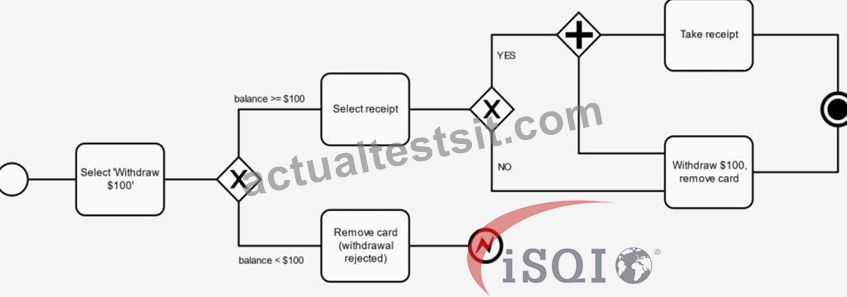
You would like to achieve the following coverage criterion "execute all possible process tasks". Consider the following test cases:
Test 1: balance = $100, receipt = YES
Test 2: balance = $120, receipt = NO
Test 3: balance = $85
Test 4: balance = $20, receipt = YES
Which of the following is the minimal set of test cases allowing to achieve required coverage?
- A. Test 1, Test 3
- B. Test 1, Test 2, Test 4
- C. Test 2, Test 4
- D. Test 1, Test 2, Test 3
Answer: A
Explanation:
Comprehensive Detailed Explanation (Approx. 200-220 words):
This question focuses on the coverage criterion "execute all possible process tasks" from the BPMN model of a $100 withdrawal.
Let's analyze the process:
The process starts when the user selects "Withdraw $100."
A decision gateway checks if the balance is # $100.
If NO: the card is removed and withdrawal is rejected.
If YES: the user is prompted to select whether they want a receipt.
Depending on the user's choice:
If YES: the receipt is printed # then $100 is withdrawn # card is removed.
If NO: $100 is withdrawn # card is removed (no receipt printed).
To meet the criterion "execute all possible process tasks," we must cover:
Rejected withdrawal path (balance < 100)
Withdrawal without receipt
Withdrawal with receipt
Receipt printing
Card removal in both success and failure
Test case coverage:
Test 1 (balance = $100, receipt = YES): covers successful withdrawal + receipt printed.
Test 3 (balance = $85): covers withdrawal rejected + card removed.
Together, these two tests execute all possible process tasks:
Withdraw with receipt
Reject due to insufficient balance
Receipt printed
Withdraw funds
Remove card
Other test combinations are redundant or do not add new path coverage.
NEW QUESTION # 24
Consider the following BPMN model and the related DMN model describing the decision rules associated to the "Check of delivery" activity What is the minimum number of test cases required to cover all paths without repeated loops in the BPMN model AND all decisions in the DMN table?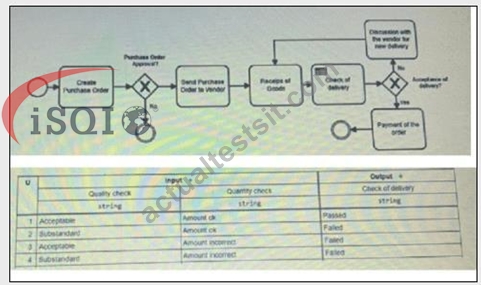
- A. 0
- B. 1
- C. 2
- D. 3
Answer: C
Explanation:
To determine the minimum number of test cases needed to cover:
All unique paths (without repeating loops) in the BPMN process model.
All decision rules (combinations) in the DMN decision table.
Let's break it down:
BPMN Paths:
If the purchase order is not approved # process ends # 1 path
If approved:
Goods received # "Check of delivery" # Acceptance YES # Payment # 1 path Goods received # "Check of delivery" # Acceptance NO # Discussion # End # 1 path
= Total distinct BPMN paths: 3
DMN Table:
There are 4 rules based on two inputs (Quality check and Quantity check):
Acceptable + Amount ok # Passed
Substandard + Amount ok # Failed
Acceptable + Amount incorrect # Failed
Substandard + Amount incorrect # Failed
You must execute 4 combinations to cover all decision rules.
To cover both all BPMN flows and all DMN rules, you need a minimum of 4 test cases (each using a different rule from the DMN table and associated BPMN path). Paths may overlap, but all rules must be exercised.
NEW QUESTION # 25
Which one of the following scenarios characterizes UX context analysis BEST?
- A. Attractive solutions from competitors are analyzed to obtain inspirations similar products
- B. External conditions and psychological conditions are analyzed to derive design decisions
- C. Users are categorized using personas to describe their physical and intellectual characteristics
- D. User behavior is described using use cases and business process models
Answer: B
Explanation:
UX context analysis evaluates the environment and conditions in which users interact with a product. This includes:
External conditions: lighting, noise, device constraints
Psychological conditions: cognitive load, stress, motivation
These factors influence usability, accessibility, and overall experience.
Option A is correct as it reflects the essence of UX context analysis - understanding the broader user environment to inform design and testing.
Other options:
B describes personas, which are user archetypes used for behavior modeling - more aligned with user profiling.
C focuses on competitor analysis - useful for inspiration, not context analysis.
D involves use cases and workflows - useful for behavior modeling, but not specifically context analysis.
A). External conditions and psychological conditions are analyzed to derive design decisions
NEW QUESTION # 26
The standard ISO 25010 defines a quality in use model with characteristics and subcharacteristics. Which elements of the following list is a characteristic of quality in use according to this standard?
- A. Efficiency
- B. Portability
- C. Compatibility
- D. Usability
Answer: A
NEW QUESTION # 27
Which of the following statements about test approaches and test techniques for acceptance testing is MOST correct?
- A. If exploratory tests are performed, then there is no need to cover the acceptance criteria
- B. The review of user requirements / user stories and associated acceptance criteria avoids dynamic acceptance u testing
- C. The refinement of requirements / user stories into acceptance criteria provides test conditions for the creation of acceptance tests
- D. Code coverage and Test-Driven Development are generally combined with boundary value analysis in acceptance testing
Answer: C
Explanation:
In ISTQB Acceptance Testing context, the process of refining requirements or user stories into acceptance criteria plays a crucial role in defining clear, testable conditions. These acceptance criteria act as the basis for deriving test conditions, which are in turn used to design acceptance test cases.
According to the ISTQB Foundation Level Acceptance Testing syllabus:
"Acceptance criteria are refined expressions of business requirements, and they help to determine the scope and intent of acceptance tests. These criteria are used to derive test conditions and guide the development of test cases." This alignment ensures that the delivered software meets the expectations set out in the requirements and satisfies the user needs. Acceptance tests are typically written from the user's perspective and are focused on verifying that the system behaves correctly in realistic business scenarios.
Option B is correct because it explicitly describes this logical and procedural relationship between user stories, acceptance criteria, and acceptance tests.
Other options are incorrect or misleading:
A is incorrect: reviewing requirements does not eliminate the need for dynamic testing.
C is incorrect: code coverage is more relevant for unit or system-level testing, not acceptance testing.
D is incorrect: exploratory testing is a valuable supplement but does not replace the need to verify acceptance criteria.
NEW QUESTION # 28
Suppose you are testing a new professional exam support system. As input the system takes two grades from two exams. For each exam the possible grade is 0 or 1 point. As output the system returns a single string - the decision about the entitlements: if the total score is 2, the candidate receives full entitlements. If the total score is 1, she receives partial entitlements. If the total score is 0, the candidate fails and receives no entitlements.
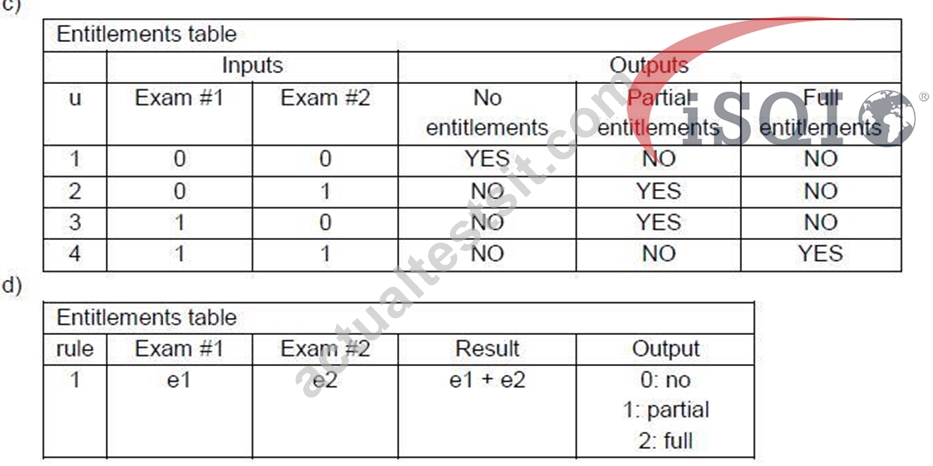
Which of the following is the correct Decision Model and Notation (DMN) model for this situation?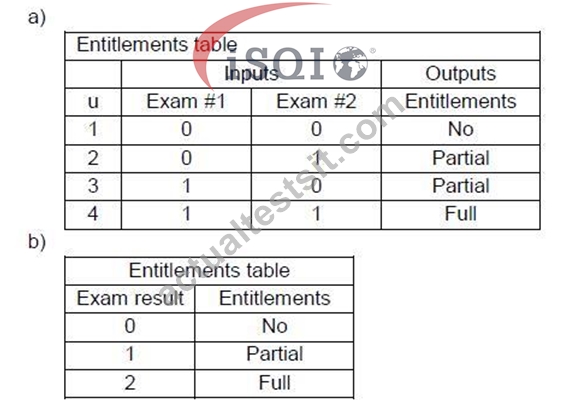
- A. Option A
- B. Option D
- C. Option C
- D. Option B
Answer: B
Explanation:
Decision Model and Notation (DMN) is a standardized approach used to model decision logic, often represented in decision tables that evaluate inputs and determine outputs. In this scenario, the entitlements granted to a candidate are based on the total score from two exams, where:
Each exam can be graded as either 0 or 1.
The combined score can be 0, 1, or 2.
The entitlements depend on the combined result:
0 # No entitlements
1 # Partial entitlements
2 # Full entitlements
Among the given diagrams:
Option A simply lists test cases but lacks explicit logic modeling.
Option B shows a mapping from total score to entitlements but doesn't model how the total is derived from the two exams.
Option C redundantly splits outputs into multiple Boolean fields and doesn't reflect how the decision is made from exam inputs.
Option D is the correct representation.
Option D uses:
e1 and e2 as inputs for Exam #1 and Exam #2.
Result as the sum of e1 + e2.
A final Output mapped based on the Result:
0 # No
1 # Partial
2 # Full
This structure accurately follows the DMN standard by expressing inputs, a derived result, and the corresponding decision output, making Option D the correct and most complete decision model.
Exact Reference - ISTQB CTFL Acceptance Testing Syllabus (Section 2.3):
"Decision tables are commonly used to express business rules that determine outputs based on combinations of inputs. DMN formalizes this structure to support automated reasoning."
NEW QUESTION # 29
Which one of the following statements regarding acceptance criteria is true?
- A. Acceptance criteria relate generally to some business goals and sometimes to some business needs
- B. For each requirement of user story, the acceptance criteria refine and specify how to test it
- C. For each requirement or user story, the acceptance criteria refine and specify what is expected
- D. Acceptance criteria are used to measure code coverage of the test object
Answer: C
Explanation:
Acceptance criteria define the conditions under which a user story or requirement is considered complete and acceptable to stakeholders. They clarify the expected behavior, outcomes, or attributes of the system.
Option C is correct because it accurately reflects that acceptance criteria are used to specify what is expected from the system in relation to a given requirement or user story. This ensures a shared understanding among developers, testers, and business stakeholders.
Other options:
A is vague and misleading - acceptance criteria relate directly to specific stories or features, not generally to high-level goals.
B is partially correct but limited - while acceptance criteria help define test conditions, their purpose is broader than just test specification.
D is incorrect - acceptance criteria are not related to code coverage, which is a technical test metric.
C). For each requirement or user story, the acceptance criteria refine and specify what is expected
NEW QUESTION # 30
Which one of the following statements describes correctly how acceptance testing may be augmented with other test techniques or approaches?
- A. In a black-box testing approach, acceptance test scenarios follow the implemented sequence of function calls in the code.
- B. In a priority-based testing approach, prioritization of acceptance tests depends on identified product risks.
- C. In a model-based testing approach, acceptance tests are generated from graphical or textual models.
- D. In a risk-based testing approach, acceptance criteria are derived from the tester's experience and intuition.
Answer: C
Explanation:
Model-Based Testing (MBT) is a test design technique in which test cases are derived from a model that describes some aspects of the system's behavior. In the context of acceptance testing, MBT can be used to generate high-level acceptance test cases automatically from business process models, use case diagrams, state models, or decision tables.
Option A is correct because MBT supports the systematic generation of acceptance test cases from these models, enabling better coverage of business rules and workflows while maintaining traceability to the requirements.
Other options:
B is close but slightly off: prioritization of acceptance tests in a priority-based approach depends on business value or stakeholder-defined priorities, not strictly on product risks.
C is incorrect. Risk-based testing relies on structured risk assessment, not just intuition or experience.
D is false. Black-box testing focuses on inputs and outputs without referencing the internal structure (such as function calls), which is characteristic of white-box testing.
Exact Reference - ISTQB CTFL Acceptance Testing Syllabus (Section 2.3):
"Model-based testing can be used to generate acceptance test cases systematically based on models representing business processes or system behavior."
NEW QUESTION # 31
As an acceptance tester, you are stuck between two stakeholders that demand contradicting acceptance criteria Which one of the following actions is MOST promising to resolve the conflict?
- A. After having collected the pros and cons of each solutions, you base your decision on those objective criteria
- B. Together with the business analyst, you determine which stakeholders is more important to decide between them
- C. Instead of discussing conflicting technical solutions, you try to understand the underlying business needs
- D. You organize a meeting of the two stakeholders so that they can solve the conflict personally
Answer: C
Explanation:
When stakeholders provide conflicting acceptance criteria, resolving the conflict effectively requires focusing on the underlying business goals rather than getting stuck in technical or solution-level disagreements.
Option D is correct because it aligns with the core role of a business analyst and an acceptance tester: to understand and validate business needs. By exploring the root business objectives, you can help stakeholders reframe the problem and reach a compromise based on what delivers the most value.
Other options:
A may lead to confrontation and unproductive discussion without proper facilitation.
B is risky - prioritizing stakeholders may escalate conflict or appear biased.
C assumes you can objectively resolve the conflict based only on pros and cons, but without understanding the business context, the decision may not meet stakeholder needs.
D). Instead of discussing conflicting technical solutions, you try to understand the underlying business needs
NEW QUESTION # 32
......
ISQI CTFL-AcT Exam aims to test whether an individual can understand the concepts and practices of acceptance testing. CTFL-AcT exam helps individuals to gain better insight into the acceptance testing process, including its purpose, the types of testing carried out, and how to identify and prioritize the risks involved in a software project. By taking CTFL-AcT exam, individuals can differentiate themselves in the field of software testing by validating their knowledge of acceptance testing.
Certification Training for CTFL-AcT Exam Dumps Test Engine: https://www.actualtestsit.com/ISQI/CTFL-AcT-exam-prep-dumps.html
ISTQB Foundation Level CTFL-AcT Real Exam Questions and Answers FREE Updated: https://drive.google.com/open?id=1Pvz9FhK5F7Jd8bRuydGS4Rpx8LNiGQy6