

Pass Scrum PSPO-I With ActualTestsIT Exam Dumps - Updated on Oct-2025
Fully Updated PSPO-I Dumps - 100% Same Q&A In Your Real Exam
Scrum PSPO-I (Professional Scrum Product Owner I) Certification Exam is designed for professionals who want to demonstrate their knowledge and skills in the role of the Product Owner. It is a globally recognized certification that validates your understanding of the Scrum framework, your ability to create and maintain a product backlog, your proficiency in stakeholder management, and your capacity to deliver value to the customers.
Scrum PSPO-I (Professional Scrum Product Owner I) Certification Exam is designed for individuals who want to validate their understanding of the Scrum framework and their ability to perform the role of a Product Owner. The Scrum PSPO-I Certification Exam is created and managed by Scrum.org, a global organization that provides training, certification, and resources for individuals and organizations who use the Scrum framework.
NEW QUESTION # 100
Why does the Product Owner want the Developers to adhere to its Definition of Done?
(choose the best answer)
- A. To predict the team's productivity over time.
- B. To know what the team will deliver over the next three Sprints.
- C. To have complete transparency into what has been done at the end of each Sprint.
- D. To be able to reprimand the team when they do not meet their velocity goal for the Sprint.
Answer: C
Explanation:
Explanation
The Product Owner wants the Developers to adhere to its Definition of Done to have complete transparency into what has been done at the end of each Sprint. This is because:
* The Definition of Done is a formal description of the state of the Increment when it meets the quality measures required for the product. It is a shared understanding among the Scrum Team and the stakeholders of what "Done" means for any Product Backlog item that is selected for a Sprint.
* The Developers are accountable for creating a "Done" Increment in every Sprint. They must ensure that every Product Backlog item they work on meets the Definition of Done before it is considered complete.
* The Product Owner is accountable for maximizing the value of the product resulting from the work of the Scrum Team. They must inspect the Increment at the end of each Sprint and assess how it delivers value and contributes to the Product Goal.
* Having a clear and consistent Definition of Done helps the Product Owner have complete transparency into what has been done at the end of each Sprint. It also helps them make informed decisions about releasing, adapting, or continuing the product development.
Other options, such as predicting the team's productivity over time, knowing what the team will deliver over the next three Sprints, or reprimanding the team when they do not meet their velocity goal for the Sprint, are not valid reasons for wanting the Developers to adhere to its Definition of Done. They may reflect a misunderstanding of what a Definition of Done is or how Scrum works.
References:
* [Scrum Guide], page 10, section "Definition of Done"
* [Scrum Guide], page 7, section "Developers"
* [Scrum Guide], page 6, section "Product Owner"
NEW QUESTION # 101
The timebox for a Daily Scrum is?
(choose the best answer)
- A. The same time of day every day.
- B. 4 hours.
- C. Two minutes per person.
- D. 15 minutes.
Answer: D
Explanation:
Explanation
The Scrum Guide states that "The Daily Scrum is a 15-minute time-boxed event for the Development Team to synchronize activities and create a plan for the next 24 hours."1 The Daily Scrum is a quick and simple planning meeting designed to keep everyone in the loop with how other team members are getting on. It ensures that team members are fully aligned with each other and on track to hit the Sprint Goal.
References:
1: The Scrum Guide2, page 11
2: The Scrum Guide
NEW QUESTION # 102
When n Scrum teams are working on a product, there should always be only 1 Product Owner but 1-n Scrum Masters.
- A. False
- B. True
Answer: B
NEW QUESTION # 103
How do changes in the project environment impact the Product Backlog?
- A. The old baselined Product Backlog would be saved, and a new one would be created for the rest of the project.
- B. The Product Backlog evolves to reflect the changes.
- C. The Product Backlog should be kept high-level enough to tolerate such changes.
- D. There will be no effect on the Product Backlog.
Answer: B
NEW QUESTION # 104
True or False: A Product Owner is essentially the same thing as a traditional Project Manager.
- A. False
- B. True
Answer: A
Explanation:
* A Product Owner is not the same thing as a traditional Project Manager. A Product Owner is a role in Scrum, a framework for developing, delivering, and sustaining complex products. A Project Manager is a role in traditional project management, a discipline for planning, executing, and controlling projects.
* A Product Owner is accountable for maximizing the value of the product resulting from the work of the Scrum Team. The Product Owner is responsible for managing and refining the Product Backlog, collaborating with the stakeholders and the Developers, and ordering the items in a way that best achieves goals and missions. The Product Owner represents the interests of everyone with a stake in the product and ensures that the Scrum Team works on the right things at the right time.
* A Project Manager is accountable for delivering the project within the predefined scope, time, and cost constraints. The Project Manager is responsible for defining and managing the project plan, resources, risks, issues, and dependencies. The Project Manager coordinates and controls the activities of the project team and the stakeholders and ensures that the project meets the quality standards and expectations.
* Some of the main differences between a Product Owner and a Project Manager are: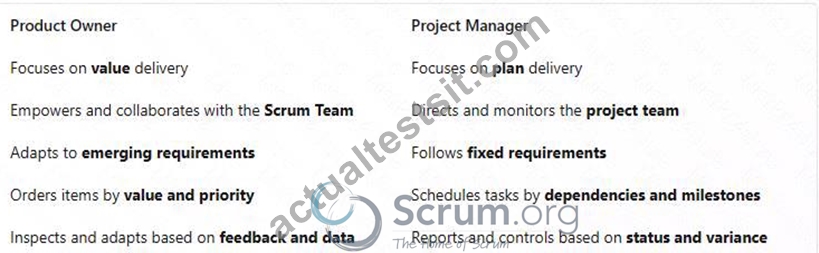
References:
* Scrum Guide: https://www.scrumguides.org/scrum-guide.html
* Product Owner: https://www.scrum.org/resources/what-is-a-product-owner
* Project Manager: https://www.pmi.org/about/learn-about-pmi/what-is-project-management
NEW QUESTION # 105
The Scrum Master observes the Product Owner struggling with ordering the Product Backlog.
What is an appropriate action for the Scrum Master to take?
(choose the best answer)
- A. Suggest the Product Owner extend the Sprint, so he can have more time to order the Product Backlog.
- B. Encourage the Product Owner to work with the Developers to see which items technically are fastest to implement.
- C. Offer the Product Owner help in understanding that the goal of ordering the Product Backlog is to maximize value.
- D. Present the Product Owner with an ordered Product Backlog to use.
- E. Suggest that the Developers order the Product Backlog to be sure that it is a feasible ordering of work.
Answer: C
Explanation:
The Scrum Master's role includes coaching the Scrum Team and helping them understand Scrum practices. If the Product Owner is struggling with ordering the Product Backlog, the Scrum Master should offer guidance and support to help the Product Owner understand that the primary goal of ordering the Product Backlog is to maximize the value delivered to the customer. This involves considering factors such as business value, risk, return on investment (ROI), dependencies, and impact. The Scrum Master can facilitate this understanding and help the Product Owner apply it to the ordering of the Product Backlog items.
References: The Scrum Guide and resources from Scrum.org provide insights into the role of the Scrum Master in supporting the Product Owner and ensuring that the Product Backlog is ordered in a way that maximizes value
NEW QUESTION # 106
True or False: The value delivered by a product can only be determined by revenue.
- A. False
- B. True
Answer: A
Explanation:
The value delivered by a product can not be determined by revenue alone, because:
* Revenue is only one aspect of value, and it may not reflect the true impact or benefit of the product for the stakeholders, the users, and the society. For example, a product may generate high revenue, but also cause environmental damage, ethical issues, or customer dissatisfaction.
* Value is a subjective and relative concept, and it may vary depending on the context, the perspective, and the criteria of the evaluation. For example, a product may have different value for different segments of customers, or for different markets or regions.
* Value is dynamic and emergent, and it may change over time due to various factors, such as feedback, competition, innovation, or regulation. For example, a product may lose its value as new alternatives or solutions become available, or as customer needs or preferences evolve.
References:
* Scrum Guide 2020, page 6: "The Product Owner is accountable for maximizing the value of the product resulting from the work of the Scrum Team."
* Scrum Guide 2020, page 11: "The Product Goal describes a future state of the product which can serve as a target for the Scrum Team to plan against."
* Scrum Guide 2020, page 11: "The Product Owner is accountable for effective Product Backlog management, which includes ... optimizing the value of the work the Scrum Team performs."
NEW QUESTION # 107
Which three of the following are true about Scrum?
(choose the best three answers)
- A. Scrum is a framework for developing and sustaining complex products.
- B. Each component of Scrum serves a specific purpose and is essential to Scrum's success and your usage of Scrum to develop complex products.
- C. Scrum is based on empiricism and lean thinking.
- D. Scrum implements self-management by replacing Project Managers with Scrum Masters.
- E. Scrum is a methodology where you can pick and choose which parts of Scrum you think will work for your environment.
Answer: A,B,C
Explanation:
Explanation
The following are true about Scrum:
* Scrum is based on empiricism and lean thinking. Empiricism is the principle of making decisions based on what is observed and experienced, rather than on theory or speculation. Lean thinking is the
* philosophy of eliminating waste and maximizing value in any process or system. Scrum applies these concepts by providing a framework for inspecting and adapting the product and the process, and by focusing on delivering the most valuable features to the customers and stakeholders.
* Scrum is a framework for developing and sustaining complex products. A complex product is one that has unpredictable or unknown aspects that require creativity, experimentation, and adaptation to deliver.
A framework is a set of minimal and essential rules and roles that provide structure and guidance, but leave room for flexibility and innovation. Scrum provides such a framework for teams to collaborate and deliver complex products iteratively and incrementally, while embracing change and feedback.
* Each component of Scrum serves a specific purpose and is essential to Scrum's success and your usage of Scrum to develop complex products. Scrum consists of three roles (Product Owner, Scrum Master, Developers), five events (Sprint, Sprint Planning, Daily Scrum, Sprint Review, Sprint Retrospective), and three artifacts (Product Backlog, Sprint Backlog, Increment). Each of these components has a clear definition, accountability, and goal that contributes to the overall effectiveness and value of Scrum.
Removing or changing any of these components may cause the benefits of Scrum to be lost or diminished.
References:
* Scrum Guide 2020, page 3: "Scrum is founded on empiricism and lean thinking."
* Scrum Guide 2020, page 3: "Scrum is a lightweight framework that helps people, teams and organizations generate value through adaptive solutions for complex problems."
* Scrum Guide 2020, page 4: "Each component within the framework serves a specific purpose and is essential to Scrum's success and usage."
NEW QUESTION # 108
The Daily Scrum is an event that happens every day. What would be three key concerns if the frequency were to be lowered to every two or three days?
(choose the best three answers)
- A. The Product Owner cannot accurately report progress to the stakeholders.
- B. Impediments are raised and resolved more slowly.
- C. The Scrum Master loses the ability to update the Gantt chart properly.
- D. The Sprint Backlog may become inaccurate.
- E. Too much work is spent updating the Scrum board before the meeting.
- F. Opportunities to inspect and adapt the Sprint Backlog are lost.
Answer: B,D,F
Explanation:
The Daily Scrum is a 15-minute event for the Developers to inspect their progress toward the Sprint Goal and adapt the Sprint Backlog as necessary1. It is a key opportunity for the Developers to plan their work for the next 24 hours and collaborate on any challenges or impediments2. If the frequency of the Daily Scrum were to be lowered to every two or three days, three key concerns would be:
The Sprint Backlog may become inaccurate. The Sprint Backlog is the plan for how the Developers will achieve the Sprint Goal, and it is updated throughout the Sprint as more is learned[3][3]. The Daily Scrum is a chance for the Developers to inspect the Sprint Backlog and make adjustments based on the current situation4. If the Daily Scrum is less frequent, the Sprint Backlog may not reflect the reality of the work, and the Developers may lose track of their progress and alignment with the Sprint Goal.
Opportunities to inspect and adapt the Sprint Backlog are lost. Scrum is based on empiricism, which means that knowledge comes from experience and making decisions based on what is observed5. The Daily Scrum is an essential event for the Developers to apply empiricism to their work, by inspecting the Sprint Backlog and adapting it to optimize the value and quality of the Increment. If the Daily Scrum is less frequent, the Developers may miss opportunities to inspect and adapt their work, and may not be able to deliver a valuable, useful Increment every Sprint.
Impediments are raised and resolved more slowly. An impediment is anything that prevents the Scrum Team from delivering a product Increment. The Daily Scrum is a forum for the Developers to identify and communicate any impediments that affect their work, and to seek help from the Scrum Master or other team members. If the Daily Scrum is less frequent, the impediments may not be raised and resolved in a timely manner, and may cause delays or quality issues in the product delivery.
Reference:
1: The Scrum Guide, November 2020, p. 10
2: The Scrum Guide, November 2020, p. 11
[3][3]: The Scrum Guide, November 2020, p. 10
4: Understanding and Applying the Scrum Framework, Scrum.org, accessed on December 16, 2023
5: The Scrum Guide, November 2020, p. 4
6: The Scrum Guide, November 2020, p. 11
7: The Scrum Guide, November 2020, p. 14
8: Developing People and Teams, Scrum.org, accessed on December 16, 2023
NEW QUESTION # 109
True or False: The Scrum Team is accountable for creating a valuable increment every Sprint.
- A. False
- B. True
Answer: B
Explanation:
Explanation
* The Scrum Team is a self-organizing and cross-functional team that delivers valuable products in an agile way. The Scrum Team consists of one Product Owner, one Scrum Master, and Developers. They are all accountable for creating a valuable, useful, and potentially releasable product Increment each Sprint.
* An Increment is a concrete stepping stone toward the product vision. It is the sum of all the Product Backlog items completed during a Sprint and the value of the increments of all previous Sprints. At the end of a Sprint, the new Increment must be "Done", which means it meets the Definition of Done and is usable.
* The Scrum Team is accountable for creating a valuable increment every Sprint, not just once or occasionally. This means that the Scrum Team must deliver a product functionality that provides value to the customers and users and contributes to the product goals and missions. The value of an increment can be measured by various factors, such as customer satisfaction, feedback, revenue, market share, or social impact.
* The Scrum Team is also accountable for creating a valuable increment every Sprint, not just any
* increment. This means that the Scrum Team must deliver a product functionality that meets the quality standards and expectations of the customers and users and complies with the Definition of Done. The quality of an increment can be measured by various factors, such as usability, reliability, performance, security, or maintainability.
References:
* Scrum Guide: https://www.scrumguides.org/scrum-guide.html
* Scrum Team: https://www.scrum.org/resources/what-is-a-scrum-team
* Increment: https://www.scrum.org/resources/what-is-an-increment
NEW QUESTION # 110
The Product Backlog can be changed directly by stakeholders of the project.
- A. FALSE
- B. TRUE
Answer: A
NEW QUESTION # 111
Each artifact contains a commitment. For the Sprint Backlog it is the Product Goal.
- A. FALSE
- B. TRUE
Answer: A
NEW QUESTION # 112
As the Sprint Planning progresses, the Developers realize that the workload may be greater than their capacity to complete the work. Which two are valid actions?
(choose the best two answers)
- A. The Developers work overtime during this Sprint.
- B. Recruit additional Developers before the work can begin.
- C. Remove or change selected Product Backlog items.
- D. The Developers ensure that the Scrum Team is aware, start the Sprint, and monitor progress.
- E. Cancel the Sprint.
Answer: C,D
Explanation:
According to the Scrum Guide1, the Developers are responsible for selecting the amount of work they can do in a Sprint, based on their capacity and past performance2. If they realize that the workload may be greater than their capacity, they can either remove or change some of the selected Product Backlog items, or they can start the Sprint and monitor the progress, making adjustments as needed3. Recruiting additional Developers, canceling the Sprint, or working overtime are not valid actions, as they would disrupt the Scrum values of commitment, focus, and respect
NEW QUESTION # 113
Who "owns" the Product Backlog?
- A. The Product Owner
- B. The Developers
- C. The Scrum Master
Answer: A
NEW QUESTION # 114
Which of the following actions may a Scrum Master take in starting up a project?
- A. Ask the Development Team members to introduce themselves to each other and tell about their skills and background.
- B. Ensure that team members have clear roles and responsibilities.
- C. Ask the development managers to introduce their departments and capabilities.
- D. Ensure that a bonus system is in place for the top performance of individuals.
Answer: A
NEW QUESTION # 115
To be self-management means, that it is okay for the Developers to don't do the Daily Scrum.
- A. False
- B. True
Answer: A
NEW QUESTION # 116
During the Sprint, the Sprint Backlog can be modified even if it endangers the Sprint Goal.
- A. FALSE
- B. TRUE
Answer: A
NEW QUESTION # 117
Which statement best describes the Sprint Backlog as the output of the Sprint Planning?
(choose the best answer)
- A. Each task is estimated in hours.
- B. It is a complete list of all work to be done in a Sprint.
- C. It is ordered by the Product Owner.
- D. It is the Developers plan for the Sprint.
- E. Every item has a designated owner.
Answer: D
Explanation:
The Sprint Backlog is the output of the Sprint Planning, where the Developers select the Product Backlog items that they can deliver in the Sprint and create a plan for how to do the work. The Scrum Guide states that "The Sprint Backlog is composed of the Sprint Goal (why), the set of Product Backlog items selected for the Sprint (what), as well as an actionable plan for delivering the Increment (how)."1 The Sprint Backlog is owned and managed by the Developers, who can update it throughout the Sprint as more is learned. The Sprint Backlog makes visible all the work that the Developers identify as necessary to meet the Sprint Goal.1 Reference:
1: The Scrum Guide2, page 15
2: The Scrum Guide
NEW QUESTION # 118
What are typical topics, inspected/discussed in the Sprint Retrospective?
- A. Definition of Done
- B. Tools
- C. Interactions
- D. Product Backlog Items
- E. Individuals
- F. Processes
Answer: A,B,C,E,F
NEW QUESTION # 119
The Sprint Planning is a formal opportunity to inspect and adapt Scrum artifacts.
- A. FALSE
- B. TRUE
Answer: B
NEW QUESTION # 120
During a Sprint, when is new work or further decomposition of work added to the Sprint Backlog?
(choose the best answer)
- A. As soon as possible after it is identified.
- B. When the Product Owner identifies new work.
- C. During the Daily Scrum after the Developers approve it.
- D. When the Scrum Master has time to enter it.
Answer: A
Explanation:
Explanation
New work or further decomposition of work is added to the Sprint Backlog as soon as possible after it is identified because:
It reflects the current state of the Sprint. The Sprint Backlog is a plan that the Developers create and update throughout the Sprint, based on their progress, learnings, and changes. By adding new work or further decomposition of work to the Sprint Backlog promptly, the Developers can ensure that the Sprint Backlog is transparent, accurate, and up-to-date.
It enables the Developers to self-manage their work. The Developers are accountable for organizing and managing their own work, and they have the authority to change the Sprint Backlog as needed. By adding new work or further decomposition of work to the Sprint Backlog promptly, the Developers can exercise their autonomy and empowerment, and adjust their plan accordingly.
It supports the achievement of the Sprint Goal. The Sprint Goal is a single objective that provides guidance and focus for the Developers throughout the Sprint. By adding new work or further decomposition of work to the Sprint Backlog promptly, the Developers can ensure that their work is aligned with and contributes to the Sprint Goal.
References:
Scrum Guide 2020, page 6: "Developers are the people in the Scrum Team that are committed to creating any aspect of a usable Increment each Sprint." Scrum Guide 2020, page 6: "The Developers are accountable for ... organizing and managing their work." Scrum Guide 2020, page 10: "The Sprint Goal is a single objective for the Sprint." Scrum Guide 2020, page 14: "The purpose of each Sprint is to deliver Increments of potentially releasable functionality that adhere to the Scrum Team's current Definition of Done." Scrum Guide 2020, page 14: "The Sprint Backlog is composed of ... all of the work needed to deliver a product Increment that meets the Definition of Done." Scrum Guide 2020, page 14: "The Developers can change the content of the Sprint Backlog throughout the Sprint as more is learned."
NEW QUESTION # 121
Who creates the Definition of Done?
(choose the best answer)
- A. The Product Owner
- B. The Developers
- C. The Scrum Team
- D. The Scrum Master
Answer: C
Explanation:
The Definition of Done is a formal description of the state of the Increment when it meets the quality measures required for the product. The Definition of Done is created by the Scrum Team, not just the Developers. The Scrum Team must have a shared understanding of what it means for work to be complete, to ensure transparency. The Definition of Done is used to assess when work is complete on the product Increment. The Definition of Done may vary significantly per Scrum Team, depending on the context. The Definition of Done evolves over time and is updated whenever the Scrum Team learns more about the product and the environment in which it operates.
References:
* The Scrum Guide
* Understanding and Applying the Scrum Framework
* Professional Scrum Product Owner™ I Certification
NEW QUESTION # 122
What tactic should a Scrum Team use to divide a group of 100 people into multiple Scrum Teams?
(choose the best answer)
- A. Ask the Product Owner to assign the people to teams.
- B. Ask the people to divide themselves into teams.
- C. Create teams based on their skills across multiple layers (such as database, UI, etc.).
Answer: B
Explanation:
According to Scrum.org, when splitting a large group into multiple Scrum Teams, it can be beneficial to allow the people to self-organize into smaller teams12. This approach respects the principle of self-organization, which is a key aspect of Scrum12. It allows individuals to choose the team they feel they can contribute to most effectively12. However, it's important to note that this process should be facilitated and guided to ensure a balanced distribution of skills and capabilities across the teams12.
NEW QUESTION # 123
......
To ensure that Product Owners have the necessary skills and knowledge to perform their role effectively, Scrum.org offers the Professional Scrum Product Owner I (PSPO-I) exam. PSPO-I exam is designed to assess whether a candidate has a solid understanding of the Scrum framework and the Product Owner role. It tests their knowledge of the Scrum values, principles, and practices, as well as their ability to apply these in a real-world context.
Latest PSPO-I Exam Dumps - Valid and Updated Dumps: https://www.actualtestsit.com/Scrum/PSPO-I-exam-prep-dumps.html
Verified PSPO-I Exam Questions Certain Success: https://drive.google.com/open?id=1TQw8T8FgoXHH8PWQmPEt0Je_TckxKeWr