

Updated Mar-2026 Test Engine to Practice Test for AB-731 Exam Questions and Answers!
AI Transformation Leader Certification Sample Questions and Practice Exam
Microsoft AB-731 Exam Syllabus Topics:
| Topic | Details |
|---|---|
| Topic 1 |
|
| Topic 2 |
|
| Topic 3 |
|
NEW QUESTION # 16
What is considered a best practice when forming an AI adoption team in an enterprise environment?
- A. Include primarily IT and project management staff initially to streamline deployment, adding governance and compliance roles later.
- B. Include only data scientists and engineers at first to validate technical feasibility, then add other stakeholders later.
- C. Include procurement and vendor management specialists early to evaluate AI tools, involving business teams once a platform is selected.
- D. Include representatives from legal, leadership, and business units to align AI initiatives with organizational prioritie
Answer: D
Explanation:
Forming a cross-functional AI adoption team is a foundational best practice for enterprise environments.
A diverse "AI Center of Excellence" (CoE) or steering committee ensures that technical capabilities do not develop in isolation from regulatory requirements or business goals.
Key Representatives & Their Roles
*-> Executive Leadership: Champions the vision, secures budget, and ensures the AI strategy aligns with high-level corporate priorities.
*-> Legal & Compliance: Manages risk related to data privacy (e.g., GDPR), intellectual property, and evolving AI regulations to maintain stakeholder trust.
*- Business Units: Identify high-value use cases, define success metrics (KPIs), and ensure the AI tools actually solve operational pain points.
IT & Data Science: Provides the technical architecture, manages data pipelines, and handles the actual deployment and monitoring of models.
Change Management: Focuses on the "human" side of adoption, including upskilling employees and addressing fears about job displacement.
Reference:
https://learn.microsoft.com/en-us/azure/cloud-adoption-framework/scenarios/ai/center-of- excellence
NEW QUESTION # 17
For each of the following statements, select Yes if the statement is true. Otherwise, select No. NOTE: Each correct selection is worth one point.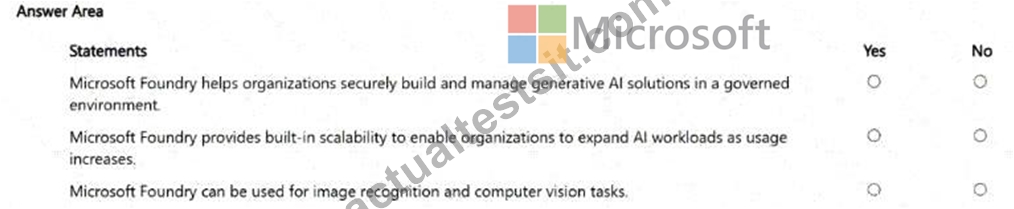
Answer:
Explanation: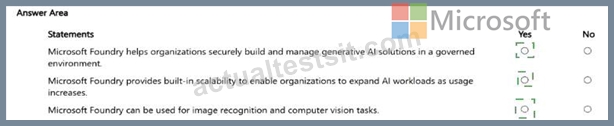
Explanation:
Microsoft Foundry is positioned as a unified platform experience for building, optimizing, and governing AI applications and agents. Microsoft explicitly emphasizes "fleetwide security and governance" and the ability to build and manage AI in a unified environment, which directly supports statement 1 being Yes : it is designed to help organizations build and operate generative AI solutions with centralized governance controls (for example, environment setup, data isolation, access control, and operational management).
For statement 2, Foundry supports scaling as demand increases . Microsoft documentation for Foundry- related model usage notes that as usage grows, Foundry can automatically increase quotas by moving users to higher tiers (and allows requesting additional quota). This is a concrete scalability mechanism tied to increased workload demand, so the statement is Yes .
For statement 3, Foundry is not limited to text-only generative AI. Microsoft provides "Azure Vision in Foundry Tools," which delivers computer vision capabilities such as analyzing images, reading text (OCR), and other image-processing features. That means Foundry can be used for image recognition/computer vision workloads, so the statement is Yes .
NEW QUESTION # 18
Which business requirement most closely relates to grounding a generative AI model?
- A. supporting multiple languages
- B. ensuring that verified company data sources are used for response generation
- C. enabling users to interact by using natural language queries
- D. measuring the number of user interactions per day
Answer: B
Explanation:
Ensuring that verified company data sources are used for response generation relates to grounding a generative AI model by anchoring its outputs in trusted, domain-specific, or enterprise-specific information. This process bridges the gap between the general knowledge a model has from its training data and the specific, up-to-date facts required for accurate, trustworthy business applications.
Reference:
https://decagon.ai/glossary/what-is-ai-grounding
NEW QUESTION # 19
Which statement accurately describes the difference between a pretrained generative AI model and a fine- tuned generative AI model?
- A. A pretrained model is faster to train than a fine-tuned model because the pretrained model uses fewer parameters.
- B. A pretrained model is trained on broad datasets, while a fine-tuned model is adapted to perform well on a narrower, domain-specific dataset.
- C. A pretrained model requires labeled data, while a fine-tuned model does not.
- D. A pretrained model is optimized for a specific task, while a fine-tuned model is designed for general-purpose use.
Answer: B
Explanation:
A pretrained generative AI model is trained initially on a large, broad, and diverse dataset so it learns general language (or multimodal) patterns and capabilities. Fine-tuning then takes that pretrained base and performs additional training on a smaller, task- or domain-specific dataset to specialize behavior- improving performance for a particular use case, tone, style, or domain knowledge representation. That is exactly what option C states, making it the correct answer.
Option A is incorrect because both pretraining and fine-tuning may use labeled or unlabeled data depending on the technique; the distinction is not "labeled vs. unlabeled." Option B is incorrect because a pretrained model is not "faster to train" due to fewer parameters; pretraining is typically the most compute-intensive phase precisely because it's done at large scale, while fine-tuning is smaller but still trains the same model architecture. Option D is reversed: the pretrained model is the general-purpose foundation, while the fine- tuned model is the specialized variant for a specific task or dataset.
NEW QUESTION # 20
- For each of the following statements, select Yes if the statement is true. Otherwise, select No. NOTE: Each correct selection is worth one point.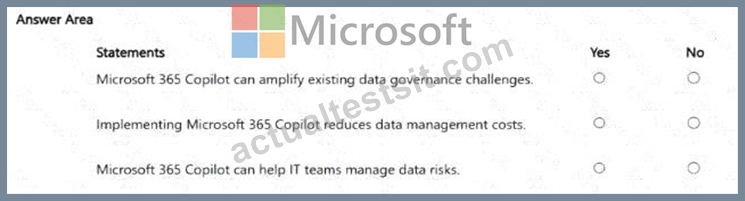
Answer:
Explanation: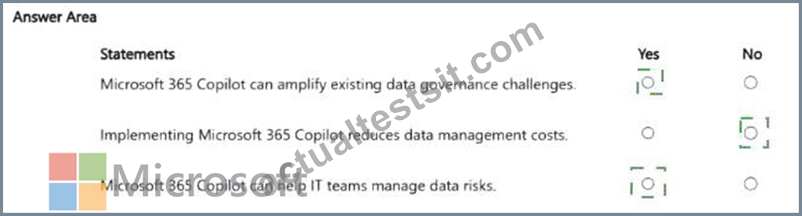
Explanation:
Answer Area
Microsoft 365 Copilot can amplify existing data governance challenges.
answer: Yes
Implementing Microsoft 365 Copilot reduces data management costs.
answer: No
Microsoft 365 Copilot can help IT teams manage data risks.
answer: Yes
Yes - Copilot relies on the permissions, sharing links, and content exposure that already exist in Microsoft
365. If an organization has oversharing (for example, broadly accessible SharePoint sites, poorly scoped Teams, unmanaged external sharing, or excessive access rights), Copilot can surface that content more easily through natural-language querying. In other words, Copilot doesn't create new permissions, but it can increase visibility of governance gaps and make the impact of weak information architecture more apparent.
No - It is not accurate to claim that implementing Copilot inherently reduces data management costs.
Adoption often requires up-front investment in data hygiene, sensitivity labeling, retention, permission cleanup, DLP, and change management. Some organizations may realize productivity gains or reduced effort over time, but "reduces costs" is not a guaranteed outcome and depends heavily on the current state of governance, the scale of remediation needed, and how Copilot is rolled out.
Yes - Copilot can support IT risk management when deployed with the right controls: identity and access governance, sensitivity labels, DLP policies, retention, auditing, and compliance tooling. Because Copilot operates within the Microsoft 365 security/compliance boundary and honors existing access controls, IT can apply centralized policies to reduce leakage risk and improve overall control of how organizational data is accessed and used.
NEW QUESTION # 21
You are exploring how Microsoft 365 Copilot uses Microsoft Graph to deliver AI-powered experiences.
Which information in Microsoft Graph can Copilot use by default?
- A. emails, files, meetings, and chats in Microsoft 365
- B. social media activity
- C. content from public websites
- D. data stored in a file share
Answer: A
NEW QUESTION # 22
Your company sells hiking and camping gear online. You need a generative AI solution that can interact with customers and ask questions about their needs. What should you include in the solution?
- A. predictive AI
- B. a chatbot
- C. a recommendation engine
- D. computer vision
Answer: B
Explanation:
The requirement is an interactive generative AI experience that can converse with customers and ask clarifying questions (for example: "What climate are you hiking in?", "How many people will share the tent?", "What's your budget?", "Do you prioritize weight or comfort?"). The best solution component for that conversational, question-and-answer interaction is a chatbot (A), powered by a generative AI model.
A chatbot provides the dialog framework: maintaining conversational context across turns, prompting the user for missing requirements, and responding in natural language. This makes it suitable for customer support, guided shopping assistance, troubleshooting, and pre-sales Q & A-especially when customers don't know exactly what they need and benefit from a guided conversation.
The other options don't match the core requirement. Predictive AI (B) forecasts outcomes (like demand or churn) and isn't inherently conversational. Computer vision (C) analyzes images (like recognizing products from photos) and doesn't address asking questions in dialogue. A recommendation engine (D) can be useful in ecommerce, but it typically suggests items based on behavior or attributes; it doesn't by itself provide a conversational flow that asks users questions and adapts responses in natural language. In practice, you can combine a chatbot with a recommendation engine behind the scenes-but the "include in the solution" component that directly satisfies interactive questioning is the chatbot.
NEW QUESTION # 23
Your company stores thousands of reports and documents across multiple systems. You recommend using Azure AI Search as part of a new generative AI solution to improve information discovery. What is a key benefit of using Azure AI Search in this scenario?
- A. queries and retrieves information from large collections of data by using natural language
- B. automates document workflows based on the document content
- C. generates responses to customer questions without referencing the existing data
- D. improves model accuracy by fine-tuning organizational data
Answer: A
Explanation:
Azure AI Search provides an indexing and retrieval layer that makes large, distributed document collections searchable in a consistent way. The key benefit in an information discovery scenario is that it can index content from many sources and then retrieve relevant documents/passages using rich query capabilities, including natural language-style queries and semantic ranking. That directly aligns with B .
This retrieval capability is foundational for RAG architectures: the system uses Azure AI Search to find the best matching content, then supplies those results to a generative model so the answer is grounded in organizational knowledge. That improves relevance and reduces hallucinations because the model is guided by retrieved evidence.
Option A is the opposite of what you want-Search is used precisely to reference existing data. C is more aligned to workflow automation platforms (Logic Apps/Power Automate) and document processing services.
D describes fine-tuning, which is a different approach; Azure AI Search improves discovery and grounding through retrieval, not by changing model weights.
NEW QUESTION # 24
Your company manages an online catalog of office supplies.
You plan to use a generative AI solution to create product descriptions for your company's website. The solution must meet the following requirements:
- Ensure that the descriptions can be posted immediately after they are created.
- Enable the selection and inclusion of product details in each
description.
- Be fast and simple for non-technical staff to use.
What is the best type of solution to use? More than one answer choice may achieve the goal.
Select the BEST answer.
- A. custom Azure Machine Learning model
- B. the Researcher agent in Microsoft 365 Copilot
- C. a fine-tuned large language model (LLM)
- D. an interactive AI agent
Answer: B
Explanation:
Using the Researcher agent within Microsoft 365 Copilot provides a highly effective solution for creating and immediately posting product descriptions. It allows non-technical staff to generate tailored, brand-aligned content by leveraging both internal product data and web research, allowing for immediate publication.
Reference:
https://learn.microsoft.com/en-us/dynamics365/business-central/ai-overview
NEW QUESTION # 25
You plan to meet with stakeholders to discuss how generative AI can benefit your company. You need to provide a relevant description of generative AI. Which description should you use?
- A. Generative AI is designed to recommend products based on user behavior.
- B. Generative AI is designed to translate documents into other languages.
- C. Generative AI is designed to predict future trends based on historical data.
- D. Generative AI is designed to generate responses based on a user's natural language prompts.
Answer: D
Explanation:
Generative AI's defining capability is producing new content (text, images, code) in response to instructions-most commonly provided as natural language prompts. Option A best captures that general- purpose description for stakeholders: users ask questions or provide instructions, and the system generates responses or drafts content accordingly.
B is a specific application (translation) that generative AI can do, but it's not the defining description. C describes predictive analytics/forecasting, which is a different AI category. D describes recommendation systems, typically driven by user behavior and ranking algorithms, which can be enhanced by AI but is not the core definition of generative AI.
NEW QUESTION # 26
Your company stores thousands of reports and documents across multiple systems.
You recommend using Azure AI Search as part of a new generative AI solution to improve information discovery.
What is a key benefit of using Azure AI Search in this scenario?
- A. queries and retrieves information from large collections of data by using natural language
- B. automates document workflows based on the document content
- C. generates responses to customer questions without referencing the existing data
- D. improves model accuracy by fine-tuning organizational data
Answer: A
Explanation:
In an environment with tens of thousands of reports and documents across multiple systems, Azure AI Search (formerly Cognitive Search) significantly improves information discovery through several core mechanisms:
*-> Natural Language & Semantic Search: Unlike traditional keyword search, it understands the intent and context behind queries. Users can ask conversational questions (e.g., "Find all contracts mentioning GDPR compliance in 2023") and receive relevant results even without exact keyword matches.
*-> Unified Multi-System Ingestion: It uses indexers to automatically pull and unify data from diverse sources such as SharePoint, Azure Blob Storage, SQL databases, and Cosmos DB into a single searchable index.
AI-Powered Content Enrichment: During indexing, it can apply cognitive skills to extract information from unstructured data. This includes:
- Optical Character Recognition (OCR) to make scanned reports searchable.
- Entity Recognition to identify and tag people, locations, and organizations.
- Key Phrase Extraction and language detection to enhance metadata.
-Hybrid Retrieval: It combines vector search (for semantic meaning) with full-text search (for specific terms like product codes or names), merging them via Reciprocal Rank Fusion (RRF) to ensure high precision and recall.
Semantic Ranking: An advanced L2 ranking layer uses deep learning models from Bing to re- order the top search results, ensuring the most contextually relevant answers appear first.
This setup is commonly used as the retrieval foundation for Retrieval-Augmented Generation (RAG), where search results are fed into Large Language Models (LLMs) like GPT-4 to provide grounded, human-like answers based on your enterprise data.
Reference:
https://azure.microsoft.com/en-us/products/ai-services/ai-search
NEW QUESTION # 27
Hotspot Question
Select the answer that correctly completes the sentence.
Answer:
Explanation:
Explanation:
Box: model inaccuracy
When a generative AI model produces output that seems realistic but contains incorrect information, the behavior is known as _______________.
That specific behavior-where the AI generates plausible-sounding but factually incorrect information-is known as hallucination.
While "model inaccuracy" is a broad way to describe it, "hallucination" specifically refers to when a generative AI model-like a large language model (LLM)-produces incorrect, misleading, or entirely fabricated information while presenting it as fact with a confident and plausible tone.
Reference:
https://www.techtimes.com/articles/314230/20260122/ai-hallucinations-explained-why-generative- ai-often-produces-inaccurate-results.htm
NEW QUESTION # 28
During AI adoption planning, leadership evaluates workforce readiness, operating models, and governance structures required to support AI at scale. Why is this step critical?
- A. It limits AI usage to technical teams only
- B. It ensures organizational readiness and sustainable AI adoption
- C. It replaces the need for AI infrastructure investments
- D. It eliminates the need for responsible AI reviews
Answer: B
Explanation:
Assessing workforce skills, governance, and operating models ensures the organization can adopt AI responsibly and scale usage effectively.
Reference:
https://learn.microsoft.com/en-us/azure/cloud-adoption-framework/scenarios/ai/plan
NEW QUESTION # 29
Hotspot Question
For each of the following statements, select Yes if the statement is true. Otherwise, select No.
NOTE: Each correct selection is worth one point.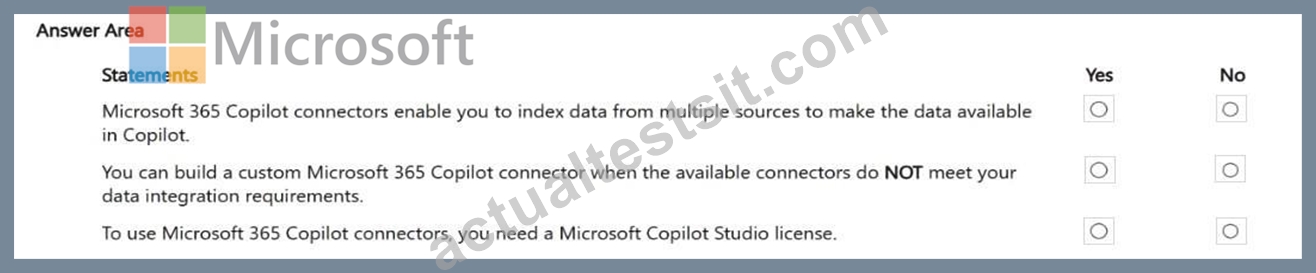
Answer:
Explanation: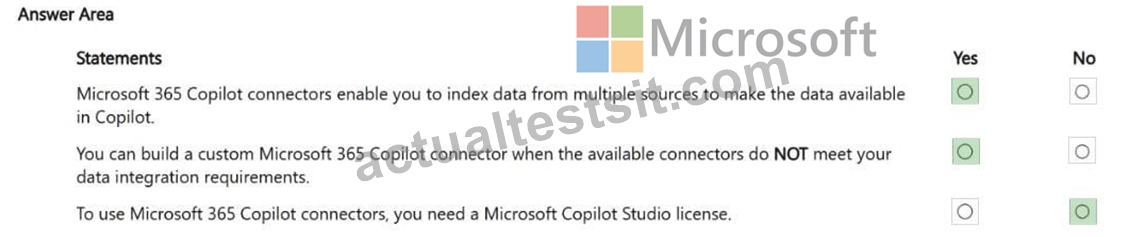
Explanation:
Box 1: Yes
Yes - Microsoft 365 Copilot enable you to index data from multiple sources to make the data available in Copilot.
Microsoft 365 Copilot enables you to index data from multiple external, non-Microsoft sources- such as Salesforce, Jira, Confluence, and enterprise databases-into the Microsoft Graph to make that data available, searchable, and actionable within Copilot. This is primarily achieved through Microsoft Graph Connectors and Copilot Studio.
Box 2: Yes
Yes - You can build custom Microsoft 365 Copilot connector when the available connectors do not meet your data integration requirements.
Building a custom Microsoft 365 Copilot connector is the recommended approach when pre-built connectors do not meet specific data integration requirements, allowing you to bring external, line-of-business data into the Microsoft Graph for Copilot to reason over.
Box 3: No
No - To use Microsoft 365 Copilot connectors, you need a Microsoft Copilot Studio license.
This is not entirely correct. While Microsoft Copilot Studio is a primary tool for managing extensions, you do not necessarily need a standalone Copilot Studio license to use Microsoft 365 Copilot connectors.
Reference:
https://learn.microsoft.com/en-us/microsoft-365-copilot/extensibility/overview-copilot-connector
https://office365itpros.com/2025/09/29/microsoft-365-copilot-connector
https://learn.microsoft.com/en-us/microsoft-365-copilot/extensibility/cost-considerations
NEW QUESTION # 30
For each of the following statements, select Yes if the statement is true. Otherwise, select No. NOTE: Each correct selection is worth one point.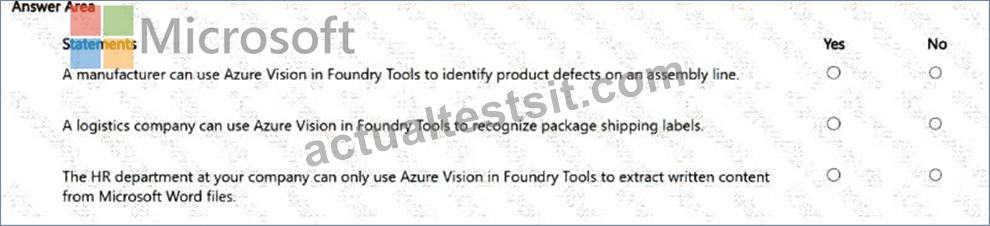
Answer:
Explanation: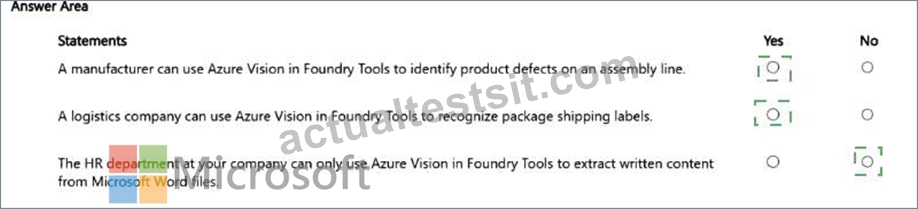
Explanation:
Answer Area
* A manufacturer can use Azure Vision in Foundry Tools to identify product defects on an assembly line.
answer: Yes
* A logistics company can use Azure Vision in Foundry Tools to recognize package shipping labels.
answer: Yes
* The HR department at your company can only use Azure Vision in Foundry Tools to extract written content from Microsoft Word files. answer: No Azure Vision in Foundry Tools provides computer vision capabilities to analyze images, including identifying visual features and reading text with OCR. Because it is designed to "analyze images" and support vision scenarios, it can be applied to manufacturing quality inspection use cases where the goal is to detect anomalies/defects from images captured on a production line. This aligns with statement 1 being Yes .
Statement 2 is also Yes because recognizing shipping labels is fundamentally text extraction from images (often plus some layout/field parsing). Azure Vision supports optical character recognition (OCR) to read printed text from images, and Microsoft documentation explicitly notes OCR can extract text from images such as product labels and similar real-world text surfaces-making shipping labels a direct fit.
Statement 3 is No because it is incorrectly restrictive. Azure Vision is not limited to extracting written content from Word documents, nor is OCR restricted to Word files. Vision capabilities apply broadly to images (and, depending on the capability, various document/image inputs) for tasks like image analysis and text recognition. HR could use it for many scenarios such as extracting text from scanned images, photos, or other visual inputs-not "only" Word files.
NEW QUESTION # 31
Your company receives thousands of scanned invoices each month.
You need to recommend an AI solution that can automatically extract key details, such as invoice numbers, vendor names, and total amounts.
What is the best solution to recommend? More than one answer choice may achieve the goal.
Select the BEST answer.
- A. Azure Machine Learning
- B. Azure AI Search
- C. Azure Vision in Foundry Tools
- D. Azure Document Intelligence in Foundry Tools
Answer: D
NEW QUESTION # 32
......
Certification dumps Agentic AI Business Solutions Architect AB-731 guides - 100% valid: https://www.actualtestsit.com/Microsoft/AB-731-exam-prep-dumps.html
100% Pass Your AB-731 AI Transformation Leader at First Attempt with ActualTestsIT: https://drive.google.com/open?id=1v2faRNuSHGrMbOTnRuQG2JVdX3PqPiHH