

SAP Certified C-ABAPD-2507 Dumps Questions Valid C-ABAPD-2507 Materials
Current C-ABAPD-2507 Exam Dumps [2026] Complete SAP Exam Smoothly
SAP C-ABAPD-2507 Exam Syllabus Topics:
| Topic | Details |
|---|---|
| Topic 1 |
|
| Topic 2 |
|
| Topic 3 |
|
| Topic 4 |
|
NEW QUESTION # 16
What is the syntax to access component carrier_name of structure connection?
- A. connection-carrier_name
- B. connection=>carrier_name
- C. connection/carrier_name
- D. connection>carrier_name
Answer: A
Explanation:
Comprehensive and Detailed Explanation From Exact Extract:
* In ABAP, structure component access uses the hyphen (-): structure-component. The other tokens are used for different purposes: -> for object reference attributes, => for static components, and / is not a field selector in ABAP.
* ABAP Cloud stresses typed APIs and static checks, ensuring misuse of component selectors is caught early; correct structure access with - is part of the enforced style.
NEW QUESTION # 17
How can you control data access of a business user? Note: There are 3 correct answers to this question.
- A. To control the "Read access" via explicit check using AUTHORITY-CHECK.
- B. To control the general access implicitly via an Access Control object (define role).
- C. To control the "Create, Update, and Delete access" via explicit check using AUTHORITY-CHECK.
- D. To control the "Read access" implicitly via an Access Control object (define role).
- E. To control the "Create, Update, and Delete access" implicitly via an Access Control object (define role).
Answer: C,D,E
NEW QUESTION # 18
You have a superclass super1 and a subclass sub1 of super1. Each class has an instance constructor and a static constructor. The first statement of your program creates an instance of sub1.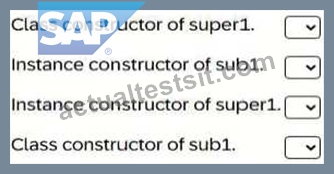
In which sequence will the constructors be executed?
- A. Instance constructor of super1.
- B. Instance constructor of sub1.
- C. Class constructor of super1.
- D. Class constructor of sub1.
Answer: A,B,C,D
NEW QUESTION # 19
Constructors have which of the following properties?
(Select 2 correct answers)
- A. The constructor can have importing parameters.
- B. The constructor must be the first method called by the client.
- C. The constructor can have returning parameters.
- D. The constructor is automatically called during instantiation.
Answer: A,D
Explanation:
Comprehensive and Detailed Explanation from Exact Extract:
* A. Automatic execution # # A constructor (CONSTRUCTOR) is automatically invoked when an instance of a class is created.
* B. Importing parameters # # Constructors can have importing parameters to initialize the object with values.
* C. First method called by client # # Not correct, because constructors are called by the system, not the client explicitly.
* D. Returning parameters # # Constructors cannot return values; they only set up the object.
This behavior is consistent across ABAP Cloud OOP classes, ensuring encapsulated initialization logic.
Verified Study Guide Reference: ABAP Objects Guide - Class Constructors and Instance Constructors.
NEW QUESTION # 20
How do you make class sub1 a subclass of class super1?
- A. In sub1 use clause "INHERITING FROM super1" in the IMPLEMENTATION part.
- B. In super1 use clause "sub1 REDEFINITION" in the IMPLEMENTATION part.
- C. In super1 use clause "sub1 REDEFINITION" in the DEFINITION part.
- D. In sub1 use clause "INHERITING FROM super1" in the DEFINITION part.
Answer: D
Explanation:
Comprehensive and Detailed Explanation From Exact Extract:
In ABAP, inheritance is declared in the class DEFINITION using the keyword INHERITING FROM. The RAP documentation shows this exact syntax in multiple class definitions, for example:
* "CLASS lcl_local_event_consumption DEFINITION INHERITING FROM
cl_abap_behavior_event_handler." This proves the inheritance clause belongs to the DEFINITION section, not the IMPLEMENTATION, and uses the form INHERITING FROM <superclass>.(Back- End Developer - ABAP Cloud study areas: RAP handler/event classes use standard ABAP OO rules; architecture shows inheritance declared in DEFINITION with INHERITING FROM.)
NEW QUESTION # 21
You want to define the following CDDS view entity with an input parameter:
* define view entity Z_CONVERT
* with parameters i_currency : ???
Which of the following can you use to replace "???"? Note: There are 2 correct answers to this question.
- A. A built-in ABAP type
- B. A built-in ABAP Dictionary type
- C. A component of an ABAP Dictionary structure
- D. A data element
Answer: B,D
NEW QUESTION # 22
Which of the following are reasons that SAP recommends developing Core Data Services view entities as opposed to classic Core Data Services DDIC-based views?
Note: There are 2 correct answers to this question.
- A. Elimination of the need for a database view
- B. Simpler and stricter syntax
- C. Automated client handling
- D. Simplified syntax check
Answer: A,B
Explanation:
Comprehensive and Detailed Explanation From Exact Extract:
SAP recommends using CDS view entities over classic CDS DDIC-based views due to the following benefits:
* Simpler and stricter syntax: CDS view entities enforce a clearer separation of concerns and reduce ambiguity, which helps ensure consistency across the stack. This makes Option C correct.
* Elimination of the need for a database view: With CDS view entities, there's no dependency on a separate DDIC SQL view object, reducing redundancy and improving activation performance. This makes Option D correct.
Incorrect options:
* Automated client handling (Option A) is supported in both CDS view entities and classic CDS views via annotations like @ClientHandling.
* Simplified syntax check (Option B) is not a distinct feature of CDS view entities. Syntax checking is part of ABAP Development Tools regardless of the CDS flavor used.
Reference: ABAP CDS Development User Guide, section 2.2 - Data Definitions and advantages of using CDS view entities over classic CDS views.
NEW QUESTION # 23
In a RAP business object, where is the validation implementation code contained?
- A. Subroutine
- B. Function
- C. Local class
- D. Global class
Answer: C
Explanation:
Comprehensive and Detailed Explanation from Exact Extract:
* In RAP, validations, determinations, and actions are implemented inside the local handler class (lhc_...) of the behavior pool.
* Global classes are not used directly for RAP BO logic, only for reusable utilities.
* Functions or subroutines are not cloud-compliant for RAP implementation.
Thus, validation code always resides in the local handler class inside the RAP behavior pool.
Study Guide Reference: RAP Development Guide - Validations in Behavior Implementation.
NEW QUESTION # 24
You have two database tables - ZDEEPARTMENTS and ZEMPLOYEES. They are linked by a foreign key relationship:
ZEMPLOYEES is the foreign key table and ZDEPARTMENTS is the check table. A department may have any number of employees (including none at all). What is the correct cardinality of the foreign key relationship?
- A. [1,1]
- B. [1,1]
- C. [0..*,1]
- D. [0..1,1]
Answer: C
NEW QUESTION # 25
Which ABAP SQL clause allows the use of inline declarations?
- A. FROM
- B. INTO
- C. INTO CORRESPONDING FIELDS OF
- D. FIELDS
Answer: B
Explanation:
The ABAP SQL clause that allows the use of inline declarations is the INTO clause. The INTO clause is used to specify the target variable or field symbol where the result of the SQL query is stored. The INTO clause can use inline declarations to declare the target variable or field symbol at the same position where it is used, without using a separate DATA or FIELD-SYMBOLS statement. The inline declaration is performed using the DATA or @DATA operators in the declaration expression12. For example:
The following code snippet uses the INTO clause with an inline declaration to declare a local variable itab and store the result of the SELECT query into it:
SELECT * FROM scarr INTO TABLE @DATA (itab).
The following code snippet uses the INTO clause with an inline declaration to declare a field symbol <fs> and store the result of the SELECT query into it:
SELECT SINGLE * FROM scarr INTO @<fs>.
You cannot do any of the following:
FROM: The FROM clause is used to specify the data source of the SQL query, such as a table, a view, or a join expression. The FROM clause does not allow the use of inline declarations12.
INTO CORRESPONDING FIELDS OF: The INTO CORRESPONDING FIELDS OF clause is used to specify the target structure or table where the result of the SQL query is stored. The INTO CORRESPONDING FIELDS OF clause does not allow the use of inline declarations. The target structure or table must be declared beforehand using a DATA or FIELD-SYMBOLS statement12.
FIELDS: The FIELDS clause is used to specify the columns or expressions that are selected from the data source of the SQL query. The FIELDS clause does not allow the use of inline declarations. The FIELDS clause must be followed by an INTO clause that specifies the target variable or field symbol where the result is stored12.
NEW QUESTION # 26
What describes multi-column internal tables?
- A. They use one incomplete data type.
- B. They must contain nested components.
- C. They use one complete data type.
- D. They are based on a structured row type.
Answer: D
NEW QUESTION # 27
Which of the following results in faster access to internal tables? Note: There are 3 correct answers to this question.
- A. In a hashed internal table, specifying the primary key completely.
- B. In a standard internal table, specifying the primary key partially from the left without gaps.
- C. In a hashed internal table, specifying the primary key partially from the left without gaps.
- D. In a sorted internal table, specifying the primary key completely.
- E. In a sorted internal table, specifying the primary key partially from the left without gaps.
Answer: A,C,D
Explanation:
The access to internal tables can be optimized by using the appropriate table type and specifying the table key. The table key is a set of fields that uniquely identifies a row in the table and determines the sorting order of the table. The table key can be either the primary key or a secondary key. The primary key is defined by the table type and the table definition, while the secondary key is defined by the user using the KEY statement1.
The following results in faster access to internal tables:
B . In a sorted internal table, specifying the primary key completely. A sorted internal table is a table type that maintains a predefined sorting order, which is defined by the primary key in the table definition. The primary key can be either unique or non-unique. A sorted internal table can be accessed using the primary key or the table index. The access using the primary key is faster than the access using the table index, because the system can use a binary search algorithm to find the row. However, the primary key must be specified completely, meaning that all the fields of the primary key must be given in the correct order and without gaps2.
D . In a hashed internal table, specifying the primary key partially from the left without gaps. A hashed internal table is a table type that does not have a predefined sorting order, but uses a hash algorithm to store and access the rows. The primary key of a hashed internal table must be unique and cannot be changed. A hashed internal table can only be accessed using the primary key, not the table index. The access using the primary key is very fast, because the system can directly calculate the position of the row using the hash algorithm. The primary key can be specified partially from the left without gaps, meaning that some of the fields of the primary key can be omitted, as long as they are the rightmost fields and there are no gaps between the specified fields.
E . In a hashed internal table, specifying the primary key completely. A hashed internal table is a table type that does not have a predefined sorting order, but uses a hash algorithm to store and access the rows. The primary key of a hashed internal table must be unique and cannot be changed. A hashed internal table can only be accessed using the primary key, not the table index. The access using the primary key is very fast, because the system can directly calculate the position of the row using the hash algorithm. The primary key can be specified completely, meaning that all the fields of the primary key must be given in the correct order.
The following do not result in faster access to internal tables, because:
A . In a sorted internal table, specifying the primary key partially from the left without gaps. A sorted internal table is a table type that maintains a predefined sorting order, which is defined by the primary key in the table definition. The primary key can be either unique or non-unique. A sorted internal table can be accessed using the primary key or the table index. The access using the primary key is faster than the access using the table index, because the system can use a binary search algorithm to find the row. However, the primary key must be specified completely, meaning that all the fields of the primary key must be given in the correct order and without gaps. If the primary key is specified partially from the left without gaps, the system cannot use the binary search algorithm and has to perform a linear search, which is slower2.
C . In a standard internal table, specifying the primary key partially from the left without gaps. A standard internal table is a table type that does not have a predefined sorting order, but uses a sequential storage and access of the rows. The primary key of a standard internal table is the standard key, which consists of all the fields of the table row in the order in which they are defined. A standard internal table can be accessed using the primary key or the table index. The access using the primary key is slower than the access using the table index, because the system has to perform a linear search to find the row. The primary key can be specified partially from the left without gaps, but this does not improve the access speed, because the system still has to perform a linear search.
NEW QUESTION # 28
Which extensibility type does SAP recommend you use to enhance the existing UI for an SAP Fiori app?
- A. Key user
- B. Side-by-side
- C. Developer
- D. Classic
Answer: C
Explanation:
According to the SAP clean core extensibility and ABAP cloud topic, SAP recommends using developer extensibility to enhance the existing UI for an SAP Fiori app. Developer extensibility allows you to use the UI adaptation editor in SAP Web IDE to modify the UI layout, add or remove fields, and bind them to the data model. You can also use the SAPUI5 framework to create custom controls, views, and controllers. Developer extensibility is based on the in-app extensibility concept, which means that the extensions are part of the same application and are deployed together with the app. Developer extensibility requires developer skills and access to the source code of the app. Reference: SAP Learning Hub, SAP S/4HANA Cloud Extensibility - In-App Extensibility, SAP Fiori: Extensibility
NEW QUESTION # 29
Which of the following are rules that extensions in SAP S/4HANA Cloud, public edition must adhere to?
(Select 3 correct answers)
- A. Use cloud-enabled and released technologies.
- B. Use tier 2 wrappers to enable access to non-released SAP APIs.
- C. Extend SAP objects through predefined extension points.
- D. Modify SAP objects in exceptional cases only.
- E. Use released remote or local SAP APIs.
Answer: A,C,E
Explanation:
Comprehensive and Detailed Explanation From Exact Extract:
* Tier 1 (cloud-ready) extensions "follow ABAP Cloud rules and hence by default can only access the public SAP interfaces (objects released for cloud development)." This directly supports using released APIs (C) and cloud-enabled/released technologies (D).
* The three-tier extensibility model separates safe cloud extensions (Tier 1) from classic code; Tier 2 wrappers exist only to mitigate missing public APIs, but they are not the recommended pattern for S
/4HANA Cloud public-edition extensions (therefore B is not a rule).
* In S/4HANA Cloud, object changes are not allowed; instead, customers must use predefined extension points (E)-for example, whitelisted extension includes, released BAdIs, or CDS extension points exposed for cloud usage-consistent with the ABAP Cloud principle of public, released artifacts only. (This is the prescribed approach in the ABAP Cloud extensibility guidance that accompanies the three-tier model.)
NEW QUESTION # 30
What RAP object contains only the fields required for a particular app?
- A. Projection view
- B. Metadata extension
- C. Database view
- D. Data model view
Answer: A
Explanation:
Comprehensive and Detailed Explanation from Exact Extract:
* In RAP, the Projection View is designed to expose only the fields relevant for a specific app, keeping the UI lean and controlled.
* Metadata extension # adds UI-related metadata, not fields.
* Database view # technical representation, not app-specific.
* Data model view # defines the data structure, not app-specific projection.
* Verified by RAP documentation: Projection views are application-specific representations of the underlying data model.
Study Guide Reference: SAP RAP Help - Business Object Projection Layer.
NEW QUESTION # 31
How can you control data access of a business user?
Note: There are 3 correct answers to this question.
- A. To control the "Read access" via explicit check using AUTHORITY-CHECK.
- B. To control the general access implicitly via an Access Control object (define role).
- C. To control the "Create, Update, and Delete access" via explicit check using AUTTHORITY-
- D. To control the "Read access" implicitly via an Access Control object (define role).
- E. To control the "Create, Update, and Delete access" implicitly via an Access Control object (define role).
Answer: A,B,C
NEW QUESTION # 32
In what order are objects created to generate a RESTful Application Programming application?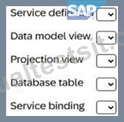
- A. Projection view
- B. Database table
- C. Data model view
- D. Service binding
- E. Service definition
Answer: A,B,C,D,E
NEW QUESTION # 33
When processing an internal table with the statement LOOP AT itab... ENDLOOP, what system variable contains the current row number?
- A. sy-linno
- B. sy-index
- C. sy-subrc
- D. sy-tabix
Answer: D
Explanation:
When processing an internal table with the statement LOOP AT itab... ENDLOOP, the system variable that contains the current row number is sy-tabix. The sy-tabix variable is a predefined field of the system structure sy that holds the index or the row number of the current line in an internal table loop. The sy-tabix variable is initialized with the value 1 for the first loop pass and is incremented by 1 for each subsequent loop pass. The sy-tabix variable can be used to access or modify the current line of the internal table using the index access12.
NEW QUESTION # 34
......
C-ABAPD-2507 Premium PDF & Test Engine Files with 80 Questions & Answers: https://www.actualtestsit.com/SAP/C-ABAPD-2507-exam-prep-dumps.html
Get 100% Real C-ABAPD-2507 Accurate & Verified Answers As Seen in the Real Exam!: https://drive.google.com/open?id=1LumOYtZdoGumWqVa2Cge-hflVb886j-P