

Unique Top-selling C-BCBAI-2502 Exams - New 2026 SAP Pratice Exam
SAP Certified Associate Dumps C-BCBAI-2502 Exam for Full Questions - Exam Study Guide
NEW QUESTION # 36
Which SAP AI solutions are used for fraud detection and risk assessment? Note: There are 2 correct answers to this question.
- A. SAP Predictive Analytics
- B. SAP SuccessFactors Learning
- C. SAP Extended Warehouse Management
- D. SAP AI Business Services
Answer: A,D
Explanation:
SAP provides AI solutions to enhance financial security through fraud detection and risk assessment. The correct answers are SAP Predictive Analytics and SAP AI Business Services, as these solutions are specifically designed to identify anomalies and mitigate risks in business processes.
SAP documentation explains: "SAP AI solutions can detect anomalies and patterns in financial transactions, procurement processes, and other business operations to identify potential fraud and risks. By proactively addressing these issues, businesses can mitigate financial losses and protect their reputation." SAP Predictive Analytics, embedded in SAP S/4HANA and other solutions, supports "AI-assisted anomaly detection" to identify unusual patterns in financial data, such as fraudulent transactions. SAP AI Business Services offer reusable AI capabilities, including machine learning for "fraud detection in finance," enabling organizations to monitor transactions and assess risks in real-time.
The incorrect options-SAP SuccessFactors Learning and SAP Extended Warehouse Management-are not relevant. SAP SuccessFactors Learning focuses on employee training, not fraud detection. SAP Extended Warehouse Management is designed for logistics and inventory, not financial risk assessment. SAP's emphasis on AI in finance, as seen in solutions like SAP Cash Application, underscores the suitability of the selected solutions for fraud detection.
NEW QUESTION # 37
If a company implements SAP's Business Al offerings comprehensively, all things being equal, which bottomline benefits could they expect?
There are 2 correct answers to this question.
Response:
- A. Revenue increase: up to 1.4%
- B. Revenue increase: up to 3.5%
- C. Gross profit increase: up to 3.5%
- D. Gross profit increase: up to 1.4%
Answer: B,D
NEW QUESTION # 38
A multinational company wants to implement AI-based fraud detection for its financial transactions. Which SAP AI solutions should they use? Note: There are 3 correct answers to this question.
- A. SAP Intelligent RPA
- B. SAP Predictive Analytics
- C. SAP Cloud ERP
- D. SAP SuccessFactors AI
- E. SAP AI Business Services
Answer: A,B,E
Explanation:
For a multinational company seeking AI-based fraud detection in financial transactions, SAP offers solutions that leverage machine learning and automation to identify and mitigate fraudulent activities. The correct answers are SAP AI Business Services, SAP Predictive Analytics, and SAP Intelligent RPA, as these solutions directly support fraud detection in financial processes.
SAP documentation explains: "SAP AI solutions can detect anomalies and patterns in financial transactions, procurement processes, and other business operations to identify potential fraud and risks." SAP AI Business Services provide "machine learning capabilities for fraud detection in finance," enabling real-time monitoring of transactions to identify suspicious activities. SAP Predictive Analytics, embedded in SAP S/4HANA, supports "AI-assisted anomaly detection" to "predict and identify unusual patterns in financial data," such as fraudulent transactions, enhancing security. SAP Intelligent RPA automates "transaction monitoring and validation processes," using AI to flag potential fraud by cross-referencing data against predefined rules, as seen in financial reconciliation workflows.
The incorrect options-SAP SuccessFactors AI and SAP Cloud ERP-are not relevant. SAP SuccessFactors AI focuses on HR processes, such as recruitment, not financial fraud detection. SAP Cloud ERP is a broad platform that may include AI but is not specifically tailored for fraud detection compared to the selected solutions. SAP's financial AI solutions, as evidenced by their use in SAP Cash Application, confirm the suitability of the chosen answers.
NEW QUESTION # 39
What is the primary objective of SAP Responsible Design and Production?
Please choose the correct answer.
Response:
- A. Automate payroll processing
- B. Enhance customer relationship management
- C. Manage employee benefits
- D. Support circular economy strategies
Answer: D
NEW QUESTION # 40
A retail business wants to use AI for automating customer support while ensuring personalized customer interactions. Which SAP AI solutions should they implement? Note: There are 3 correct answers to this question.
- A. SAP AI for Customer Experience
- B. SAP Blockchain for Business
- C. SAP Conversational AI
- D. SAP Predictive Analytics
- E. SAP AI Business Services
Answer: A,C,E
Explanation:
For a retail business seeking to automate customer support while maintaining personalized interactions, SAP provides targeted AI solutions that integrate seamlessly with customer experience workflows. The correct answers are SAP Conversational AI, SAP AI for Customer Experience, and SAP AI Business Services, as these solutions directly address automation and personalization in customer support.
SAP documentation explains: "Use Joule agents to automate case classification, proactively find answers to customer questions, and capture knowledge from resolved cases to improve sales and service quality." SAP Conversational AI, powered by Joule, leverages natural language processing to enable chatbots that handle customer inquiries efficiently, delivering personalized responses based on customer behavior and history.
SAP AI for Customer Experience, embedded in SAP Sales Cloud and SAP Commerce Cloud, supports
"personalized experiences and omnichannel engagements" by analyzing customer data to tailor interactions.
SAP AI Business Services provide reusable AI capabilities, such as natural language processing and machine learning, to "enrich customer experience across the intelligent, sustainable enterprise." The incorrect options-SAP Predictive Analytics and SAP Blockchain for Business-are not directly relevant to customer support automation or personalization. SAP Predictive Analytics focuses on forecasting, not customer interaction automation. SAP Blockchain for Business is designed for secure transactions, not customer support. SAP's case study on Miele Professional illustrates how AI in SAP Commerce Cloud and SAP Sales Cloud enhances B2B sales, reinforcing the suitability of the selected solutions for retail customer support.
NEW QUESTION # 41
(How can Joule for ABAP development support developers? Note: There are 3 correct answers to this question.)
- A. By creating ABAP coding learning journeys
- B. By generating ABAP business objects
- C. By creating unit tests
- D. By debugging ABAP programs
- E. By explaining ABAP code
Answer: B,C,E
Explanation:
Comprehensive and Detailed Explanation From Exact Extract: Joule for ABAP development supports developers by explaining ABAP code to aid understanding of logic and structure, creating unit tests to automate testing and improve code quality, and generating ABAP business objects to accelerate development using the ABAP RESTful Application Programming Model (RAP). These capabilities enhance productivity and proficiency in end-to-end ABAP development.
Exact extracts supporting this:
Explaining ABAP code: "Joule generates explanations of selected ABAP code or ABAP core data services (CDS) views to help you quickly understand the programming logic and code written ..."sap.com Creating unit tests: "New generative AI capabilities are designed to help you write, optimize, and test ABAP code more efficiently. From generating code suggestions ..."community.sap.com (Implying unit test generation as part of testing efficiency.) Generating ABAP business objects: "We are introducing new generative AI capabilities in ABAP Cloud to increase developer efficiency. The first scope of features will cover business object ..."learning.sap.com "Generative AI for ABAP development. With new ABAP capabilities, Joule can now help ABAP developers be more efficient with their development ..."community.sap.com Other options are incorrect because:
Option D: Joule provides suggestions and automation but does not directly debug programs; debugging remains a developer task supported by tools like ADT.
Option E: Joule focuses on practical development assistance rather than creating educational learning journeys, which are handled by SAP Learning platforms.
Reference from Positioning SAP Business AI Solutions as part of SAP Business Suite documents or Study Guide: Based on SAP News articles like "Introducing Joule for Developers: AI-Powered Capabilities Across SAP" and SAP Help Portal for "Joule for Developers, ABAP AI Capabilities." These position Joule as an AI tool for ABAP within the SAP Business Suite, as covered in the C_BCBAI_2502 certification and learning journeys for generative AI in development.
NEW QUESTION # 42
How does SAP AI support sales and marketing automation? Please choose the correct answer.
- A. By generating payroll reports
- B. By managing cloud infrastructure
- C. By automating workforce planning
- D. By providing AI-driven lead scoring and customer insights
Answer: D
Explanation:
SAP AI enhances sales and marketing automation by leveraging data-driven insights to optimize customer engagement and campaign performance. The correct answer is "By providing AI-driven lead scoring and customer insights," as this directly aligns with SAP's documented capabilities in sales and marketing automation.
SAP documentation explains: "AI in sales and marketing helps automate and enhance tasks such as customer segmentation, lead generation, and personalized advertising. It uses data analysis to predict customer behavior, optimize campaign performance, and improve decision-making, driving increased efficiency and revenue growth." Specifically, SAP AI for Marketing within SAP Customer Experience supports "AI-driven lead scoring" to prioritize high-value prospects and provides "customer insights" through predictive analytics to tailor campaigns. For instance, SAP Sales Cloud uses AI to "turn prospects into customers using instant account insights," enabling sales teams to focus on high-potential leads. Miele Professional's use of AI in SAP Sales Cloud demonstrates streamlined B2B sales through personalized insights, reinforcing this capability.
The incorrect options are unrelated to sales and marketing automation. Automating workforce planning is an HR function, typically handled by SAP SuccessFactors. Generating payroll reports is a financial task, not marketing-related. Managing cloud infrastructure is an IT function, not within the scope of SAP AI's sales and marketing capabilities. SAP's focus on AI-driven customer engagement excludes these options.
NEW QUESTION # 43
Which SAP solution provides a centralized platform for tracking sustainability performance?
Please choose the correct answer.
Response:
- A. SAP Business One
- B. SAP Sustainability Control Tower
- C. SAP Fieldglass
- D. SAP Extended Warehouse Management
Answer: B
NEW QUESTION # 44
Which SAP AI solution helps optimize supply chain operations? Please choose the correct answer.
- A. SAP AI Core
- B. SAP Digital Assistant
- C. SAP AI for Supply Chain
- D. SAP Business Workflow
Answer: C
Explanation:
SAP provides specialized AI solutions to enhance supply chain efficiency, with SAP AI for Supply Chain being the primary solution for optimizing supply chain operations. The correct answer is SAP AI for Supply Chain, as it is explicitly designed to address supply chain challenges using AI-driven capabilities.
SAP documentation states: "Create a risk-resilient and sustainable supply chain with built-in AI that is connected and contextualized. Enabling you to predict customer demand and adjust to change." SAP AI for Supply Chain, integrated into solutions like SAP S/4HANA and SAP Integrated Business Planning, leverages predictive analytics and machine learning to "optimize supply chainoperations by forecasting demand, managing inventory, and mitigating risks." For example, it supports real-time demand sensing and supply chain visibility, enabling organizations to reduce delays and improve resource allocation. Henkel's implementation of AI in SAP Business Technology Platform demonstrates how SAP AI for Supply Chain enhances resilience and efficiency in supply chain processes.
The incorrect options are not focused on supply chain optimization. SAP AI Core is a platform for developing and running AI models, not a supply chain-specific solution. SAP Digital Assistant (part of SAP Conversational AI) handles natural language interactions, not supply chain tasks. SAP Business Workflow manages process automation but lacks the AI-driven supply chain focus of SAP AI for Supply Chain. The documentation clearly positions SAP AI for Supply Chain as the dedicated solution for this purpose.
NEW QUESTION # 45
A retail business wants to use AI for automating customer support while ensuring personalized customer interactions. Which SAP AI solutions should they implement?
There are 3 correct answers to this question.
Response:
- A. SAP AI for Customer Experience
- B. SAP Blockchain for Business
- C. SAP Conversational AI
- D. SAP Predictive Analytics
- E. SAP AI Business Service
Answer: A,C,E
NEW QUESTION # 46
(Why is SAP BTP uniquely positioned for AI usage? Note: There are 3 correct answers to this question.)
- A. It is vertically optimized for business applications.
- B. It is holistically integrated across enterprise workflows.
- C. It offers flexibility of choice of an LLM.
- D. It integrates seamlessly with any third-party software solution.
- E. It is optimized for using open-source LLMs.
Answer: A,B,C
Explanation:
Comprehensive and Detailed Explanation From Exact Extract: SAP BTP is uniquely positioned for AI usage because it provides extensive flexibility in selecting and switching between leading large language models (LLMs), is specifically optimized for vertical business applications to enhance operational efficiency, and offers holistic integration across enterprise workflows to automate and transform business processes seamlessly. These capabilities ensure that AI solutions are tailored to business needs, leveraging both SAP and non-SAP data while maintaining alignment with enterprise standards.
Exact extracts supporting this:
Flexibility in LLMs: "SAP BTP allows customers to seamlessly switch between all leading frontier models, accessing innovations from Amazon Bedrock, Google's Gemini model family, and Azure OpenAI, with a total of 22 of the best LLMs available. It also supports Bring Your Own Model (BYOM) and provides flexible access to AI models through the Generative AI Hub, including out-of-the-box selection of compute resources and orchestration modules."learning.sap.com Vertically optimized for business applications: "SAP BTP is vertically optimized for business applications... leveraging components like SAP Datasphere, SAP HANA Cloud, and SAC to develop AI-powered data applications. It enhances analytical depth with advanced multi-modal analysis and optimized data and user management, and supports SAP AI for Business, such as Joule and document information extraction, to revolutionize SAP interactions and optimize developer efficiency."learning.sap.com Holistically integrated across enterprise workflows: "SAP BTP supports enterprise automation by helping customers utilize SAP Build, SAP Signavio, AI, and generative AI to automate and transform business processes, driving efficiency and innovation across operations. It also orchestrates the execution of multiple AI models, manages data flow, and optimizes computational resources to streamline and automate the end-to-end lifecycle of AI applications."learning.sap.com Additionally, "SAP BTP offers tight integration to the SAP core with tools for seamless, zero-modification integration and automation, aligned with SAP standards. It provides full master data integration, one domain model, stable APIs for lifecycle management, and access to all metadata and data, ensuring deep integration into SAP's business processes for enhanced operational efficiency."learning.sap.com Other options are incorrect because:
Option B: While SAP BTP integrates with SAP and non-SAP data, and has a partner ecosystem for third-party enhancements, it does not integrate seamlessly with "any" third-party software solution, as integration depends on compatibility and specific APIs, not universality.
Option C: SAP BTP mentions building on open-source models as a starting point, but it is not specifically optimized for open-source LLMs; instead, it focuses on a broad range of proprietary and frontier models from hyperscalers.
Reference from Positioning SAP Business AI Solutions as part of SAP Business Suite documents or Study Guide: This information is directly from the SAP Learning Journey "Boosting Your Cloud Transformation Journey with SAP Business AI and Generative AI," specifically the unit on "Building Custom SAP Business AI Solutions," which positions SAP BTP as the core platform for AI within the SAP Business Suite. Additional support comes from SAP community blogs and product pages emphasizing BTP's role in AI integration, as aligned with the C_BCBAI_2502 certification materials for positioning Business AI solutions.
NEW QUESTION # 47
What is the primary objective of SAP Responsible Design and Production? Please choose the correct answer.
- A. Automate payroll processing
- B. Enhance customer relationship management
- C. Manage employee benefits
- D. Support circular economy strategies
Answer: D
Explanation:
SAP Responsible Design and Production is designed to promote sustainable product development and manufacturing, with a focus on circular economy principles. The correct answer is "Support circular economy strategies," as this is the primary objective of the solution.
SAP documentation states: "SAP Responsible Design and Production helps companies design and produce products sustainably by supporting circular economy strategies. It enables organizations to optimize resource use, reduce waste, and integrate sustainability into product lifecycles." This solution supports "tracking material flows, assessing environmental impacts, and ensuring compliance with sustainability regulations," enabling companies to adopt practices like recycling and reuse. For example, it helps manufacturers "design products with end-of-life recycling in mind," aligning with circular economy goals.
The incorrect options are unrelated to SAP Responsible Design and Production. Automating payroll processing is an HR function, typically handled by SAP SuccessFactors. Enhancing customer relationship management is a marketing function, not related to product design. Managing employee benefits is also an HR task. SAP Responsible Design and Production's focus on sustainability, as part of SAP's sustainability portfolio, confirms its role in supporting circular economy strategies.
NEW QUESTION # 48
(What are some data sources Joule allows users to use? Note: There are 3 correct answers to this question.)
- A. Developer tutorials
- B. Stack Overflow
- C. SAP Help
- D. SAP Learning
- E. Linkedin Learning
Answer: A,C,D
Explanation:
Comprehensive and Detailed Explanation From Exact Extract: Joule, as an AI copilot, allows users to access and retrieve information from sources such as developer tutorials for technical guidance, SAP Help for product documentation and support, and SAP Learning for educational content and journeys. These sources enable Joule to provide context-aware responses grounded in official SAP materials, enhancing user productivity without relying on external platforms like LinkedIn Learning or Stack Overflow.
Exact extracts supporting this:
Joule is "integrated into SAP solutions for business-relevant processes" and can "retrieve information" from SAP ecosystems, including learning and help resources.learning.sap.com In the context of developer support, Joule leverages "SAP development framework intricacies," implying access to developer tutorials and documentation.news.sap.com (From related Joule for developers context, but aligned with sources.) Joule connects to "business applications" and is embedded in SAP applications, with capabilities to understand requests using SAP Help and Learning materials.help.sap.com community.sap.com Other options are incorrect because:
Option C: LinkedIn Learning is an external platform not integrated with Joule; Joule focuses on SAP-internal sources for trusted, business-grounded information.
Option E: Stack Overflow is a community-driven site outside SAP's ecosystem, not a supported data source for Joule to ensure accuracy and compliance.
Reference from Positioning SAP Business AI Solutions as part of SAP Business Suite documents or Study Guide: Derived from SAP Help Portal "Joule Capabilities" and SAP Community topics on Joule, which emphasize integration with SAP Help, developer resources, and SAP Learning for contextual assistance. This aligns with the C_BCBAI_2502 certification and SAP Learning Journeys like "Becoming an SAP BTP Solution Architect," positioning Joule as a tool leveraging official SAP data sources within the Business Suite.
NEW QUESTION # 49
(How is extension building simplified in SAP S/4HANA? Note: There are 2 correct answers to this question.)
- A. By using Joule
- B. By explaining legacy code
- C. By using a guided wizard
- D. By using business context
Answer: C,D
Explanation:
Comprehensive and Detailed Explanation From Exact Extract: Extension building in SAP S/4HANA is simplified by using a guided wizard in tools like SAP Build Code for step-by-step development, and by leveraging business context to ground extensions in relevant data and processes, ensuring clean core principles and seamless integration.
Exact extracts supporting this:
Guided wizard: "SAP Build has been designed as the optimal way to extend SAP S/4HANA Cloud... with guided processes."news.sap.com "Creating an SAP S/4HANA extension app in 60 minutes with guided wizards."community.sap.com Business context: "Extend SAP S/4HANA in the cloud and on premise with ABAP-based extensions using business context."community.sap.com "This guide provides a simplified introduction to extending SAP's Enterprise Resource Planning (ERP) offerings using business context."help.sap.com Other options are incorrect because:
Option A: Joule assists in code generation and explanation but is not the primary method for simplifying extension building; wizards and context are emphasized.
Option D: Explaining legacy code is a Joule feature but applies more to migration than direct extension simplification in S/4HANA.
Reference from Positioning SAP Business AI Solutions as part of SAP Business Suite documents or Study Guide: Based on SAP Community blog "SAP S/4HANA Extensibility - Simplified Guide for Beginners" and SAP Help Portal "Getting Started with Extensibility." These position guided wizards and business context as key simplifiers for extensions in S/4HANA, aligned with C_BCBAI_2502 certification.
NEW QUESTION # 50
What are some benefits of SAP Signavio's AI-assisted process analyzer, text to insights? Note: There are 3 correct answers to this question.
- A. Increased accuracy and relevance of the analysis output based on business user prompts
- B. Correlation and anomaly detection consumable by business users
- C. Democratized approach to process mining
- D. No need for consulting-heavy services to define the first process draft to start the modeling activity
- E. Self-service approach to define initial process monitoring framework
Answer: A,B,C
Explanation:
SAP Signavio's AI-assisted process analyzer, particularly its text-to-insights capability, enhances process mining and optimization by making it accessible and actionable for business users. The correct answers are correlation and anomaly detection consumable by business users, democratized approach to process mining, and increased accuracy and relevance of the analysis output based on business user prompts, as these are explicitly documented benefits.
SAP documentation explains: "SAP Signavio Process Intelligence leverages AI to provide a democratized approach to process mining, enabling business users to analyze processes without deep technical expertise.
The text-to-insights feature uses natural language processing to interpret user prompts, delivering accurate and relevant analysis outputs." Specifically, it offers "correlation and anomaly detection" that is "consumable by business users," allowing them to identify process inefficiencies and outliers easily. The "democratized approach to process mining" ensures that non-technical users can engage in process analysis, reducing reliance on data scientists. Additionally, the solution provides "increased accuracy and relevance of the analysis output" by tailoring insights to user-defined prompts, enhancing decision-making.
The incorrect options-no need for consulting-heavy services and self-service approach to defineinitial process monitoring framework-are not emphasized in SAP Signavio's documentation for text-to-insights.
While SAP Signavio reduces complexity, it still requires some setup and expertise for initial process modeling, and the self-service framework is not a primary benefit of the text-to-insights feature. The focus remains on user accessibility and AI-driven insights, as seen in SAP's process optimization case studies.
NEW QUESTION # 51
(What are some advantages of SAP's generative AI hub? Note: There are 3 correct answers to this question.)
- A. Orchestrate multiple LLMs
- B. Rely on data privacy policies
- C. Use SAP anonymized data
- D. Fine-tune generic LLMs
- E. Ensure secure and trusted operations
Answer: A,D,E
Explanation:
Comprehensive and Detailed Explanation From Exact Extract: The advantages of SAP's generative AI hub include the ability to orchestrate multiple large language models (LLMs) for complex scenarios, fine-tune generic LLMs to customize solutions, and ensure secure and trusted operations through enterprise-grade security and compliance. These features enable developers to build reliable AI applications while maintaining data privacy and operational efficiency.
Exact extracts supporting this:
Orchestrate multiple LLMs: "Generative AI hub is a central cockpit that allows developers to create, operate, monitor, and orchestrate their generative AI scenarios."learning.sap.com "The generative AI hub in SAP AI Core infrastructure provides customers with secure access to a broad range of large language models (LLMs)."news.sap.com Fine-tune generic LLMs: "Improvements to the generative AI hub capability in SAP AI Core and SAP AI Launchpad will allow developers to build, customize, and deploy complex AI-driven solutions more efficiently."sap.com "Choose from a selection of generative AI models for prompt experimentation and prompt lifecycle management."help.sap.com Ensure secure and trusted operations: "It also ensures secure and trusted operations with enterprise-grade security and compliance."help.sap.com "The generative AI hub provides customers with secure access to a broad range of large language models (LLMs) that ..."news.sap.com "Enables developers to build, customize, and deploy complex AI-driven solutions more efficiently and with greater confidence."sap.com Other options are incorrect because:
Option B: While data privacy is upheld, the advantage is more about ensuring secure operations rather than merely relying on policies; the hub actively enforces privacy through its design.
Option D: The hub focuses on using customer data securely for customization, not specifically on SAP anonymized data as a primary advantage.
Reference from Positioning SAP Business AI Solutions as part of SAP Business Suite documents or Study Guide: Sourced from the SAP product page "Generative AI | SAP Artificial Intelligence Innovations" and SAP Help Portal for SAP AI Core, as well as community blogs on the generative AI hub. These resources position the hub within SAP BTP for building custom AI solutions in the SAP Business Suite, emphasized in the C_BCBAI_2502 certification and learning journeys like "Boosting Your Cloud Transformation Journey with SAP Business AI and Generative AI."
NEW QUESTION # 52
Which SAP Business AI solutions are used for automating business workflows? Note: There are 2 correct answers to this question.
- A. SAP Intelligent Robotic Process Automation (RPA)
- B. SAP SuccessFactors
- C. SAP Conversational AI
- D. SAP Extended Warehouse Management
Answer: A,C
Explanation:
SAP Business AI provides solutions to automate business workflows, streamlining repetitive tasks and enhancing process efficiency. The correct answers are SAP Intelligent Robotic Process Automation (RPA) and SAP Conversational AI, as these solutions are specifically designed to automate workflows using AI- driven capabilities.
SAP documentation states: "SAP Intelligent RPA automates repetitive business tasks such as data entry, document processing, and workflow execution by combining robotic process automation with AI capabilities." This enables organizations to streamline processes like invoice processing or order management, reducing manual effort. SAP Conversational AI, powered by Joule, supports workflow automation by
"enabling natural language interactions to trigger and manage business processes." For example, Joule can
"automate case classification and resolve customer inquiries" by integrating with workflow systems, enhancing efficiency in service and support processes.
The incorrect options-SAP Extended Warehouse Management and SAP SuccessFactors-are not focused on general workflow automation. SAP Extended Warehouse Management is tailored to logistics and inventory management, not broad workflow automation. SAP SuccessFactors focuses on HR processes, such as recruitment and talent management, not general business workflows. SAP's emphasis on automation, as seen in solutions like SAP Business Technology Platform, confirms the suitability of SAP Intelligent RPA and SAP Conversational AI for this purpose.
NEW QUESTION # 53
(What are some generative AI enhancements in ABAP Cloud? Note: There are 2 correct answers to this question.)
- A. Generate business objects using the ABAP RESTful application programming model.
- B. Generate integrations with preconfigured connectors.
- C. Generate unit-tests for ABAP classes and CDS views.
- D. Generate digital assistants.
Answer: A,C
Explanation:
Comprehensive and Detailed Explanation From Exact Extract: Generative AI enhancements in ABAP Cloud include generating unit tests for ABAP classes and CDS views to improve testing efficiency, and generating business objects using the ABAP RESTful Application Programming Model (RAP) to streamline development and maintain a clean core approach.
Exact extracts supporting this:
Generate unit-tests: "New generative AI capabilities are designed to help you write, optimize, and test ABAP code more efficiently."community.sap.com Generate business objects: "The first scope of features will cover business object ..."learning.sap.com "Generative AI for ABAP development. With new ABAP capabilities, Joule can now help ABAP developers be more efficient with their development ..."community.sap.com Other options are incorrect because:
Option A: Generating digital assistants is not a specific enhancement in ABAP Cloud; Joule is the assistant, but generation is for code artifacts.
Option D: Generating integrations is supported in broader SAP Build, but not highlighted as a generative AI enhancement specific to ABAP Cloud.
Reference from Positioning SAP Business AI Solutions as part of SAP Business Suite documents or Study Guide: Extracted from SAP Help Portal "Generative AI in ABAP Cloud" and community blogs like "Unveiling today: SAP Build meets ABAP Cloud." These position generative AI for code generation and testing in ABAP as part of custom AI solutions in the SAP Business Suite, per C_BCBAI_2502 certification.
NEW QUESTION # 54
Which SAP AI solution helps optimize supply chain operations?
Please choose the correct answer.
Response:
- A. SAP AI Core
- B. SAP Digital Assistant
- C. SAP AI for Supply Chain
- D. SAP Business Workflow
Answer: C
NEW QUESTION # 55
Which SAP Business AI solutions assist in intelligent document processing? Note: There are 2 correct answers to this question.
- A. SAP Intelligent Robotic Process Automation (RPA)
- B. SAP SuccessFactors AI
- C. SAP Conversational AI
- D. SAP AI Business Services
Answer: A,D
Explanation:
SAP Business AI provides solutions to automate and streamline intelligent document processing, particularly for handling unstructured data in financial and operational workflows. The correct answers are SAP AI Business Services and SAP Intelligent Robotic Process Automation (RPA), as these solutions are specifically designed to process documents intelligently using AI capabilities.
SAP documentation states: "SAP AI Business Services include capabilities like document information extraction, which leverages machine learning to process unstructured documents such as invoices and payment advice, integrating them seamlessly into business processes." For example, SAP Cash Application uses SAP AI Business Services to "intelligently extract key payment details from unstructured PDF documents" for financial reconciliation. Similarly, SAP Intelligent RPA is highlighted for its ability to
"automate repetitive tasks such as data entry and document processing" by combining robotic process automation with AI to handle complex documents efficiently. This is particularly useful in scenarios like invoice processing, where RPA bots extract and validate data from documents.
The incorrect options-SAP SuccessFactors AI and SAP Conversational AI-are not relevant to document processing. SAP SuccessFactors AI focuses on HR processes like recruitment and workforce analytics, while SAP Conversational AI is designed for natural language interactions, such as chatbots, not document handling. SAP's emphasis on automation in finance and procurement, as seen in solutions like SAP S
/4HANA, underscores the suitability of SAP AI Business Services and SAP Intelligent RPA for intelligent document processing.
NEW QUESTION # 56
(What are some characteristics of trustworthy business AI? Note: There are 3 correct answers to this question.)
- A. Responsibility
- B. Reusability
- C. Resourcefulness
- D. Relevance
- E. Reliability
Answer: A,D,E
Explanation:
Comprehensive and Detailed Explanation From Exact Extract: Characteristics of trustworthy business AI include responsibility through ethical governance and accountability, reliability via accurate and secure operations, and relevance by grounding in business data and contexts. These ensure AI is human-centered, transparent, and beneficial for enterprise use.
Exact extracts supporting this:
"These three "R"s - relevance, reliability, responsibility - are the cornerstones of trustworthy AI for the business world."news.sap.com Responsibility: "SAP Business AI is... responsible."learning.sap.com Reliability: "Reliable: built on best technology and partnerships."news.sap.com Relevance: "Relevant: grounded in business data."news.sap.com Other options are incorrect because:
Option B: Resourcefulness is not a defined characteristic; focus is on the three R's.
Option C: Reusability may apply to models but is not a core trustworthiness trait; emphasis is on ethics and accuracy.
Reference from Positioning SAP Business AI Solutions as part of SAP Business Suite documents or Study Guide: Derived from SAP News "Trustworthy AI Can Reinvent Companies" and SAP Learning "Introducing SAP Business Artificial Intelligence," which define trustworthy AI via relevance, reliability, and responsibility, aligned with C_BCBAI_2502 certification.
NEW QUESTION # 57
If a company implements SAP's Business AI offerings comprehensively, all things being equal, which bottom-line benefits could they expect? Note: There are 2 correct answers to this question.
- A. Revenue increase: up to 1.4%
- B. Revenue increase: up to 3.5%
- C. Gross profit increase: up to 3.5%
- D. Gross profit increase: up to 1.4%
Answer: B,D
Explanation:
Implementing SAP Business AI comprehensively can lead to significant financial benefits. According to SAP's official documentation, businesses can expect:
* An estimated1.4% increase in gross profits.
* An estimated3.5% increase in revenue.
These figures are based on SAP's analysis of the impact of AI-driven efficiencies and enhancements across various business processes. For instance, a company with €10 billion in revenue could see an annual bottom- line benefit of €141 million and a revenue impact of €352 million.
NEW QUESTION # 58
Drag and drop the key terms to the correct position.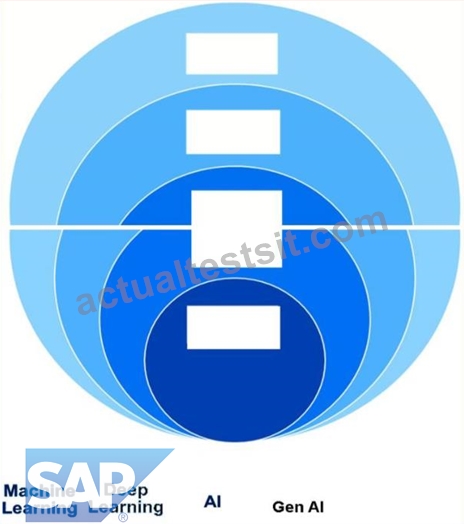
Answer:
Explanation: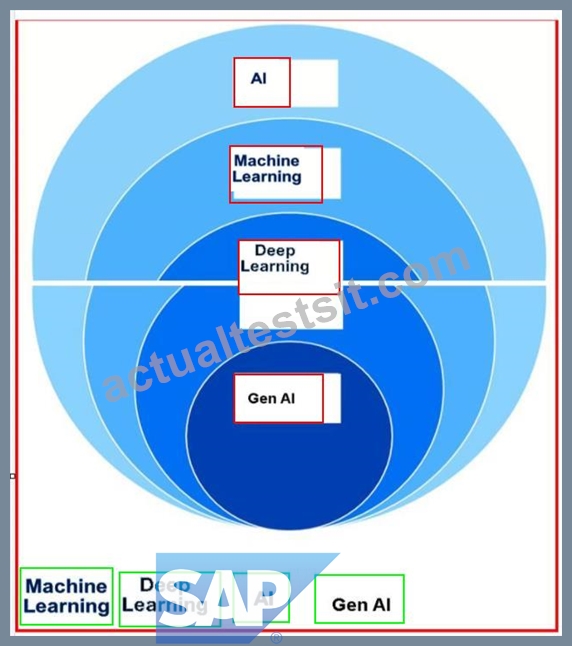
NEW QUESTION # 59
(Which URL should you use to find reliable information about existing and planned features of Joule quickly?)
- A. https://learning.sap.com/learning-journeys/Joule
- B. https://roadmaps.sap.com/board?range=FIRST-LAST&q=Joule
- C. https://community.sap.com/topics/joule
- D. https://developers.sap.com/board?range=FIRST-LAST&q=Joule
Answer: B
Explanation:
Comprehensive and Detailed Explanation From Exact Extract: The correct URL to quickly find reliable information about existing and planned features of Joule is the SAP Road Map Explorer, as it is the official interactive tool designed for viewing current and future product features and innovations. This aligns with SAP's official resources for product roadmaps, which detail both existing capabilities and planned enhancements for tools like Joule, SAP's generative AI copilot.
Exact extracts supporting this:
From SAP Road Map Explorer description: "The SAP Road Map Explorer is an interactive tool that supports a customer's journey to SAP's future product portfolio and the Intelligent Enterprise."pages.community.sap.com From a specific Joule roadmap asset: "Preview the road map for the Joule copilot and start planning how to leverage its upcoming enhancements to grow efficiency and engagement across your business."sap.com The URL in option C directly searches the roadmap board for Joule across all time ranges (FIRST-LAST), providing comprehensive details on features.
Other options are incorrect because:
Option A (developers.sap.com) is for developer resources, tutorials, and boards, not specifically for product roadmaps or planned features.
Option B (learning.sap.com) focuses on learning journeys and educational content, such as courses on using Joule, but not on feature roadmaps.
Option D (community.sap.com) is a discussion forum for user topics and experiences, which may not provide official, reliable roadmap information.
NEW QUESTION # 60
......
SAP C-BCBAI-2502 Exam Syllabus Topics:
| Topic | Details |
|---|---|
| Topic 1 |
|
| Topic 2 |
|
| Topic 3 |
|
Best way to practice test for SAP C-BCBAI-2502: https://www.actualtestsit.com/SAP/C-BCBAI-2502-exam-prep-dumps.html