

[Jan-2023] Free Professional-Data-Engineer Exam Dumps to Improve Exam Score
2023 Realistic Professional-Data-Engineer Dumps Exam Tips Test Pdf Exam Material
Requirements
The certification does not have any official prerequisites. However, it is advised to have at least three years of industry experience with one or more years of expertise in designing and managing different solutions with the use of Google Cloud Platform. It is also required to review the topics of the qualifying exam before sitting for it.
Operationalizing Machine Learning Models
Here the candidates need to demonstrate their expertise in using pre-built Machine Learning models as a service, including Machine Learning APIs (for instance, Speech API, Vision API, etc.), customizing Machine Learning APIs (for instance, Auto ML text, AutoML Vision, etc.), conversational experiences (for instance, Dialogflow). The applicants should also have the skills in deploying the Machine Learning pipeline. This involves the ability to ingest relevant data, perform retraining of machine learning models (BigQuery ML, Cloud Machine Learning Engine, Spark ML, Kubeflow), as well as execute continuous evaluation. Additionally, the students should be able to choose the relevant training & serving infrastructure as well as know how to fulfill measuring, monitoring, and troubleshooting of Machine Learning models.
Preparation Process
To perform well in the Google Professional Data Engineer certification exam, the candidates must be ready to devote ample time to preparation. There is a host of study materials available on the Internet, but if you want to be confident in the authenticity of the resources that you use, it is best to refer to the official platform. Google recommends that the applicants follow the Professional Data Engineer learning path, which is a comprehensive option involving in-person classes, online training, hands-on labs, and other resources from Google Cloud.
Besides that, it is recommended that the students use the official sample questions to familiarize themselves with the question formats that they will encounter during the actual exam. The official webpage also contains additional resources such as Google Cloud documentation and Google Cloud solutions. There is also an option of joining the subject-related webinar to get valuable preparation tips from the Google experts.
NEW QUESTION 113
Cloud Bigtable is a recommended option for storing very large amounts of
____________________________?
- A. single-keyed data with very high latency
- B. multi-keyed data with very low latency
- C. single-keyed data with very low latency
- D. multi-keyed data with very high latency
Answer: C
Explanation:
Explanation
Cloud Bigtable is a sparsely populated table that can scale to billions of rows and thousands of columns, allowing you to store terabytes or even petabytes of data. A single value in each row is indexed; this value is known as the row key. Cloud Bigtable is ideal for storing very large amounts of single-keyed data with very low latency. It supports high read and write throughput at low latency, and it is an ideal data source for MapReduce operations.
Reference: https://cloud.google.com/bigtable/docs/overview
NEW QUESTION 114
You are building a data pipeline on Google Cloud. You need to prepare data using a casual method for a machine-learning process. You want to support a logistic regression model. You also need to monitor and adjust for null values, which must remain real-valued and cannot be removed. What should you do?
- A. Use Cloud Dataflow to find null values in sample source data. Convert all nulls to using a custom script.
- B. Use Cloud Dataflow to find null values in sample source data. Convert all nulls to 'none' using a Cloud Dataprep job.
- C. Use Cloud Dataprep to find null values in sample source data. Convert all nulls to 0 using a Cloud Dataprep job.
- D. Use Cloud Dataprep to find null values in sample source data. Convert all nulls to 'none' using a Cloud Dataproc job.
Answer: B
NEW QUESTION 115
Your company is loading comma-separated values (CSV) files into Google BigQuery. The data is fully imported successfully; however, the imported data is not matching byte-to-byte to the source file. What is the most likely cause of this problem?
- A. The CSV data loaded in BigQuery is not using BigQuery's default encoding.
- B. The CSV data loaded in BigQuery is not flagged as CSV.
- C. The CSV data has not gone through an ETL phase before loading into BigQuery.
- D. The CSV data has invalid rows that were skipped on import.
Answer: A
NEW QUESTION 116
When creating a new Cloud Dataproc cluster with the projects.regions.clusters.create operation, these four values are required: project, region, name, and ____.
- A. label
- B. type
- C. node
- D. zone
Answer: D
Explanation:
Explanation
At a minimum, you must specify four values when creating a new cluster with the projects.regions.clusters.create operation:
The project in which the cluster will be created
The region to use
The name of the cluster
The zone in which the cluster will be created
You can specify many more details beyond these minimum requirements. For example, you can also specify the number of workers, whether preemptible compute should be used, and the network settings.
Reference:
https://cloud.google.com/dataproc/docs/tutorials/python-library-example#create_a_new_cloud_dataproc_cluste
NEW QUESTION 117
You are deploying a new storage system for your mobile application, which is a media streaming service.
You decide the best fit is Google Cloud Datastore. You have entities with multiple properties, some of which can take on multiple values. For example, in the entity `Movie' the property `actors' and the property
`tags' have multiple values but the property `date released' does not. A typical query would ask for all movies with actor=<actorname> ordered by date_released or all movies with tag=Comedy ordered by date_released. How should you avoid a combinatorial explosion in the number of indexes?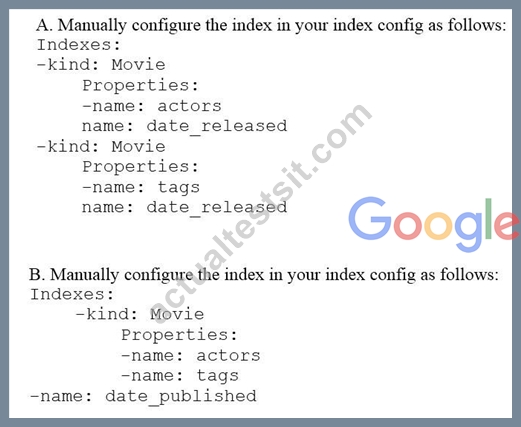

- A. Option B.
- B. Option D
- C. Option C
- D. Option A
Answer: D
NEW QUESTION 118
To give a user read permission for only the first three columns of a table, which access control method would you use?
- A. It's not possible to give access to only the first three columns of a table.
- B. Primitive role
- C. Predefined role
- D. Authorized view
Answer: D
Explanation:
Explanation
An authorized view allows you to share query results with particular users and groups without giving them read access to the underlying tables. Authorized views can only be created in a dataset that does not contain the tables queried by the view.
When you create an authorized view, you use the view's SQL query to restrict access to only the rows and columns you want the users to see.
Reference: https://cloud.google.com/bigquery/docs/views#authorized-views
NEW QUESTION 119
You are working on a sensitive project involving private user data. You have set up a project on Google Cloud Platform to house your work internally. An external consultant is going to assist with coding a complex transformation in a Google Cloud Dataflow pipeline for your project. How should you maintain users' privacy?
- A. Grant the consultant the Cloud Dataflow Developer role on the project.
- B. Grant the consultant the Viewer role on the project.
- C. Create a service account and allow the consultant to log on with it.
- D. Create an anonymized sample of the data for the consultant to work with in a different project.
Answer: C
NEW QUESTION 120
Which of the following statements is NOT true regarding Bigtable access roles?
- A. To give a user access to only one table in a project, you must configure access through your application.
- B. Using IAM roles, you cannot give a user access to only one table in a project, rather than all tables in a project.
- C. To give a user access to only one table in a project, grant the user the Bigtable Editor role for
that table. - D. You can configure access control only at the project level.
Answer: C
Explanation:
For Cloud Bigtable, you can configure access control at the project level. For example, you can grant the ability to:
Read from, but not write to, any table within the project.
Read from and write to any table within the project, but not manage instances.
Read from and write to any table within the project, and manage instances.
NEW QUESTION 121
What is the recommended action to do in order to switch between SSD and HDD storage for your Google Cloud Bigtable instance?
- A. the selection is final and you must resume using the same storage type
- B. export the data from the existing instance and import the data into a new instance
- C. create a third instance and sync the data from the two storage types via batch jobs
- D. run parallel instances where one is HDD and the other is SDD
Answer: B
Explanation:
When you create a Cloud Bigtable instance and cluster, your choice of SSD or HDD storage for the cluster is permanent. You cannot use the Google Cloud Platform Console to change the type of storage that is used for the cluster.
If you need to convert an existing HDD cluster to SSD, or vice-versa, you can export the data from the existing instance and import the data into a new instance. Alternatively, you can write
a Cloud Dataflow or Hadoop MapReduce job that copies the data from one instance to another.
NEW QUESTION 122
By default, which of the following windowing behavior does Dataflow apply to unbounded data sets?
- A. Windows at every 100 MB of data
- B. Windows at every 10 minutes
- C. Windows at every 1 minute
- D. Single, Global Window
Answer: D
Explanation:
Dataflow's default windowing behavior is to assign all elements of a PCollection to a single, global window, even for unbounded PCollections
NEW QUESTION 123
MJTelco Case Study
Company Overview
MJTelco is a startup that plans to build networks in rapidly growing, underserved markets around the
world. The company has patents for innovative optical communications hardware. Based on these patents,
they can create many reliable, high-speed backbone links with inexpensive hardware.
Company Background
Founded by experienced telecom executives, MJTelco uses technologies originally developed to
overcome communications challenges in space. Fundamental to their operation, they need to create a
distributed data infrastructure that drives real-time analysis and incorporates machine learning to
continuously optimize their topologies. Because their hardware is inexpensive, they plan to overdeploy the
network allowing them to account for the impact of dynamic regional politics on location availability and
cost.
Their management and operations teams are situated all around the globe creating many-to-many
relationship between data consumers and provides in their system. After careful consideration, they
decided public cloud is the perfect environment to support their needs.
Solution Concept
MJTelco is running a successful proof-of-concept (PoC) project in its labs. They have two primary needs:
Scale and harden their PoC to support significantly more data flows generated when they ramp to more
than 50,000 installations.
Refine their machine-learning cycles to verify and improve the dynamic models they use to control
topology definition.
MJTelco will also use three separate operating environments - development/test, staging, and production
- to meet the needs of running experiments, deploying new features, and serving production customers.
Business Requirements
Scale up their production environment with minimal cost, instantiating resources when and where
needed in an unpredictable, distributed telecom user community.
Ensure security of their proprietary data to protect their leading-edge machine learning and analysis.
Provide reliable and timely access to data for analysis from distributed research workers
Maintain isolated environments that support rapid iteration of their machine-learning models without
affecting their customers.
Technical Requirements
Ensure secure and efficient transport and storage of telemetry data
Rapidly scale instances to support between 10,000 and 100,000 data providers with multiple flows
each.
Allow analysis and presentation against data tables tracking up to 2 years of data storing approximately
100m records/day
Support rapid iteration of monitoring infrastructure focused on awareness of data pipeline problems
both in telemetry flows and in production learning cycles.
CEO Statement
Our business model relies on our patents, analytics and dynamic machine learning. Our inexpensive
hardware is organized to be highly reliable, which gives us cost advantages. We need to quickly stabilize
our large distributed data pipelines to meet our reliability and capacity commitments.
CTO Statement
Our public cloud services must operate as advertised. We need resources that scale and keep our data
secure. We also need environments in which our data scientists can carefully study and quickly adapt our
models. Because we rely on automation to process our data, we also need our development and test
environments to work as we iterate.
CFO Statement
The project is too large for us to maintain the hardware and software required for the data and analysis.
Also, we cannot afford to staff an operations team to monitor so many data feeds, so we will rely on
automation and infrastructure. Google Cloud's machine learning will allow our quantitative researchers to
work on our high-value problems instead of problems with our data pipelines.
MJTelco's Google Cloud Dataflow pipeline is now ready to start receiving data from the 50,000
installations. You want to allow Cloud Dataflow to scale its compute power up as required. Which Cloud
Dataflow pipeline configuration setting should you update?
- A. The disk size per worker
- B. The number of workers
- C. The zone
- D. The maximum number of workers
Answer: C
NEW QUESTION 124
You've migrated a Hadoop job from an on-prem cluster to dataproc and GCS. Your Spark job is a complicated analytical workload that consists of many shuffing operations and initial data are parquet files (on average
200-400 MB size each). You see some degradation in performance after the migration to Dataproc, so you'd like to optimize for it. You need to keep in mind that your organization is very cost-sensitive, so you'd like to continue using Dataproc on preemptibles (with 2 non-preemptible workers only) for this workload.
What should you do?
- A. Switch from HDDs to SSDs, override the preemptible VMs configuration to increase the boot disk size.
- B. Switch from HDDs to SSDs, copy initial data from GCS to HDFS, run the Spark job and copy results back to GCS.
- C. Switch to TFRecords formats (appr. 200MB per file) instead of parquet files.
- D. Increase the size of your parquet files to ensure them to be 1 GB minimum.
Answer: D
NEW QUESTION 125
You want to migrate an on-premises Hadoop system to Cloud Dataproc. Hive is the primary tool in use, and the data format is Optimized Row Columnar (ORC). All ORC files have been successfully copied to a Cloud Storage bucket. You need to replicate some data to the cluster's local Hadoop Distributed File System (HDFS) to maximize performance. What are two ways to start using Hive in Cloud Dataproc? (Choose two.)
- A. Run the gsutil utility to transfer all ORC files from the Cloud Storage bucket to the master node of the Dataproc cluster. Then run the Hadoop utility to copy them do HDFS. Mount the Hive tables from HDFS.
- B. Load the ORC files into BigQuery. Leverage BigQuery connector for Hadoop to mount the BigQuery tables as external Hive tables. Replicate external Hive tables to the native ones.
- C. Run the gsutil utility to transfer all ORC files from the Cloud Storage bucket to HDFS. Mount the Hive tables locally.
- D. Leverage Cloud Storage connector for Hadoop to mount the ORC files as external Hive tables. Replicate external Hive tables to the native ones.
- E. Run the gsutil utility to transfer all ORC files from the Cloud Storage bucket to any node of the Dataproc cluster. Mount the Hive tables locally.
Answer: A,E
NEW QUESTION 126
You want to archive data in Cloud Storage. Because some data is very sensitive, you want to use the "Trust No One" (TNO) approach to encrypt your data to prevent the cloud provider staff from decrypting your data.
What should you do?
- A. Use gcloud kms keys create to create a symmetric key. Then use gcloud kms encrypt to encrypt each archival file with the key. Use gsutil cp to upload each encrypted file to the Cloud Storage bucket.
Manually destroy the key previously used for encryption, and rotate the key once. - B. Specify customer-supplied encryption key (CSEK) in the .boto configuration file. Use gsutil cp to upload each archival file to the Cloud Storage bucket. Save the CSEK in Cloud Memorystore as permanent storage of the secret.
- C. Specify customer-supplied encryption key (CSEK) in the .boto configuration file. Use gsutil cp to upload each archival file to the Cloud Storage bucket. Save the CSEK in a different project that only the security team can access.
- D. Use gcloud kms keys create to create a symmetric key. Then use gcloud kms encrypt to encrypt each archival file with the key and unique additional authenticated data (AAD). Use gsutil cp to upload each encrypted file to the Cloud Storage bucket, and keep the AAD outside of Google Cloud.
Answer: A
NEW QUESTION 127
You are building new real-time data warehouse for your company and will use Google BigQuery streaming inserts. There is no guarantee that data will only be sent in once but you do have a unique ID for each row of data and an event timestamp. You want to ensure that duplicates are not included while interactively querying data. Which query type should you use?
- A. Use the LAG window function with PARTITION by unique ID along with WHERE LAG IS NOT NULL.
- B. Use the ROW_NUMBER window function with PARTITION by unique ID along with WHERE row equals 1.
- C. Include ORDER BY DESK on timestamp column and LIMIT to 1.
- D. Use GROUP BY on the unique ID column and timestamp column and SUM on the values.
Answer: B
Explanation:
Explanation
https://cloud.google.com/bigquery/docs/reference/standard-sql/analytic-function-concepts
NEW QUESTION 128
You are designing storage for very large text files for a data pipeline on Google Cloud. You want to support ANSI SQL queries. You also want to support compression and parallel load from the input locations using Google recommended practices. What should you do?
- A. Compress text files to gzip using the Grid Computing Tools. Use Cloud Storage, and then import into Cloud Bigtable for query.
- B. Compress text files to gzip using the Grid Computing Tools. Use BigQuery for storage and query.
- C. Transform text files to compressed Avro using Cloud Dataflow. Use BigQuery for storage and query.
- D. Transform text files to compressed Avro using Cloud Dataflow. Use Cloud Storage and BigQuery permanent linked tables for query.
Answer: A
Explanation:
Explanation/Reference:
NEW QUESTION 129
Which methods can be used to reduce the number of rows processed by BigQuery?
- A. Splitting tables into multiple tables; putting data in partitions; using the LIMIT clause
- B. Splitting tables into multiple tables; putting data in partitions
- C. Splitting tables into multiple tables; using the LIMIT clause
- D. Putting data in partitions; using the LIMIT clause
Answer: B
Explanation:
Explanation
If you split a table into multiple tables (such as one table for each day), then you can limit your query to the data in specific tables (such as for particular days). A better method is to use a partitioned table, as long as your data can be separated by the day.
If you use the LIMIT clause, BigQuery will still process the entire table.
Reference: https://cloud.google.com/bigquery/docs/partitioned-tables
NEW QUESTION 130
Your company built a TensorFlow neural-network model with a large number of neurons and layers. The model fits well for the training dat
a. However, when tested against new data, it performs poorly. What method can you employ to address this?
- A. Dropout Methods
- B. Dimensionality Reduction
- C. Serialization
- D. Threading
Answer: A
Explanation:
Reference https://medium.com/mlreview/a-simple-deep-learning-model-for-stock-price-prediction-using-tensorflow-30505541d877
NEW QUESTION 131
You are working on a sensitive project involving private user data. You have set up a project on Google Cloud Platform to house your work internally. An external consultant is going to assist with coding a complex transformation in a Google Cloud Dataflow pipeline for your project. How should you maintain users' privacy?
- A. Grant the consultant the Viewer role on the project.
- B. Create a service account and allow the consultant to log on with it.
- C. Grant the consultant the Cloud Dataflow Developer role on the project.
- D. Create an anonymized sample of the data for the consultant to work with in a different project.
Answer: C
Explanation:
A service account is a special type of Google account intended to represent a non-human user that needs to authenticate and be authorized to access data in Google APIs.
https://cloud.google.com/iam/docs/understanding-service-accounts
NEW QUESTION 132
MJTelco Case Study
Company Overview
MJTelco is a startup that plans to build networks in rapidly growing, underserved markets around the world. The company has patents for innovative optical communications hardware. Based on these patents, they can create many reliable, high-speed backbone links with inexpensive hardware.
Company Background
Founded by experienced telecom executives, MJTelco uses technologies originally developed to overcome communications challenges in space. Fundamental to their operation, they need to create a distributed data infrastructure that drives real-time analysis and incorporates machine learning to continuously optimize their topologies. Because their hardware is inexpensive, they plan to overdeploy the network allowing them to account for the impact of dynamic regional politics on location availability and cost.
Their management and operations teams are situated all around the globe creating many-to-many relationship between data consumers and provides in their system. After careful consideration, they decided public cloud is the perfect environment to support their needs.
Solution Concept
MJTelco is running a successful proof-of-concept (PoC) project in its labs. They have two primary needs:
Scale and harden their PoC to support significantly more data flows generated when they ramp to more
than 50,000 installations.
Refine their machine-learning cycles to verify and improve the dynamic models they use to control
topology definition.
MJTelco will also use three separate operating environments - development/test, staging, and production
- to meet the needs of running experiments, deploying new features, and serving production customers.
Business Requirements
Scale up their production environment with minimal cost, instantiating resources when and where
needed in an unpredictable, distributed telecom user community.
Ensure security of their proprietary data to protect their leading-edge machine learning and analysis.
Provide reliable and timely access to data for analysis from distributed research workers
Maintain isolated environments that support rapid iteration of their machine-learning models without
affecting their customers.
Technical Requirements
Ensure secure and efficient transport and storage of telemetry data
Rapidly scale instances to support between 10,000 and 100,000 data providers with multiple flows each.
Allow analysis and presentation against data tables tracking up to 2 years of data storing approximately
100m records/day
Support rapid iteration of monitoring infrastructure focused on awareness of data pipeline problems both in telemetry flows and in production learning cycles.
CEO Statement
Our business model relies on our patents, analytics and dynamic machine learning. Our inexpensive hardware is organized to be highly reliable, which gives us cost advantages. We need to quickly stabilize our large distributed data pipelines to meet our reliability and capacity commitments.
CTO Statement
Our public cloud services must operate as advertised. We need resources that scale and keep our data secure. We also need environments in which our data scientists can carefully study and quickly adapt our models. Because we rely on automation to process our data, we also need our development and test environments to work as we iterate.
CFO Statement
The project is too large for us to maintain the hardware and software required for the data and analysis.
Also, we cannot afford to staff an operations team to monitor so many data feeds, so we will rely on automation and infrastructure. Google Cloud's machine learning will allow our quantitative researchers to work on our high-value problems instead of problems with our data pipelines.
You need to compose visualization for operations teams with the following requirements:
Telemetry must include data from all 50,000 installations for the most recent 6 weeks (sampling once
every minute)
The report must not be more than 3 hours delayed from live data.
The actionable report should only show suboptimal links.
Most suboptimal links should be sorted to the top.
Suboptimal links can be grouped and filtered by regional geography.
User response time to load the report must be <5 seconds.
You create a data source to store the last 6 weeks of data, and create visualizations that allow viewers to see multiple date ranges, distinct geographic regions, and unique installation types. You always show the latest data without any changes to your visualizations. You want to avoid creating and updating new visualizations each month. What should you do?
- A. Load the data into relational database tables, write a Google App Engine application that queries all rows, summarizes the data across each criteria, and then renders results using the Google Charts and visualization API.
- B. Export the data to a spreadsheet, compose a series of charts and tables, one for each possible combination of criteria, and spread them across multiple tabs.
- C. Look through the current data and compose a small set of generalized charts and tables bound to criteria filters that allow value selection.
- D. Look through the current data and compose a series of charts and tables, one for each possible combination of criteria.
Answer: C
NEW QUESTION 133
......
Powerful Professional-Data-Engineer PDF Dumps for Professional-Data-Engineer Questions: https://www.actualtestsit.com/Google/Professional-Data-Engineer-exam-prep-dumps.html
Authentic Professional-Data-Engineer Dumps - Free PDF Questions to Pass: https://drive.google.com/open?id=1IHV73bpZOeTsZvimtj1AkNBUoLW94qQq