

Pass Your Python Institute PCEP-30-02 Exam with Correct 30 Questions and Answers
Latest [Dec 25, 2023] 2023 Realistic Verified PCEP-30-02 Dumps
NEW QUESTION # 11
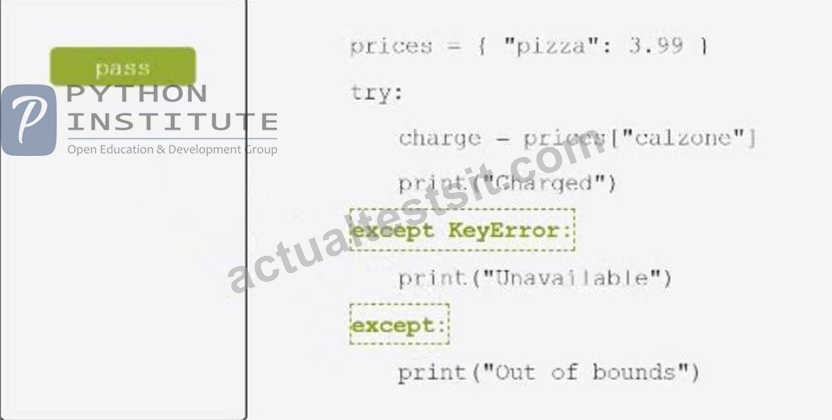
Drag and drop the code boxes in order to build a program which prints Unavailable to the screen.
(Note: one code box will not be used.)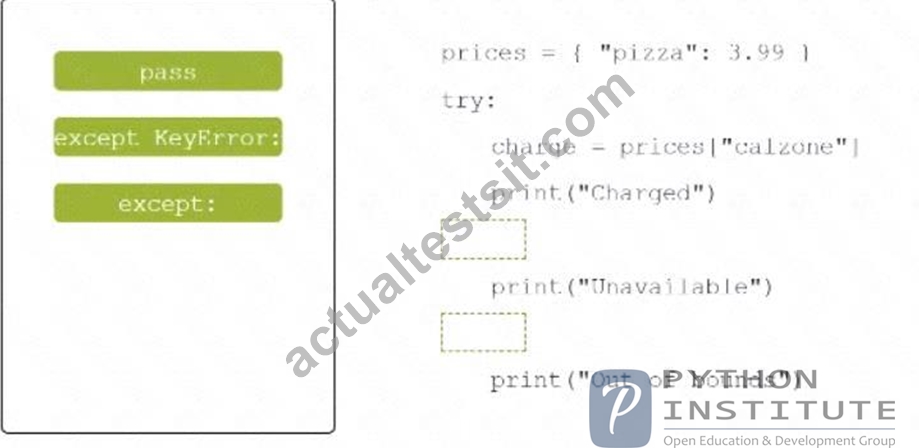
Answer:
Explanation: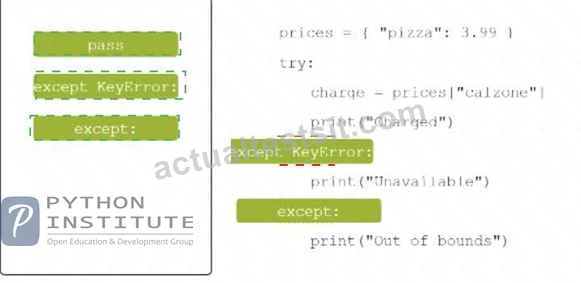
NEW QUESTION # 12
What is the expected output of the following code?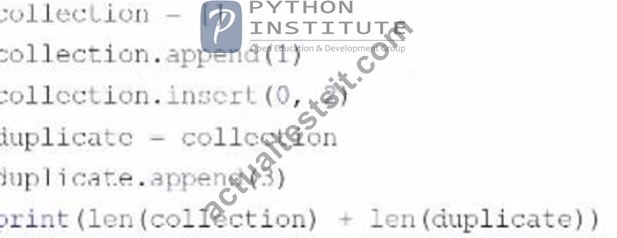
- A. 0
- B. 1
- C. 2
- D. The code raises an exception and outputs nothing.
Answer: D
Explanation:
Explanation
The code snippet that you have sent is trying to print the combined length of two lists, "collection" and
"duplicate". The code is as follows:
collection = [] collection.append(1) collection.insert(0, 2) duplicate = collection duplicate.append(3) print(len(collection) + len(duplicate)) The code starts with creating an empty list called "collection" and appending the number 1 to it. The list now contains [1]. Then, the code inserts the number 2 at the beginning of the list. The list now contains [2, 1].
Then, the code creates a new list called "duplicate" and assigns it the value of "collection". However, this does not create a copy of the list, but rather a reference to the same list object. Therefore, any changes made to
"duplicate" will also affect "collection", and vice versa. Then, the code appends the number 3 to "duplicate".
The list now contains [2, 1, 3], and so does "collection". Finally, the code tries to print the sum of the lengths of "collection" and "duplicate". However, this causes an exception, because the len function expects a single argument, not two. The code does not handle the exception, and therefore outputs nothing.
The expected output of the code is nothing, because the code raises an exception and terminates. Therefore, the correct answer is D. The code raises an exception and outputs nothing.
NEW QUESTION # 13
Arrange the code boxes in the correct positions to form a conditional instruction which guarantees that a certain statement is executed when the speed variable is less than 50.0.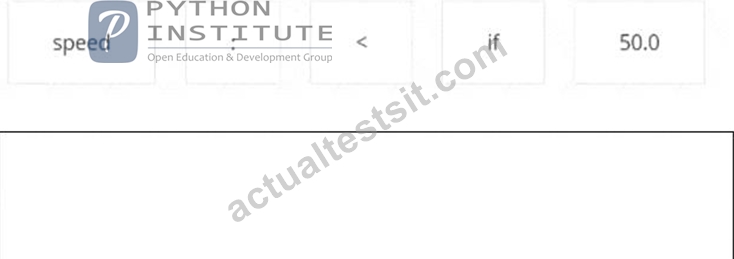
Answer:
Explanation: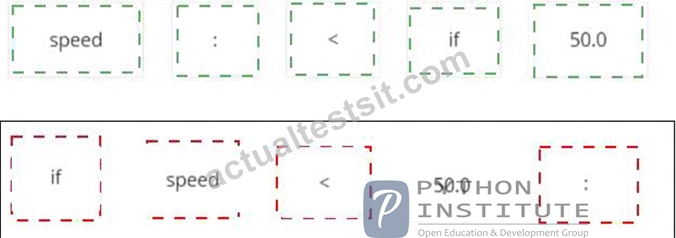
Explanation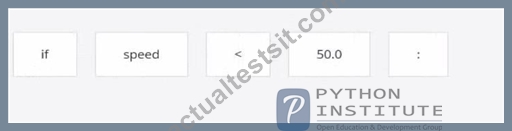
One possible way to arrange the code boxes in the correct positions to form a conditional instruction which guarantees that a certain statement is executed when the speed variable is less than 50.0 is:
if speed < 50.0:
print("The speed is low.")
This code uses the if keyword to create a conditional statement that checks the value of the variable speed. If the value is less than 50.0, then the code will print "The speed is low." to the screen. The print function is used to display the output. The code is indented to show the block of code that belongs to the if condition.
You can find more information about the if statement and the print function in Python in the following references:
Python If ... Else
Python Print Function
NEW QUESTION # 14
What happens when the user runs the following code?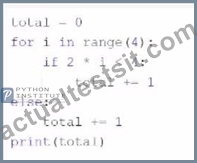
- A. The code outputs 1.
- B. The code outputs 2.
- C. The code outputs 3.
- D. The code enters an infinite loop.
Answer: B
Explanation:
Explanation
The code snippet that you have sent is calculating the value of a variable "total" based on the values in the range of 0 to 3. The code is as follows:
total = 0 for i in range(0, 3): if i % 2 == 0: total = total + 1 else: total = total + 2 print(total) The code starts with assigning the value 0 to the variable "total". Then, it enters a for loop that iterates over the values 0, 1, and 2 (the range function excludes the upper bound). Inside the loop, the code checks if the current value of "i" is even or odd using the modulo operator (%). If "i" is even, the code adds 1 to the value of
"total". If "i" is odd, the code adds 2 to the value of "total". The loop ends when "i" reaches 3, and the code prints the final value of "total" to the screen.
The code outputs 2 to the screen, because the value of "total" changes as follows:
When i = 0, total = 0 + 1 = 1
When i = 1, total = 1 + 2 = 3
When i = 2, total = 3 + 1 = 4
When i = 3, the loop ends and total = 4 is printed
Therefore, the correct answer is B. The code outputs 2.
NEW QUESTION # 15
A set of rules which defines the ways in which words can be coupled in sentences is called:
- A. semantics
- B. syntax
- C. lexis
- D. dictionary
Answer: B
Explanation:
Explanation
Syntax is the branch of linguistics that studies the structure and rules of sentences in natural languages. Lexis is the vocabulary of a language. Semantics is the study of meaning in language. A dictionary is a collection of words and their definitions, synonyms, pronunciations, etc.
NEW QUESTION # 16
Insert the code boxes in the correct positions in order to build a line of code which asks the user for a float value and assigns it to the mass variable.
(Note: some code boxes will not be used.)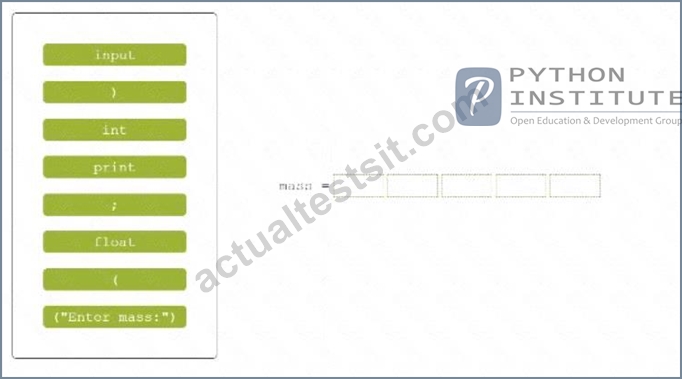
Answer:
Explanation: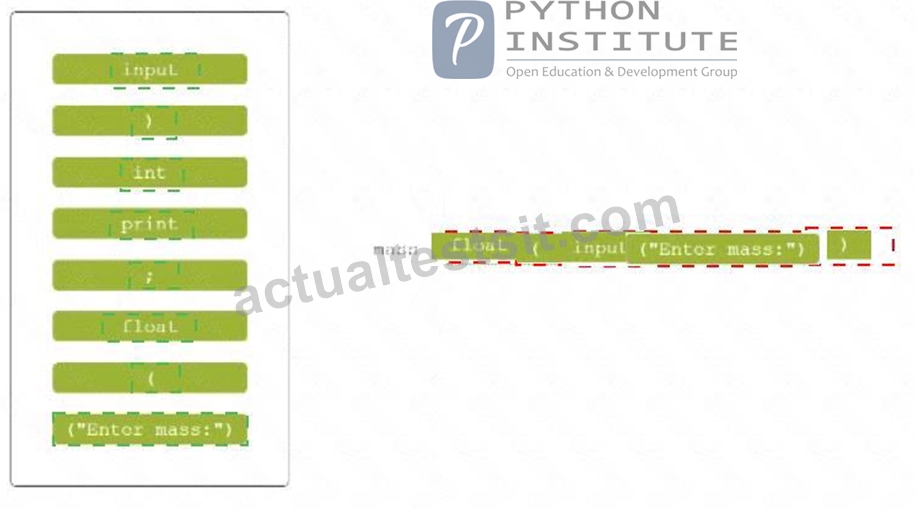
Explanation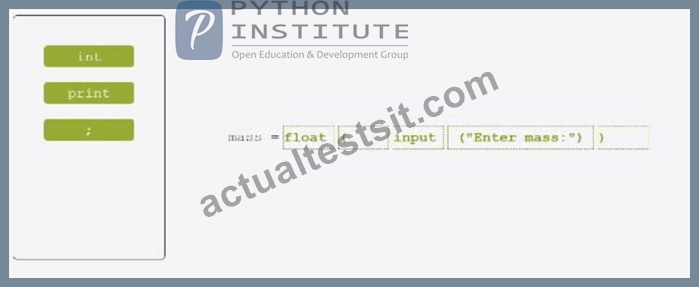
One possible way to insert the code boxes in the correct positions in order to build a line of code that asks the user for a float value and assigns it to the mass variable is:
mass = float(input("Enter the mass:
This line of code uses the input function to prompt the user for a string value, and then uses the float function to convert that string value into a floating-point number. The result is then assigned to the variable mass.
You can find more information about the input and float functions in Python in the following references:
[Python input() Function]
[Python float() Function]
NEW QUESTION # 17
Arrange the code boxes in the correct positions in order to obtain a loop which executes its body with the level variable going through values 5, 1, and 1 (in the same order).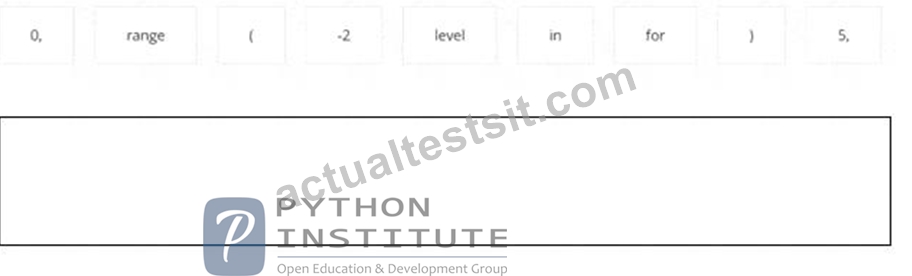
Answer:
Explanation: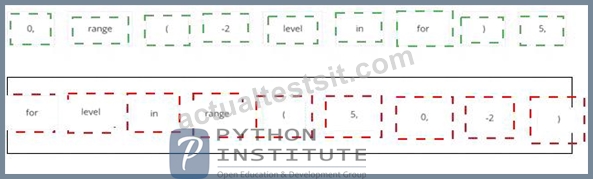

NEW QUESTION # 18
Assuming that the following assignment has been successfully executed:
Which of the following expressions evaluate to True? (Select two expressions.)
- A. 1.1 in the_list |1:3 |
- B. the_list. index {'1'} -- 0
- C. len (the list [0:2]} <3
- D. the_List.index {"1"} in the_list
Answer: B,C
Explanation:
Explanation
The code snippet that you have sent is assigning a list of four values to a variable called "the_list". The code is as follows:
the_list = ['1', 1, 1, 1]
The code creates a list object that contains the values '1', 1, 1, and 1, and assigns it to the variable "the_list".
The list can be accessed by using the variable name or by using the index of the values. The index starts from
0 for the first value and goes up to the length of the list minus one for the last value. The index can also be negative, in which case it counts from the end of the list. For example, the_list[0] returns '1', and the_list[-1] returns 1.
The expressions that you have given are trying to evaluate some conditions on the list and return a boolean value, either True or False. Some of them are valid, and some of them are invalid and will raise an exception.
An exception is an error that occurs when the code cannot be executed properly. The expressions are as follows:
A). the_List.index {"1"} in the_list: This expression is trying to check if the index of the value '1' in the list is also a value in the list. However, this expression is invalid, because it uses curly brackets instead of parentheses to call the index method. The index method is used to return the first occurrence of a value in a list. For example, the_list.index('1') returns 0, because '1' is the first value in the list. However, the_list.index
{"1"} will raise a SyntaxError exception and output nothing.
B). 1.1 in the_list |1:3 |: This expression is trying to check if the value 1.1 is present in a sublist of the list.
However, this expression is invalid, because it uses a vertical bar instead of a colon to specify the start and end index of the sublist. The sublist is obtained by using the slicing operation, which uses square brackets and a colon to get a part of the list. For example, the_list[1:3] returns [1, 1], which is the sublist of the list from the index 1 to the index 3, excluding the end index. However, the_list |1:3 | will raise a SyntaxError exception and output nothing.
C). len (the list [0:2]} <3: This expression is trying to check if the length of a sublist of the list is less than 3.
This expression is valid, because it uses the len function and the slicing operation correctly. The len function is used to return the number of values in a list or a sublist. For example, len(the_list) returns 4, because the list has four values. The slicing operation is used to get a part of the list by using square brackets and a colon. For example, the_list[0:2] returns ['1', 1], which is the sublist of the list from the index 0 to the index 2, excluding the end index. The expression len (the list [0:2]} <3 returns True, because the length of the sublist ['1', 1] is 2, which is less than 3.
D). the_list. index {'1'} - 0: This expression is trying to check if the index of the value '1' in the list is equal to 0. This expression is valid, because it uses the index method and the equality operator correctly. The index method is used to return the first occurrence of a value in a list. For example, the_list.index('1') returns 0, because '1' is the first value in the list. The equality operator is used to compare two values and return True if they are equal, or False if they are not. For example, 0 == 0 returns True, and 0 == 1 returns False. The expression the_list. index {'1'} - 0 returns True, because the index of '1' in the list is 0, and 0 is equal to 0.
Therefore, the correct answers are C. len (the list [0:2]} <3 and D. the_list. index {'1'} - 0.
NEW QUESTION # 19
What happens when the user runs the following code?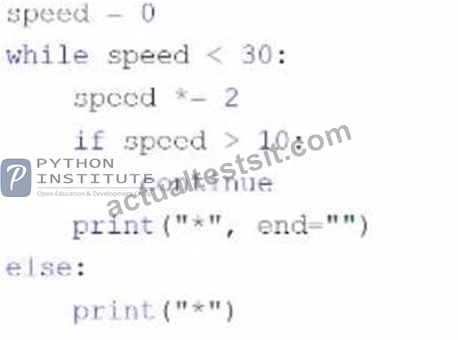
- A. The program outputs three asterisks ( *** )to the screen.
- B. The program enters an infinite loop.
- C. The program outputs one asterisk ( * ) to the screen.
- D. The program outputs five asterisks ( ***** ) to the screen.
Answer: B
Explanation:
Explanation
The code snippet that you have sent is a while loop with an if statement and a print statement inside it. The code is as follows:
while True: if counter < 0: print("") else: print("**")
The code starts with entering a while loop that repeats indefinitely, because the condition "True" is always true. Inside the loop, the code checks if the value of "counter" is less than 0. If yes, it prints a single asterisk () to the screen. If no, it prints three asterisks (**) to the screen. However, the code does not change the value of
"counter" inside the loop, so the same condition is checked over and over again. The loop never ends, and the code enters an infinite loop.
The program outputs either one asterisk () or three asterisks (**) to the screen repeatedly, depending on the initial value of "counter". Therefore, the correct answer is D. The program enters an infinite loop.
NEW QUESTION # 20
Drag and drop the conditional expressions to obtain a code which outputs * to the screen.
(Note: some code boxes will not be used.)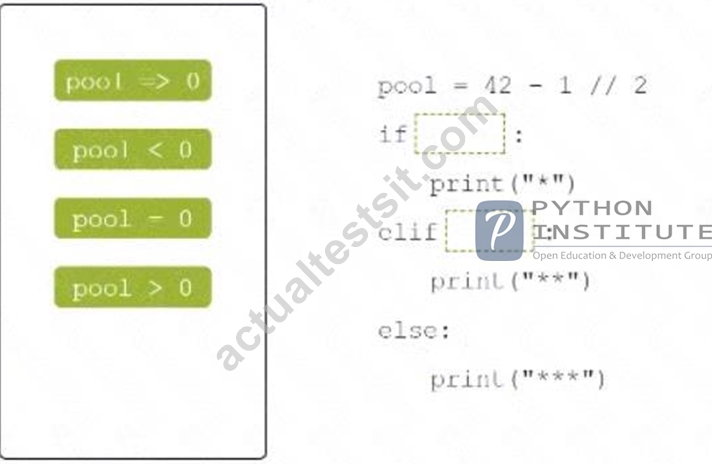
Answer:
Explanation: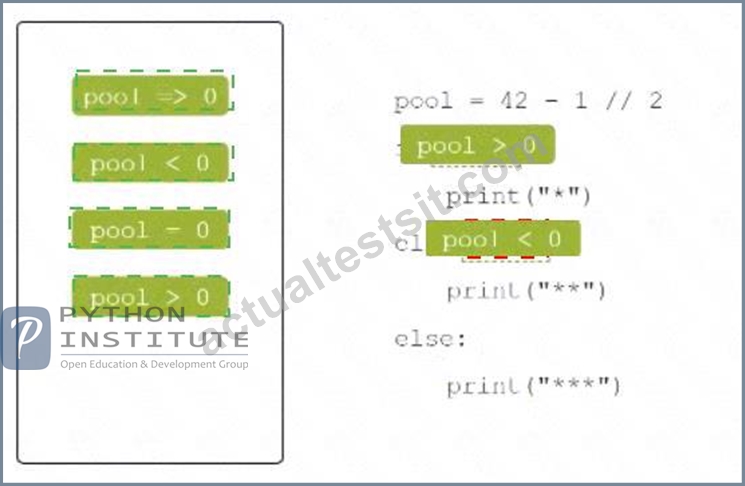
Explanation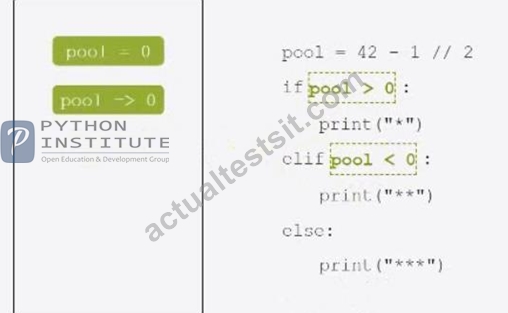
One possible way to drag and drop the conditional expressions to obtain a code which outputs * to the screen is:
if pool > 0:
print("*")
elif pool < 0:
print("**")
else:
print("***")
This code uses the if, elif, and else keywords to create a conditional statement that checks the value of the variable pool. Depending on whether the value is greater than, less than, or equal to zero, the code will print a different pattern of asterisks to the screen. The print function is used to display the output. The code is indented to show the blocks of code that belong to each condition. The code will output * if the value of pool is positive, ** if the value of pool is negative, and *** if the value of pool is zero.
You can find more information about the conditional statements and the print function in Python in the following references:
[Python If ... Else]
[Python Print Function]
[Python Basic Syntax]
NEW QUESTION # 21
What is the expected result of the following code?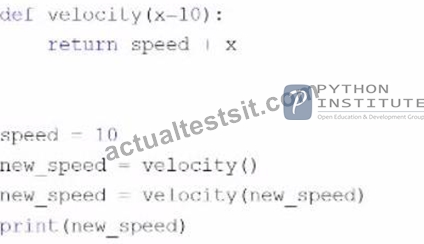
- A. The code is erroneous and cannot be run.
- B. 0
- C. 1
- D. 2
Answer: A
Explanation:
Explanation
The code snippet that you have sent is trying to use the global keyword to access and modify a global variable inside a function. The code is as follows:
speed = 10 def velocity(): global speed speed = speed + 10 return speed print(velocity()) The code starts with creating a global variable called "speed" and assigning it the value 10. A global variable is a variable that is defined outside any function and can be accessed by any part of the code. Then, the code defines a function called "velocity" that takes no parameters and returns the value of "speed" after adding 10 to it. Inside the function, the code uses the global keyword to declare that it wants to use the global variable
"speed", not a local one. A local variable is a variable that is defined inside a function and can only be accessed by that function. The global keyword allows the function to modify the global variable, not just read it. Then, the code adds 10 to the value of "speed" and returns it. Finally, the code calls the function "velocity" and prints the result.
However, the code has a problem. The problem is that the code uses the global keyword inside the function, but not outside. The global keyword is only needed when you want to modify a global variable inside a function, not when you want to create or access it outside a function. If you use the global keyword outside a function, you will get a SyntaxError exception, which is an error that occurs when the code does not follow the rules of the Python language. The code does not handle the exception, and therefore it will terminate with an error message.
The expected result of the code is an unhandled exception, because the code uses the global keyword incorrectly. Therefore, the correct answer is A. The code is erroneous and cannot be run.
NEW QUESTION # 22
What is true about exceptions and debugging? (Select two answers.)
- A. The default (anonymous) except branch cannot be the last branch in the try-except block.
- B. One try-except block may contain more than one except branch.
- C. If some Python code is executed without errors, this proves that there are no errors in it.
- D. A tool that allows you to precisely trace program execution is called a debugger.
Answer: B,D
Explanation:
Explanation
Exceptions and debugging are two important concepts in Python programming that are related to handling and preventing errors. Exceptions are errors that occur when the code cannot be executed properly, such as syntax errors, type errors, index errors, etc. Debugging is the process of finding and fixing errors in the code, using various tools and techniques. Some of the facts about exceptions and debugging are:
A tool that allows you to precisely trace program execution is called a debugger. A debugger is a program that can run another program step by step, inspect the values of variables, set breakpoints, evaluate expressions, etc. A debugger can help you find the source and cause of an error, and test possible solutions. Python has a built-in debugger module called pdb, which can be used from the command line or within the code. There are also other third-party debuggers available for Python, such as PyCharm, Visual Studio Code, etc12 If some Python code is executed without errors, this does not prove that there are no errors in it. It only means that the code did not encounter any exceptions that would stop the execution. However, the code may still have logical errors, which are errors that cause the code to produce incorrect or unexpected results. For example, if you write a function that is supposed to calculate the area of a circle, but you use the wrong formula, the code may run without errors, but it will give you the wrong answer. Logical errors are harder to detect and debug than syntax or runtime errors, because they do not generate any error messages. You have to test the code with different inputs and outputs, and compare them with the expected results34 One try-except block may contain more than one except branch. A try-except block is a way of handling exceptions in Python, by using the keywords try and except. The try block contains the code that may raise an exception, and the except block contains the code that will execute if an exception occurs. You can have multiple except blocks for different types of exceptions, or for different actions to take. For example, you can write a try-except block like this:
try: # some code that may raise an exception except ValueError: # handle the ValueError exception except ZeroDivisionError: # handle the ZeroDivisionError exception except: # handle any other exception This way, you can customize the error handling for different situations, and provide more informative messages or alternative solutions5 The default (anonymous) except branch can be the last branch in the try-except block. The default except branch is the one that does not specify any exception type, and it will catch any exception that is not handled by the previous except branches. The default except branch can be the last branch in the try-except block, but it cannot be the first or the only branch. For example, you can write a try-except block like this:
try: # some code that may raise an exception except ValueError: # handle the ValueError exception except: # handle any other exception This is a valid try-except block, and the default except branch will be the last branch. However, you cannot write a try-except block like this:
try: # some code that may raise an exception except: # handle any exception This is an invalid try-except block, because the default except branch is the only branch, and it will catch all exceptions, even those that are not errors, such as KeyboardInterrupt or SystemExit. This is considered a bad practice, because it may hide or ignore important exceptions that should be handled differently or propagated further. Therefore, you should always specify the exception types that you want to handle, and use the default except branch only as a last resort5 Therefore, the correct answers are A. A tool that allows you to precisely trace program execution is called a debugger. and C. One try-except block may contain more than one except branch.
NEW QUESTION # 23
......
Get 2023 Updated Free Python Institute PCEP-30-02 Exam Questions and Answer: https://www.actualtestsit.com/Python-Institute/PCEP-30-02-exam-prep-dumps.html
Pass PCEP-30-02 Exam Updated 30 Questions: https://drive.google.com/open?id=1RkEAY7gbF3WWJTj83p5ee5c1xGvxLNSB