

ISQI CTAL-TM_Syll2012 Deluxe Study Guide with Online Test Engine
CTAL-TM_Syll2012 dumps review - Professional Quiz Study Materials
ISQI CTAL-TM_Syll2012 Exam Syllabus Topics:
| Topic | Details |
|---|---|
| Topic 1 |
|
| Topic 2 |
|
| Topic 3 |
|
NEW QUESTION 20
Test Management
The following chart plots the cumulative number of defects opened against the cumulative number of defects closed during system testing of a software product.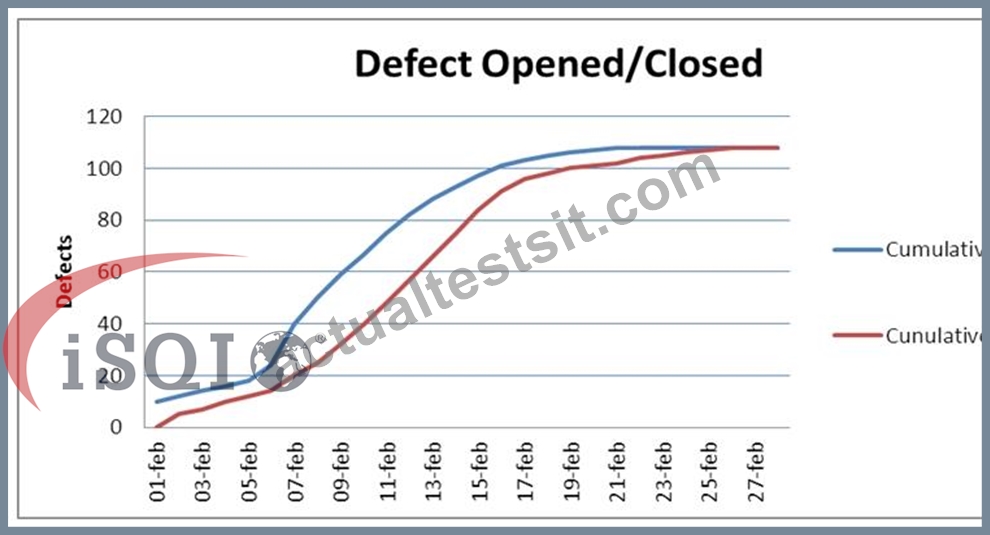
Which of the following statements is true?
- A. The chart indicates that you have plenty of problems left to find
- B. The chart can be used to reveal test progress problems
- C. The chart seems to indicate that the defect management process is working well
- D. The chart seems to indicate that the defect management process is not working well
Answer: C
NEW QUESTION 21
Assume you are currently working on a project developing a system where functional requirements are very well specified. Unfortunately non-functional requirements do almost not exist.
You are the Test Manager. You have to choose a technique for test selection that allows testing of non-functional characteristics, especially reliability.
Which of the following techniques for test selection do you expect being most useful in this scenario?
K2 1 credit
- A. Ambiguity reviews
- B. A model-based technique based on the creation of operational profiles
- C. Test condition analysis
- D. Cause-effect graphing
Answer: B
NEW QUESTION 22
In the next two months some new features will be constantly added to new releases of a project you are working on as Test Manager.
You have identified as one of the main project risks, that the requirements specification will still be incomplete when your team starts the test design and implementation phase.
Some requirements will most likely be completed too late to allow a proper test preparation.
You and your test team have already worked on several similar past projects in the same organization.
Which one of the following options would you expect to be the most effective at mitigating this risk?
K4 3 credits
- A. Don't design any test until the test execution starts, then communicate that test execution is blocked due to incomplete requirements
- B. Don't prepare any test and just run the regression test suite to check that the new features don't introduce regression
- C. Even if there are only few details missing, escalate the risk to the project manager without preparing any tests
- D. Make reasonable assumptions about the missing details and design lightweight tests that can be easily updated during test execution
Answer: D
NEW QUESTION 23
Test Management
You are the Test Manager of a new project that will have three formal levels of testing: unit, integration and system testing. The testing strategy you decide to adopt a blend of risk-based testing and reactive testing strategies.
Which of the following answers describes the most consistent example of implementation of this test strategy during the execution of the system tests?
Number of correct responses: 1
K2 1 credit
- A. Your test team executes scripted tests designed and implemented before the execution of the system test phase, to cover the identified product risks. It also performs exploratory testing sessions throughout the system test phase
- B. Your test team autonomously performs some exploratory testing sessions and, at the very end of the system testing phase, it also executes more system tests under the guidance of a sample of users
- C. Your test team executes exploratory tests following a session-based test management approach throughout the system test phase
- D. Your test team executes system tests under the guidance of a sample of users throughout the system test phase
Answer: A
NEW QUESTION 24
Test Management
The following chart plots the cumulative number of defects opened against the cumulative number of defects closed during system testing of a software product.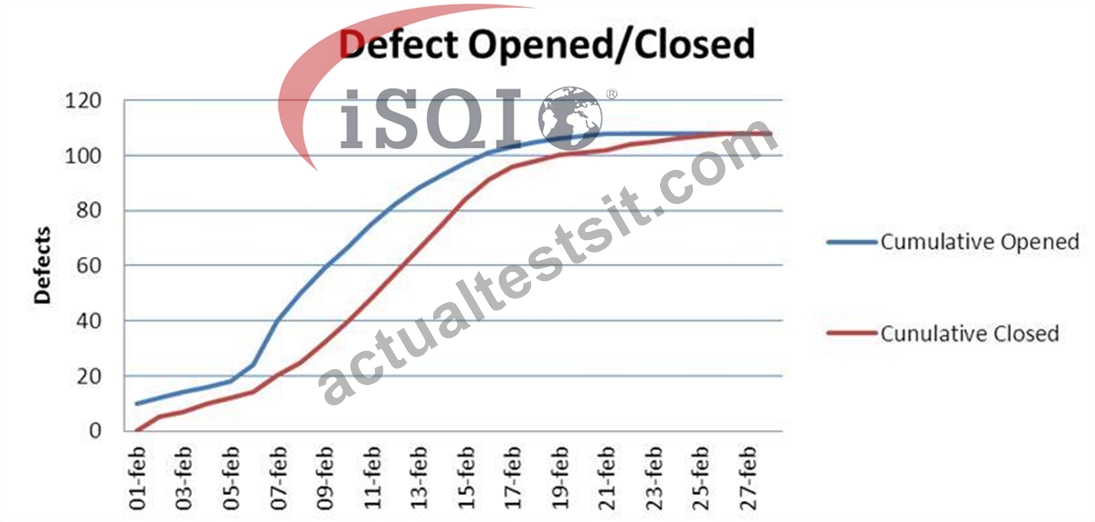
Which of the following statements is true?
Number of correct responses: 1
K2 1 credit
- A. The chart indicates that you have plenty of problems left to find
- B. The chart can be used to reveal test progress problems
- C. The chart seems to indicate that the defect management process is working well
- D. The chart seems to indicate that the defect management process is not working well
Answer: C
NEW QUESTION 25
Assume that the following test cases have been executed at the end of the first week of test execution: TC-001, TC-002 and TC-007. All these tests are 'passes'.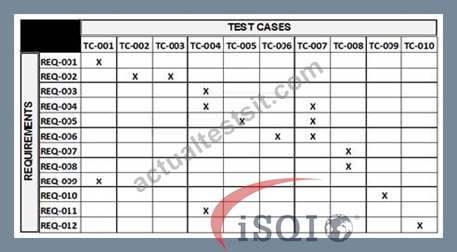
What is the MINIMUM number of the remaining test cases that must be successfully executed to fulfill the EX1 exit criteria?
K3 2 credits
- A. 0
- B. 1
- C. 2
- D. 3
Answer: A
NEW QUESTION 26
The main objectives the senior management team wants to achieve are:
- to reduce the costs associated with dynamic testing
- to use reviews to ensure that the project is on course for success and following the plan
- to use reviews as a well-documented and effective bug-removal activity following a formal process with well-defined roles
- to determine the effectiveness of reviews in terms of phase containment
- to improve phase containment effectiveness
Which of the following answers would you expect to describe the best way to achieve these objectives?
Number of correct responses: 1
K4 3 credits
- A. You should plan for lightweight exit-phase reviews at the end of each development and testing phase, and plan for a process of gathering information from testing to perform an analysis aimed at identifying the larger cluster of defects
- B. You should plan for formal exit-phase reviews at the end of each development and testing phase, and plan for a process of gathering information from testing to perform an analysis aimed at identifying the larger cluster of defects
- C. You should plan for formal exit-phase reviews at the end of each development phase and testing phase, and plan for a process of gathering information from testing to perform an analysis of the bugs found during testing to determine the people responsible for those bugs
- D. You should plan for formal exit-phase reviews at the end of each development and testing phase, and plan for a process of gathering information from testing to perform an analysis of the bugs found during testing to determine the phase in which they have been introduced
Answer: D
NEW QUESTION 27
Test Tools and Automation
Assume you are managing a test automation project for a mission-critical system.
Because vendor provided tools and open source solutions don't meet the needs of this project, you ask your test team to develop a custom automation framework.
Which of the following management issues associated to the development of this custom automation framework is least likely to manage?
Number of correct responses: 1
K2 1 credit
- A. The custom automation framework will require an adequate documentation
- B. The custom automation framework will need proper maintenance
- C. Proper testing for the custom automation framework must be performed
- D. The changes to the custom automation framework should be communicated to all external users of this tool under the GNU license
Answer: D
NEW QUESTION 28
People Skills - Team Composition
Consider the following analysis of testing skills performed on four people: Alex, Robert, John and Mark (all the skills have been rated on an ascending scale: The higher the score, the better the skill):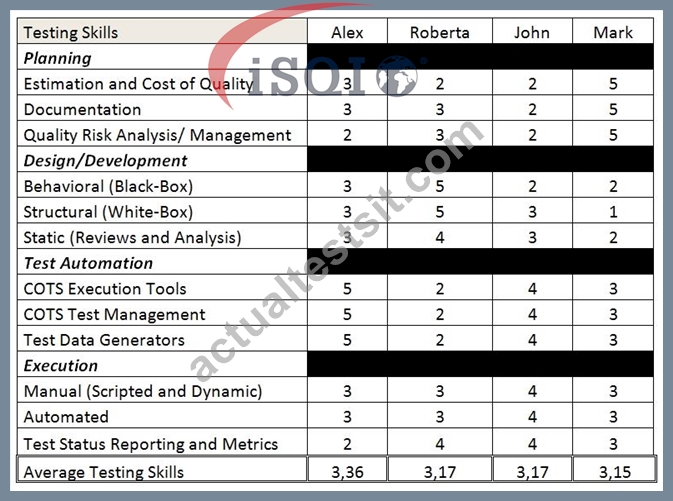
Which of these people, based on this analysis, would you expect to be most suitable to work specifically as test designer?
- A. Alex
- B. Roberta
- C. Mark
- D. John
Answer: B
NEW QUESTION 29
People Skills - Team Composition
Assume you are managing the system testing execution phase of a project.
The system test execution period for that project is scheduled for eighteen weeks and the release date is scheduled at the end of system testing.
During the sixth week of system test execution, at the staff meeting, the project manager informs you that the project deadlines are changed and the release date that is only three weeks ahead.
This new release will not allow the completion of the system tests. Suppose also that you have followed a risk-driven test approach for this project.
Which of the following statements represents the worst way to lead your test team in the next three weeks?
Number of correct responses: 1
K2 1 credit
- A. Considering the executed tests, you should reduce the test coverage back on the risk analysis and adjust downward the priority of the associated risk items
- B. Convince all the people of your test team that each of them is an important and needed member, and that their contribution is fundamental to the success of the team
- C. Neglect your management activities and work side-by-side with your test team executing tests
- D. Favor and encourage a proactive attitude where people ask for new tasks as soon as they finish their current tasks
Answer: C
NEW QUESTION 30
You are using this skills assessment spreadsheet in order to define a training development plan for your test team.
Your objective is to fill the skill gaps by having at least a team member rated as an expert for each skill identified for the "technical expertise" and "testing skills" sections, and with the ability to train the other team members.
Considering the budget constraints you can send only one person to a training course.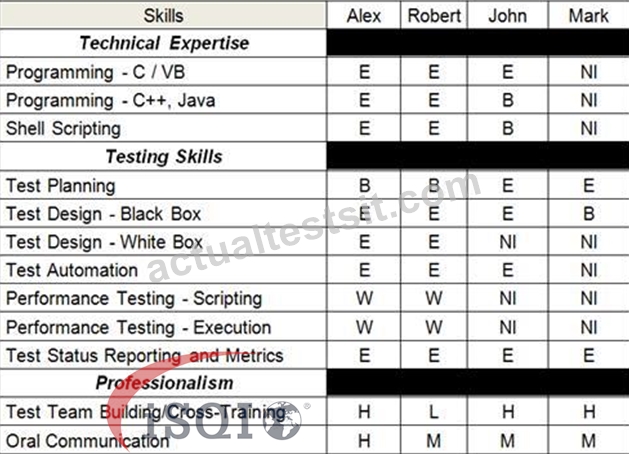
Based only on the given information, which of the following answers would you expect to be the best option to achieve your objective?
Number of correct responses: 1
K4 3 credits
- A. Send John to a performance testing training course
- B. Send Robert to a performance testing training course
- C. Send Mark to a test automation training course
- D. Send Alex to a performance testing training course
Answer: D
NEW QUESTION 31
Test Management
Consider the following test strategies:
I. Consultative test strategy
II. Reactive test strategy
III. Analytical test strategy
IV. Process-compliant test strategy
Consider also the following examples of test activities:
1. Prioritize the test cases, based on the results of a FMEA analysis, to ensure early coverage of the most important areas and discovery of the most important defects during test execution
2. Execute usability testing driven by the guidance of a sample of users (external to the test team)
3. Perform exploratory testing sessions throughout the system test phase
4. On an Agile project, execute tests that cover the test conditions identified for each user story of a feature planned for an iteration Which of the following correctly matches each test strategy with an appropriate example?
- A. I-2; II-3; III-1; IV-4
- B. I-2; II-3; III-4; IV-1
- C. I-3; II-2; III-1; IV-4
- D. I-1; II-2; III-3; IV-4
Answer: A
Explanation:
Section: Test Management
NEW QUESTION 32
Test Management
Based on the historical data of 5 past and similar projects, you have calculated these average numbers of defects detected in system testing:
- for each 10000 LOC (lines of code), 200 defects
- for each person-month of development team effort, 49 defects
You want to use this information to perform estimation for a new project.
The project manager tells you that he/she has estimated 20000 new LOC for this new project.
Four developers work for four months on this project before system testing.
During system testing, 797 defects are discovered.
Assume that the system test of this new project is using the same amount of work as spent in the past projects.
Based on this information only, which of the following statement is certainly true about this project?
Number of correct responses: 1
K3 3 credits
- A. More LOC than planned have been delivered to system testing with a higher defect density than the past projects
- B. 40000 LOC have been delivered to system testing (against the 20000 LOC planned by the project manager)
- C. The code for the new project contains a higher defect density than the code of the past projects
- D. The number of defects found during the system test phase on the new project is approximately proportional to the development team effort
Answer: D
NEW QUESTION 33
People Skills - Team Composition
Your test team consists of four members (Mary, Bob, Mark, Dave) with different interpersonal skills.
The following skills assessment spreadsheet shows the characteristics of the team members with respect to a list of interpersonal-skills (for each characteristic only the member with the highest level of that characteristic is indicated and marked with 'X'):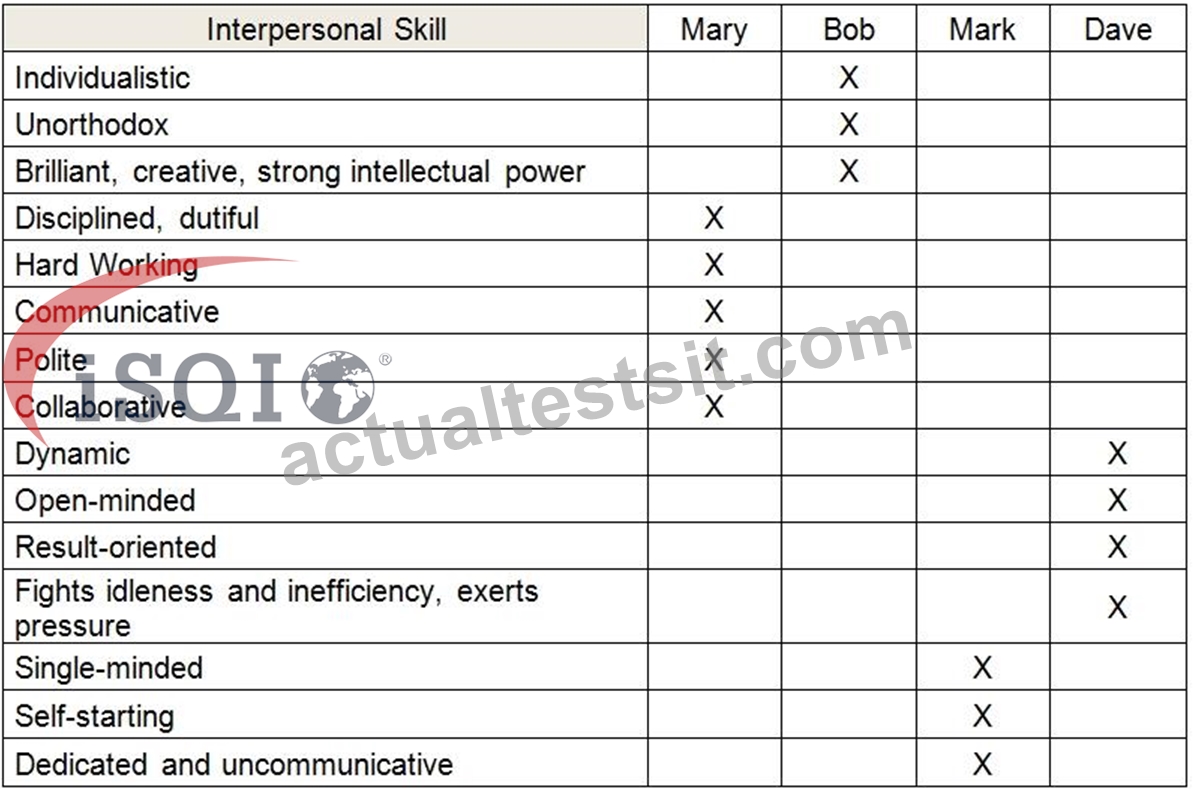
On the next project a member of your test team will have to perform some routine tasks requiring collaboration with other teams.
Who in your test team would you expect to be most suitable at doing these tasks?
- A. Mary
- B. Dave
- C. Bob
- D. Mark
Answer: A
NEW QUESTION 34
You are the Test Manager of a project that adopts a V-model with four formal levels of testinG. unit, integration, system and acceptance testing.
On this project reviews have been conducted for each development phase prior to testing, which is to say that reviews of requirements, functional specification, high-level design, low-level design and code have been performed prior to testing.
Assume that no requirements defects have been reported after the release of the product.
Which TWO of the following metrics do you need in order to evaluate the requirements reviews in terms of phase containment effectiveness?
K3 2 credits
- A. Total number of defects found during functional specification review, high-level design review, low-level design review, code review, unit testing, integration testing, system testing and acceptance testing
- B. Time to conduct the requirements review
- C. Total number of defects attributable to requirements found during unit, integration, system and acceptance testing
- D. Number of defects found during the requirements review
- E. Total number of defects attributable to requirements, found during functional specification review, high-level design review, low-level design review, code review, unit testing, integration testing, system testing and acceptance testing
Answer: D,E
Explanation:
Topic 4, Defect Management
NEW QUESTION 35
Reviews
You are a Test Manager working for a software organization where reviews have never been applied. After a meeting with your managers examining a business case for reviews, (including their costs, benefits, and potential issues), the management finally decides to adopt formal reviews for future projects.
You have been given a budget that you have spent to provide training in the review process and to introduce the review process on a pilot project.
On that pilot project the introduction of reviews has been very positive in terms of positive involvement from all the participants. All the reviews applied to different documents have been very effective for their purposes (especially at revealing defects).
Which of the following answers describes an important success factor for the introduction of formal reviews which is missing in this scenario?
- A. Definition and use of metrics to measure the ROI (Return On Investment)
- B. Participant support
- C. Management support
- D. Training in the review process
Answer: A
NEW QUESTION 36
......
Exam Questions Answers Braindumps CTAL-TM_Syll2012 Exam Dumps PDF Questions: https://www.actualtestsit.com/ISQI/CTAL-TM_Syll2012-exam-prep-dumps.html
CTAL-TM_Syll2012 Test Prep Training Practice Exam Questions Practice Tests: https://drive.google.com/open?id=1926PY_6nEyiiWL8KkelyZkSX8HdUu0PR